
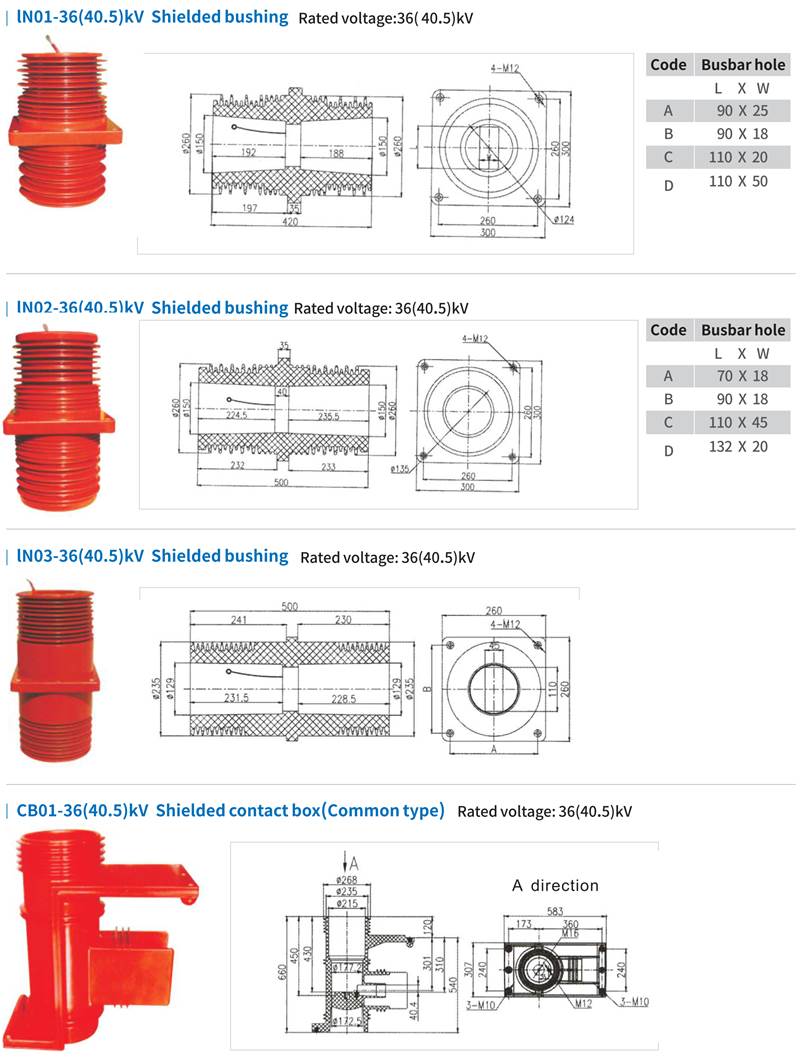
A wall bushing lets a live conductor pass through an earthed wall or partition without flashing over. In medium-voltage switchgear it seals one busbar section from the next and carries full busbar current. This guide covers how epoxy bushings are built, how to work out creepage distance, what to put in the specification and how to keep bushings healthy in service.
What a Wall Bushing Does
IEC 60137 defines a bushing as a device that carries one or more conductors through a partition, such as a wall or tank, and insulates them from it. In an MV panel, wall bushings appear in three places:
- Between panels: the main busbar passes from one cubicle to the next through bushings fixed in the side walls. This segregation keeps an internal arc in one panel from spreading along the line-up.
- Between compartments: busbar droppers and cable bars pass through partitions into breaker or cable compartments.
- Through building walls: indoor/outdoor bushings connect switchgear to an overhead line, outdoor busbar or transformer outside the switch room.
Each one must withstand the full insulation level of the panel, carry the rated current without overheating and survive the mechanical forces of a short circuit.
How an Epoxy Wall Bushing Is Built
| Part | Function |
|---|---|
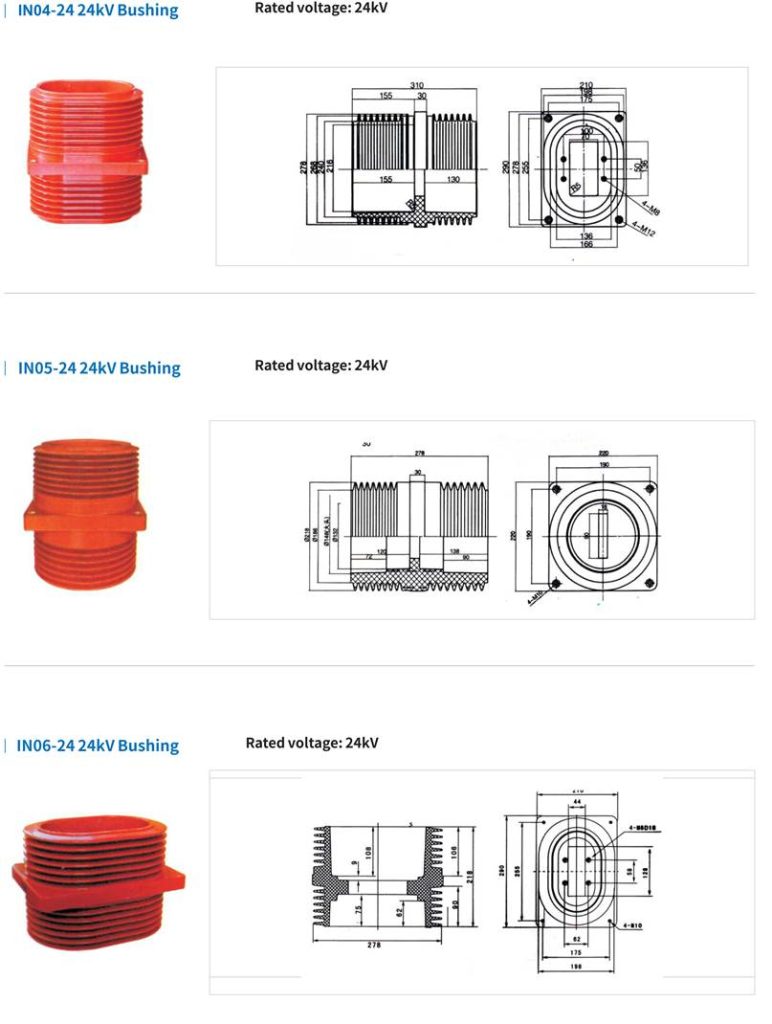
| Central conductor | Copper rod, tube or flat bar, sometimes aluminum, carrying the current; ends are drilled or threaded for busbar connection |
| Epoxy body | Cast around the conductor; provides insulation and mechanical strength |
| Sheds (ribs) | Increase creepage distance along the surface without increasing length |
| Mounting flange | Fixes the bushing to the partition; usually a cast-in metal flange or an epoxy flange with inserts |
| Field-grading electrode | Embedded screen or semi-conductive layer that smooths the electric field at the flange and conductor, reducing partial discharge |
| Capacitive tap (optional) | Provides a signal for voltage presence indication |
Most MV wall bushings are made by automatic pressure gelation, in which hot epoxy is injected into a heated mold and cures under pressure. This process gives dense parts with very few voids, which is the key to low partial discharge. Vacuum casting is used for larger or special bushings.
Indoor and outdoor versions
Indoor bushings use standard cycloaliphatic or bisphenol epoxy with modest shed profiles. Outdoor or indoor/outdoor bushings need UV and tracking resistance on the outer side, so they use hydrophobic cycloaliphatic epoxy, silicone rubber housings or porcelain, with deeper, more widely spaced sheds to shed rain and pollution.
Materials Compared
| Material | Strengths | Limitations | Typical use |
|---|---|---|---|
| Bisphenol epoxy | Excellent dielectric and mechanical strength, low cost | Not UV-resistant | Indoor panels |
| Cycloaliphatic epoxy | Good tracking and UV resistance | More brittle, higher cost | Indoor/outdoor, humid rooms |
| Porcelain | Very durable, proven outdoors | Heavy, fragile on impact | Outdoor, older designs |
| Silicone rubber over epoxy core | Hydrophobic, light, good in pollution | Higher cost | Polluted outdoor sites |
Creepage Distance Made Simple
Creepage distance is the shortest path along the insulating surface between the live conductor and the earthed flange. Clearance is the shortest path through air. Clearance protects against breakdown through air; creepage protects against surface tracking when the surface gets dirty and damp.
How to estimate the required creepage
For outdoor insulation, IEC TS 60815 defines site pollution severity classes from very light to very heavy. The required creepage is found from the unified specific creepage distance (USCD), expressed in mm per kV of phase-to-earth voltage:
| Site pollution class | Reference USCD (mm/kV, phase-to-earth) |
|---|---|
| a: very light | 22.0 |
| b: light | 27.8 |
| c: medium | 34.7 |
| d: heavy | 43.3 |
| e: very heavy | 53.7 |
Worked example: a 24 kV outdoor bushing on a medium-pollution site. Phase-to-earth voltage is 24 / √3 ≈ 13.9 kV. Required creepage ≈ 34.7 × 13.9 ≈ 482 mm, before any correction for bushing diameter or shape.
Indoor switchgear sees far less pollution, so creepage follows the type-tested panel design. For epoxy insulation in normal indoor rooms, many designs work with roughly 20 mm per kV of rated voltage, about 240 mm at 12 kV. Where condensation or dust is expected, IEC TS 62271-304 defines design classes for severe climatic conditions, and longer creepage, better sealing and heaters become necessary.
What to Specify When Buying Wall Bushings
- Rated voltage and insulation level: 12, 24 or 40.5 kV, with power-frequency and lightning impulse withstand values matching the panel.
- Rated current: 630 A to 4,000 A, chosen for the busbar it carries, with temperature rise limits per IEC 62271-1.
- Short-time and peak withstand current: for example 31.5 kA 4 s and 80 kA peak.
- Cantilever strength: enough to resist busbar forces during a short circuit.
- Creepage distance: stated in mm, appropriate to the room or site conditions.
- Partial discharge level: maximum PD at the specified test voltage, measured per IEC 60270.
- Dimensions: flange size, hole pattern, conductor shape and length on each side, phase spacing.
- Extras: capacitive tap, integrated current sensor, or earthing screen.
Request routine test reports for each batch (power-frequency withstand and PD) and type test reports for the design.
Installation Tips
- Use the correct bolt torque on the flange; overtightening is a common cause of hairline cracks.
- Avoid mechanical stress from busbars that are not aligned; the busbar should rest on its supports, not hang on the bushing.
- Clean contact surfaces and apply the specified contact grease before bolting busbars.
- For high-current ratings, check that the partition around the bushing does not form a closed steel loop that heats from eddy currents. Non-magnetic plates or slotted partitions solve this.
Inspection and Maintenance
| Check | Typical interval | What to look for |
|---|---|---|
| Visual inspection | Every planned outage, at least yearly | Dust, moisture, tracking marks, cracks, discoloration |
| Thermal imaging | Yearly, under load | Hot spots at busbar joints or the conductor ends |
| Cleaning | Every 1-3 years, more often in dusty sites | Dry lint-free cloth or approved cleaner, no abrasives |
| Insulation resistance | During major maintenance | Compare with earlier readings |
| Partial discharge | Online (TEV, UHF, ultrasonic) or during outages | Rising trend indicates voids, contamination or cracks |
Troubleshooting
- Surface tracking: caused by dirt plus moisture. Clean, dry and fix the source (heater failure, leaking roof, open cable entries). Replace if tracking has eroded the surface.
- Cracks: replace the bushing. Epoxy cracks cannot be safely repaired because they create internal discharge paths.
- Overheating: usually a loose or oxidized busbar joint rather than the bushing itself. Clean, regrease and retorque.
- Rising PD: investigate quickly; PD in epoxy grows and can lead to breakdown.
Frequently Asked Questions
What is the difference between creepage distance and clearance?
Clearance is the shortest distance through air between live and earthed parts. Creepage is the shortest distance along the insulating surface. Both must be met.
Can a bushing rated for 12 kV be used in a 24 kV panel?
No. Bushings must have a rated voltage and insulation level equal to or higher than the panel.
Why does partial discharge matter in epoxy bushings?
Partial discharge slowly erodes the epoxy around voids or cracks. A low PD level at the factory and a stable trend in service show the bushing is sound.
Do wall bushings need replacing on a schedule?
No fixed schedule applies. A well-made epoxy bushing normally lasts the life of the switchgear unless it is damaged, overheated or exposed to persistent condensation.
Work with METTZ Group
METTZ Group offers a wide range of switchgear components to suit many needs – from epoxy wall bushings and contact boxes to vacuum interrupters for complete medium-voltage switchgear lines. Check out our website to learn more, or contact METTZ Group today to work with a representative.
