
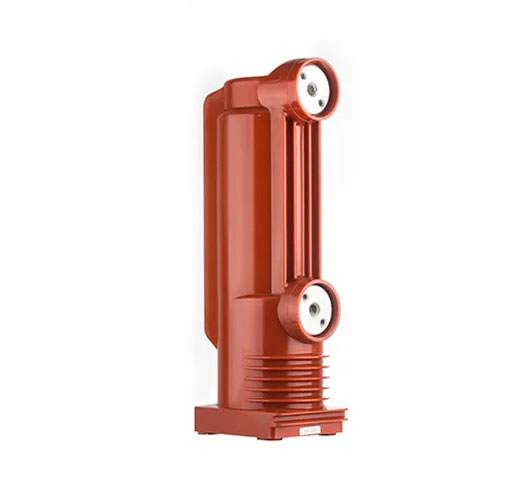
An embedded pole is a vacuum interrupter sealed inside a solid insulating body, with terminals ready to bolt into a circuit breaker. It turns a delicate component into a robust, compact module. This guide explains how embedded poles are built, what advantages they bring and which parameters matter when choosing one for a new breaker or a refurbishment.
What Is an Embedded Pole?
In electrical engineering, an embedded pole (also called an encapsulated or solid-insulated pole) is one phase of a vacuum circuit breaker in which the vacuum interrupter, upper and lower terminals and current path are cast into a single insulating housing. Three poles, one per phase, are mounted on the breaker frame and linked to the operating mechanism through insulated pull rods.
The term should not be confused with directly buried utility or lighting poles, which share the name but have nothing to do with switchgear.
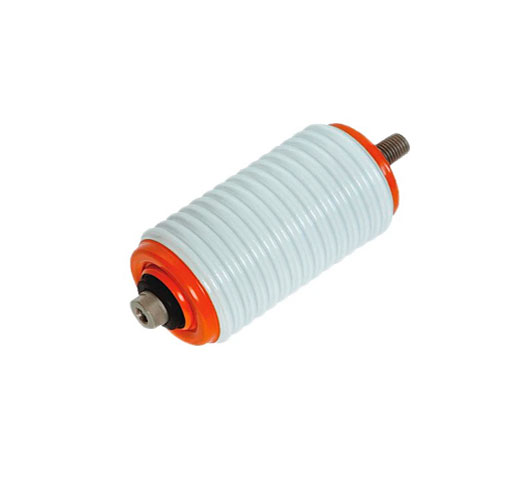
How the vacuum interrupter itself works, including contacts, bellows, shields and arc quenching, is covered in our article on vacuum interrupters. This guide focuses on the pole as a complete module.
How an Embedded Pole Is Built
| Part | Role |
|---|---|
| Vacuum interrupter | Makes and breaks current inside a sealed vacuum envelope |
| Insulating housing | Epoxy resin (APG process), or thermoplastic or silicone in some designs; insulates and protects the interrupter |
| Upper terminal | Connects the fixed contact to the busbar-side tulip contact arm |
| Lower terminal and flexible connector | Connects the moving contact stem to the cable side, allowing contact movement without strain |
| Insulating pull rod | Transfers motion from the mechanism to the moving contact while isolating it electrically |
| Contact pressure spring | Provides contact force and overtravel when closed (often in the pull-rod assembly) |
| Cooling fins (high current) | Increase surface area for heat dissipation in 2,500-4,000 A poles |
During manufacture, the interrupter is usually coated with a soft buffer layer (such as silicone rubber) to absorb the difference in thermal expansion between ceramic and epoxy. The assembly then goes into a heated mold where filled epoxy is injected under pressure. After curing, every pole should receive routine tests: power-frequency withstand, partial discharge, main circuit resistance and a vacuum integrity check of the interrupter.
Why Use Embedded Poles?
- Higher dielectric strength: solid insulation around the interrupter allows smaller phase spacing and more compact breakers.
- Protection from the environment: dust, condensation and contamination cannot reach the ceramic surface, which reduces flashover risk in humid or polluted rooms.
- Mechanical protection: the brittle ceramic envelope is shielded from impact during transport and maintenance.
- Fewer parts: no separate insulating cylinders, supports or adjustment of individual components, so assembly is faster and more repeatable.
- Maintenance-light: the sealed pole needs only cleaning, inspection and periodic tests.
- SF6-free: embedded poles are a key building block of solid-insulated and air-insulated SF6-free switchgear.
Compared with assembled (open) poles
Older designs mount the bare interrupter between insulating supports or inside an insulating cylinder. They are simpler to repair, since an interrupter can be swapped, but larger and more exposed to pollution. With an embedded pole, the interrupter cannot be replaced separately; the whole pole is exchanged.
Where Embedded Poles Are Used
- Indoor withdrawable and fixed vacuum circuit breakers at 12, 24 and 40.5 kV.
- Outdoor pole-mounted breakers and reclosers, where UV-resistant cycloaliphatic epoxy or silicone housings are used.
- Solid-insulated switchgear and compact ring main units.
- Generator, capacitor bank, motor and transformer feeders.
- Retrofit kits that convert older oil or SF6 breakers to vacuum technology.
How to Select an Embedded Pole
1. Rated voltage and insulation level
Choose a pole rated for the highest system voltage: 12 kV for 10-11 kV networks, 24 kV for 20 kV, 40.5 kV for 33-35 kV. Confirm the power-frequency and lightning impulse withstand values, for example 42/75 kV at 12 kV where national grids require the higher power-frequency value.
2. Rated normal current
Common ratings are 630, 1,250, 1,600, 2,000, 2,500, 3,150 and 4,000 A. Above about 2,000 A, poles generally have larger terminals and cooling fins. Check the temperature rise in the actual breaker and panel, not only the pole on its own.
3. Short-circuit ratings
- Rated short-circuit breaking current: typically 20, 25, 31.5 or 40 kA, set by the interrupter.
- Short-time withstand current and duration: for example 31.5 kA for 4 s.
- Peak withstand and making current: 2.5 times the short-time current at 50 Hz (2.6 times at 60 Hz).
4. Mechanical parameters
The pole must match the operating mechanism:
- Contact stroke (for example 8-12 mm at 12 kV, longer at 24-40.5 kV).
- Overtravel and required contact force.
- Closing and opening speeds the mechanism can provide.
- Pull-rod connection type and length.
- Mechanical endurance class, usually M2 (10,000 operations) or higher.
5. Dimensions and interfaces
Check phase spacing (commonly 150, 210 or 275 mm), overall height, mounting hole pattern, terminal type and the distance between upper and lower terminals. For withdrawable breakers, the terminal positions must line up with the contact arms and the panel’s contact boxes.
6. Partial discharge and dielectric quality
Ask for routine PD results measured to IEC 60270, typically a few picocoulombs at the specified test voltage. Low PD is the best indicator of a void-free casting and a well-bonded buffer layer.
7. Environment
Consider ambient temperature range, altitude (above 1,000 m apply correction factors), humidity and pollution. For outdoor use, specify UV-stable material and adequate creepage distance on the housing surface.
8. Electrical endurance and switching duty
For frequent switching or capacitor banks, choose poles and breakers tested for E2 electrical endurance and C2 capacitive switching under IEC 62271-100.
Information to Send With an Inquiry
- Rated voltage, insulation level and frequency.
- Rated current, breaking current and short-time rating.
- Phase spacing and drawing of the existing pole or breaker frame (for replacements).
- Mechanism type and stroke, and pull-rod interface.
- Installation conditions: indoor/outdoor, altitude, temperature, pollution.
- Quantity and any test witnessing requirements.
Maintenance and Replacement
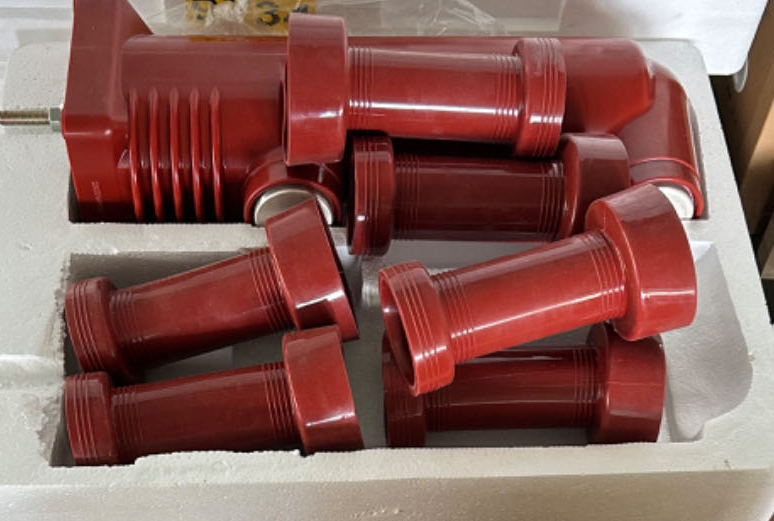
Embedded poles need little care: keep surfaces clean, check bolted terminals for tightness and heating, measure main circuit resistance and track contact wear using the breaker’s wear indicator or travel measurement. If the vacuum fails, the dielectric test across open contacts will show it. In that case the complete pole is replaced, and the breaker must be re-adjusted (stroke, overtravel, timing) and retested after replacement.
Frequently Asked Questions
What is the difference between an embedded pole and a vacuum interrupter?
The vacuum interrupter is the switching element. The embedded pole is the interrupter plus its insulating housing, terminals and connections, forming a ready-to-install phase module.
Can I replace just one embedded pole?
Yes, if an identical pole is available. After replacement, check stroke, overtravel and synchronism between all three poles and test the breaker.
Which material is best for coastal or outdoor installations?
Hydrophobic cycloaliphatic epoxy or silicone rubber housings resist UV, salt and tracking better than standard indoor epoxy.
Work with METTZ Group
METTZ Group offers a wide range of commutation apparatus components to suit many needs – from embedded poles and vacuum interrupters for 12-40.5 kV breakers to control coils and mechanism parts for refurbishment projects. Check out our website to learn more, or contact METTZ Group today to work with a representative.
