
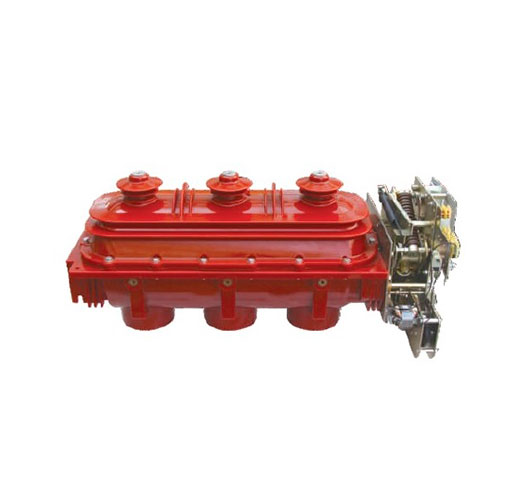
The SF6 load break switch has been the workhorse of medium-voltage distribution for decades, inside ring main units and on overhead lines. This article explains how it interrupts current, where it fits, which ratings to specify, and which SF6-free alternatives are taking its place as the F-gas rules tighten.
What an SF6 load break switch does
A load break switch (LBS) is a mechanical switching device that can make, carry and break normal load currents, and make (close onto) a short-circuit current. It can carry fault current for a short time, but it is not designed to interrupt it. Fault clearing is left to an upstream circuit breaker or to fuses combined with the switch.
In an SF6 load break switch, the contacts move inside a sealed tank filled with SF6 at slightly above atmospheric pressure. The gas insulates the live parts and the open gap, and helps extinguish the arc formed when load current is interrupted. Switches are covered by IEC 62271-103 for rated voltages above 1 kV up to 52 kV; most SF6 LBS are rated 12 kV or 24 kV, with some at 36 or 40.5 kV.
The difference between a load break switch and a circuit breaker is covered in our article on matching the device to the duty. Here we focus on the SF6 version.
How it works
Three-position design
Most SF6 load break switches used in ring main units are rotary three-position switches: closed, open and earthed. A single moving contact system rotates between the main circuit contacts and the earthing contacts. Because one shaft performs both functions, the switch cannot be closed and earthed at the same time, which gives inherent interlocking.
Arc extinction
Load currents are modest, typically up to 630 A, so the interruption principle can be simpler than in a breaker. Common methods are:
- Rotating arc: a magnetic field produced by the current itself, often with a coil or permanent magnet, makes the arc rotate through the gas, cooling and lengthening it until it goes out at current zero.
- Puffer: a small piston blows gas across the contacts as they open.
- Arc-quenching chambers or splitter plates that elongate and cool the arc.
SF6 recovers its dielectric strength rapidly after current zero, which allows small gaps and very compact tanks.
Operating mechanism
A spring mechanism operates the switch quickly, independent of how fast the operator turns the handle. Motor operators allow remote control from SCADA, which is the basis for automated distribution networks.
Where SF6 load break switches are used
- Ring main units: two or more LBS for the incoming and outgoing ring cables, plus a switch-fuse or circuit breaker feeder for the transformer.
- Compact and package substations serving residential areas, commercial buildings and small industrial sites.
- Overhead line switches: pole-mounted SF6 switches, often motorized and combined with a controller and fault passage indicators, used as sectionalizers.
- Renewable energy plants: string or collector switching in wind and solar parks, where an RMU feeds each turbine or inverter station.
- Industrial plants and infrastructure: switching transformers, motors and capacitor banks where fuses or an upstream breaker handle faults.
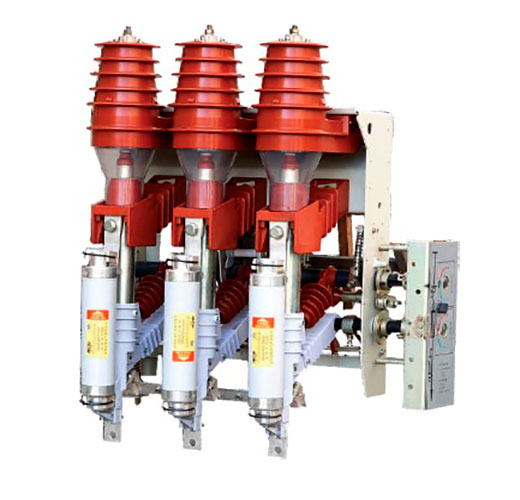
Switch-fuse combinations for transformer protection
For distribution transformers up to around 1,600-2,000 kVA, a load break switch combined with high-voltage current-limiting fuses (IEC 60282-1) is a cost-effective alternative to a circuit breaker. The arrangement is tested as a combination under IEC 62271-105. When any fuse blows, its striker pin trips the switch so that all three phases open, preventing single-phase operation of the transformer.
Fuse selection depends on transformer rating, inrush current and coordination with LV protection. Follow the fuse and switch manufacturer’s tables.
Ratings to specify
| Parameter | Typical values | Notes |
|---|---|---|
| Rated voltage (Ur) | 12, 24, 36/40.5 kV | Match the highest system voltage |
| Insulation level (Ud / Up) | 28/75 kV at 12 kV; 50/125 kV at 24 kV | Higher values for isolating distance |
| Rated normal current (Ir) | 400 A or 630 A | Ring switches usually 630 A |
| Short-time withstand current (Ik / tk) | 16, 20 or 25 kA for 1 s or 3 s | Must meet the network fault level |
| Short-circuit making current | 2.5 × Ik (50 Hz), e.g. 50 or 63 kA peak | Class E1, E2 or E3 by number of making operations |
| Mechanical endurance | Class M1 (1,000 operations) or M2 (5,000) | M2 for frequently operated or automated switches |
| Switch class | General-purpose switch | Covers mainly active load, closed-loop and cable-charging currents |
| Internal arc classification | IAC AFL or AFLR, 16-25 kA 1 s | Defined for the RMU or panel, per IEC 62271-200 |
Also specify the ambient temperature range, the gas pressure indicator or density monitor, cable bushing type, motor operation voltage, auxiliary contacts and any remote terminal unit requirements.
Advantages and limitations
Advantages
- Very compact: a complete three-way RMU fits in a cabinet roughly one meter wide.
- Sealed for life, with no need for gas handling during normal service.
- Insensitive to dust, humidity, salt and altitude.
- Integrated earthing and interlocking improve operator safety.
Limitations
- Cannot interrupt fault currents on its own.
- Contains SF6, a potent greenhouse gas, so end-of-life recovery and record keeping are mandatory in many countries.
- Internal parts cannot be repaired in the field; a damaged tank usually means replacing the unit.
SF6-free alternatives
Regulation (EU) 2024/573 bans new medium-voltage switchgear up to 24 kV using F-gases with a GWP of 10 or more from 1 January 2026, and extends this to 52 kV from 2030, with narrow exemptions. Utilities in other regions are following similar paths. The main alternatives are:
- Vacuum interrupter switches with dry air or nitrogen insulation: the vacuum bottle breaks the current, while a slightly pressurized air tank or solid insulation keeps the design compact.
- Solid-insulated switchgear: vacuum switching with live parts embedded in epoxy and an earthed screen.
- Alternative gas mixtures based on fluoroketone or fluoronitrile, which have a much lower GWP. Check whether a mixture falls under the F-gas ban in your market.
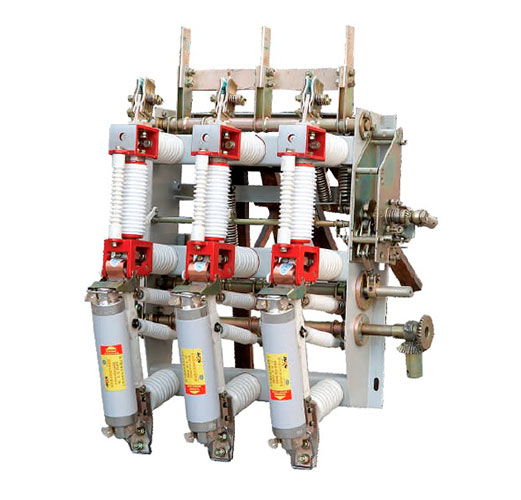
- Air-insulated load break switches with arc chutes, still a good choice where space is available.
Existing SF6 switches can remain in service. When they are replaced or decommissioned, the gas must be recovered by certified staff and reused or destroyed.
Frequently Asked Questions
Can an SF6 load break switch interrupt a short circuit?
No. It can make onto a short circuit and carry it for a limited time, but interruption requires a fuse or circuit breaker.
How long does an SF6 load break switch last?
Typical design life is 30 years or more under normal service. Lifetime depends on the number of operations, the number of fault-making events and environmental conditions.
Does an SF6 load break switch need maintenance?
The gas tank is sealed for life. Routine work is limited to checking the pressure indicator, operating the mechanism, inspecting cable terminations and testing motor and auxiliary circuits.
What replaces SF6 load break switches in new projects?
Vacuum switches with dry air or solid insulation are the most common replacements, especially in EU projects affected by the 2026 ban.
Work with METTZ Group
METTZ Group offers a wide range of load break switches to suit many needs – from indoor switches for ring main units and compact substations to outdoor switches for overhead distribution lines – along with matching fuses and medium-voltage switchgear. Check out our website to learn more, or contact METTZ Group today to work with a representative.
