
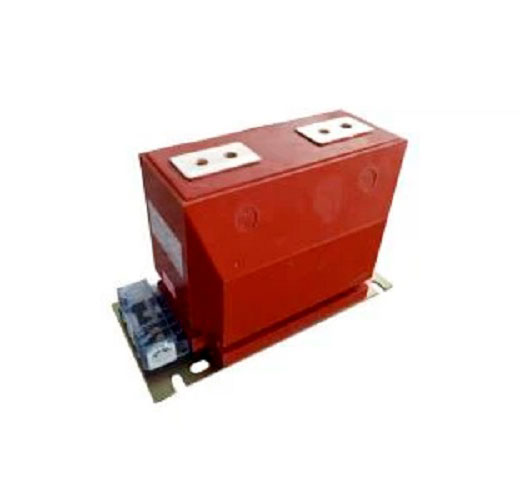
Current transformers (CTs) and voltage transformers (VTs, also called potential transformers or PTs) let meters and protection relays see what is happening on a high-voltage network safely. This guide compares how they connect, how they are rated and classed under IEC 61869, and the safety rules every technician must know.
Why Instrument Transformers Exist
Meters and relays cannot be connected directly to a 10 kV busbar carrying 2,000 A. Instrument transformers scale these quantities down to standard, safe values and isolate the secondary circuits from high voltage. They are the eyes of every substation: if they are wrong, billing is wrong and protection may fail to trip.
The international standard family is IEC 61869. Part 1 covers general requirements, Part 2 current transformers, Part 3 inductive voltage transformers, Part 4 combined units, and Part 5 capacitive voltage transformers. Newer parts cover low-power and digital instrument transformers.
Current Transformers in Brief
A CT has its primary in series with the conductor. Often the primary is just the busbar or cable passing through a ring core. The secondary delivers a current proportional to primary current, usually 1 A or 5 A at rated primary current. A 1,000/5 A CT, for example, gives 5 A when 1,000 A flows in the primary.
The CT behaves as a current source. Its secondary is connected to low-impedance burdens such as ammeters, energy meters and relay current inputs.
Voltage Transformers in Brief
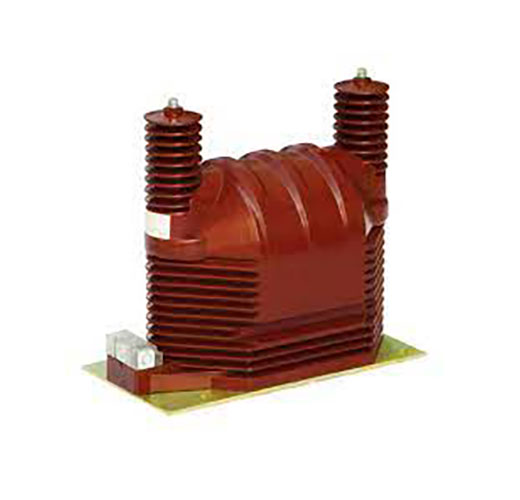
A VT has its primary connected in parallel, either between phases or from phase to earth. The secondary delivers a voltage proportional to primary voltage, typically 100 V or 110 V phase-to-phase (or that value divided by √3 for phase-to-earth units). An 11,000/110 V VT gives 110 V at rated system voltage.
At transmission voltages, capacitor voltage transformers (CVTs) use a capacitive divider plus a small inductive unit, which is more economical and also allows power line carrier coupling.
Side-by-Side Comparison
| Feature | Current transformer (CT) | Voltage transformer (VT/PT) |
|---|---|---|
| IEC standard | IEC 61869-2 | IEC 61869-3 (inductive), 61869-5 (capacitive) |
| Primary connection | In series with the load | In parallel across the supply |
| Quantity scaled | Current | Voltage |
| Rated secondary | 1 A or 5 A | 100 V, 110 V or these values / √3 |
| Primary turns | Few, often a single bar | Many |
| Primary quantity depends on | Load current in the circuit | System voltage, nearly constant |
| Secondary burden | Low impedance (near short circuit) | High impedance (near open circuit) |
| Burden rating | VA at rated secondary current, e.g. 5-15 VA | VA at rated secondary voltage, e.g. 10-100 VA |
| Dangerous condition | Open secondary circuit | Short-circuited secondary |
| Metering classes | 0.1, 0.2, 0.2S, 0.5, 0.5S, 1 | 0.1, 0.2, 0.5, 1 |
| Protection classes | 5P, 10P (e.g. 5P20), PX, TPX/TPY/TPZ | 3P, 6P |
Accuracy Classes Explained
CT metering classes
Class 0.2S or 0.5S is common for revenue metering. The “S” classes guarantee accuracy down to 1% of rated current, important for loads that spend much of their time lightly loaded. A metering CT is designed to saturate under fault current, protecting connected meters.
CT protection classes
Protection CTs must stay accurate far above rated current. In a 5P20 CT, the composite error stays within 5% up to 20 times rated current (the accuracy limit factor). Class PX (and the older TPX/TPY/TPZ classes for transient performance) are specified by knee-point voltage and are used for differential and distance protection.
VT classes
Metering VTs (class 0.2 or 0.5) are accurate between 80% and 120% of rated voltage. Protection VTs (3P or 6P) remain within limits from 5% of rated voltage up to the rated voltage factor, so they still work during faults when voltage collapses or rises.
Safety Rules You Must Not Break
- Never open-circuit an energized CT secondary. With no secondary current to oppose it, the primary current drives the core into deep saturation and can induce thousands of volts on the open terminals, risking flashover, insulation damage and injury. Use shorting terminal blocks before removing meters or relays.
- Never short-circuit a VT secondary. It would draw a very high current and destroy the winding. Protect VT secondaries with fuses or miniature circuit breakers.
- Earth one point of each secondary circuit to keep it at a safe potential if primary-to-secondary insulation fails.
- Protect VT primaries with suitable current-limiting fuses (IEC 60282-1) where specified.
Choosing the Right Instrument Transformer
- Define the purpose: revenue metering, indication, protection, or a mix (use separate cores for each).
- Set ratio from the maximum continuous load (CT) or system voltage (VT).
- Calculate burden, including cable resistance. A 5 A secondary over a long cable run can consume much of the VA rating; 1 A secondaries reduce cable losses.
- Check short-time thermal current (Ith) and dynamic current (Idyn) against the switchgear fault level.
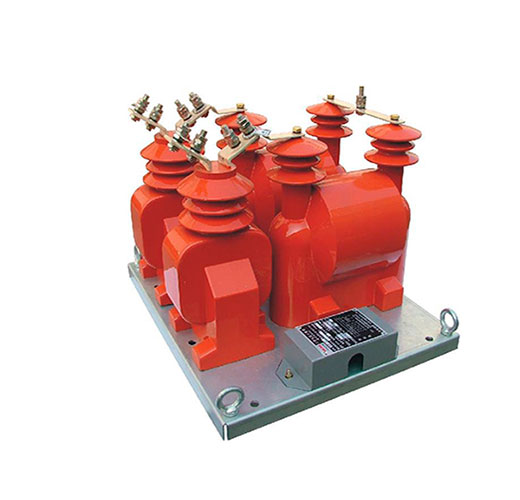
- Select insulation level, indoor or outdoor design, and cast resin, oil or gas insulation to match the switchgear.
The Digital Shift
Low-power instrument transformers (LPITs) to IEC 61869-6, -10 and -11, such as Rogowski coils and resistive dividers, output millivolt-level signals instead of 1 A or 110 V. They are compact, linear over a wide range, and do not saturate. Combined with merging units and IEC 61850 process bus (IEC 61869-9), they are a key building block of digital substations and smart compact switchgear.
Frequently Asked Questions
Is a potential transformer the same as a voltage transformer?
Yes. “Potential transformer” is the older, mainly North American term; IEC uses “voltage transformer”.
Can one CT serve both metering and protection?
Not well with one core. Multi-core CTs provide separate metering and protection cores in one housing.
Should I choose a 1 A or 5 A secondary?
Choose 1 A for long cable runs and modern relays; 5 A remains common in compact switchboards with short wiring.
Work with METTZ Group
METTZ Group offers a wide range of measuring transformers to suit many needs – from indoor cast resin current transformers to outdoor voltage transformers for substations. Check out our website to learn more, or contact METTZ Group today to work with a representative.
