
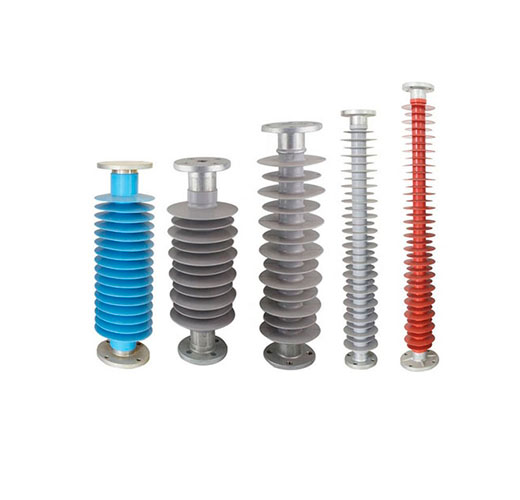
Every overhead line, substation and switchgear panel depends on insulators to hold live conductors in place without letting current escape. This guide covers what insulators have to do, how porcelain, glass and composite designs compare, and what to check when you specify them for a project.
What an Insulator Actually Does
In an insulating material, electrons are tightly bound to their atoms, so very little current flows even under a strong electric field. Good insulators have a volume resistivity many orders of magnitude higher than metals. Resistivity is only part of the story, though. A power-system insulator has three jobs at the same time:
- Electrical: withstand the normal operating voltage, switching surges and lightning impulses without puncture or flashover.
- Mechanical: carry the weight of the conductor, wind and ice loads, and short-circuit forces, often for 40 years or more.
- Environmental: keep working when the surface is wet, salty, dusty or polluted, and under UV, heat and temperature cycling.
Most field failures come from the third point. A clean, dry insulator rarely flashes over. A contaminated one in fog or light rain can, because the wet pollution layer conducts leakage current along the surface.
The Three Main Material Families
Porcelain (ceramic)
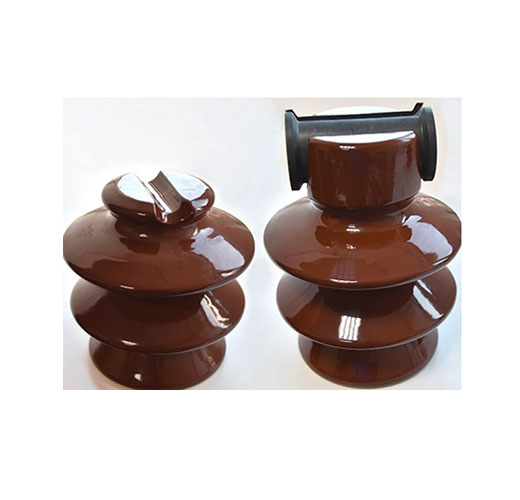
Glazed porcelain has been used for more than a century. It is chemically stable, does not age under UV and handles high compressive loads. Its downsides are weight, brittleness and the fact that internal cracks can be hard to detect. A punctured porcelain disc may look intact from the ground.
Toughened glass
Toughened glass discs behave much like porcelain electrically, but they fail in a visible way. A damaged disc shatters, while the metal cap and pin keep holding the mechanical load. Line crews can spot a broken unit from the ground or from a drone image, which makes inspection simple.
Composite (polymeric)
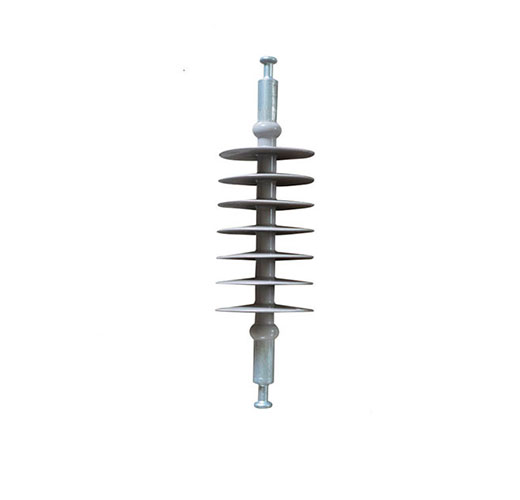
A composite insulator has a fibreglass-reinforced resin (FRP) core for strength, a silicone rubber housing and sheds for insulation, and crimped metal end fittings. Silicone rubber is hydrophobic: water beads up instead of forming a continuous film, and this property spreads to the pollution layer. That gives composite insulators excellent performance in coastal, desert and industrial areas. They also weigh up to about 90% less than an equivalent porcelain string and resist vandalism. The trade-offs are that the material ages and that interface defects need careful quality control.
| Property | Porcelain | Toughened glass | Composite (silicone) |
|---|---|---|---|
| Weight | High | High | Low |
| Pollution performance | Moderate | Moderate | Very good (hydrophobic) |
| Failure visibility | Poor (hidden puncture) | Excellent (shell shatters) | Needs close inspection |
| Vandal / impact resistance | Low | Low to moderate | High |
| Long-term ageing | Very stable | Very stable | Depends on material and design |
| Key IEC standards | IEC 60383, IEC 60168 | IEC 60383 | IEC 61109, IEC 62217, IEC 62231 |
Common Insulator Types by Application
Pin and line-post insulators
Pin and line-post insulators are mounted rigidly on the cross-arm, with the conductor tied or clamped on top. They are typical on distribution lines up to about 33 kV. Line posts have largely replaced classic pin insulators because they give more creepage distance and higher cantilever strength.
Suspension insulators
Above roughly 33 kV, conductors hang from strings of cap-and-pin discs or from single long-rod composite units. String length grows with system voltage and with how polluted the site is. Adding discs is a simple way to raise insulation strength, and one damaged disc does not drop the conductor.
Strain (tension) insulators
Strain insulators are used at dead-ends, angle towers and river crossings, where the string has to take the full conductor tension. They are often doubled or tripled in parallel for higher mechanical ratings.
Station post insulators and bushings
Inside substations, rigid post insulators support busbars, disconnectors and earthing switches. Bushings carry conductors through the walls of transformer tanks and switchgear enclosures. Indoor medium-voltage switchgear relies on cast epoxy resin supports, spouts and embedded poles, which combine insulation and mechanical support in one part.
Shackle and stay insulators
Shackle insulators are small spool-type units for low-voltage service lines. Stay (guy) insulators break the electrical path in pole stay wires so that a stay touched by a fallen conductor does not become live at ground level.
How to Select an Insulator
1. Voltage and insulation level
Start from the system’s highest voltage for equipment (Um) and the required lightning and switching impulse withstand levels from your insulation coordination study (IEC 60071). These values set the minimum arcing distance.
2. Site pollution severity
IEC TS 60815 defines site pollution severity classes from “very light” to “very heavy”. Each class maps to a minimum unified specific creepage distance (USCD) in mm per kV. For example, a coastal or heavy-industry site needs far more creepage than a clean inland area. Underestimating pollution is the most common cause of repeated flashovers.
3. Mechanical load
Specify the rated mechanical (or specified mechanical) load with a sensible safety margin over the worst combination of conductor tension, wind, ice and short-circuit forces.
4. Climate and altitude
High altitude reduces air density and dielectric strength, so external insulation must be corrected above 1,000 m. Tropical humidity, heavy UV, sandstorms and wildfire risk all influence the choice of material.
5. Maintenance strategy
Think about how the line will be inspected. Glass suits visual and drone surveys. Composite suits remote, hard-to-wash sites. Utilities in polluted regions sometimes apply room-temperature-vulcanizing (RTV) silicone coatings to existing porcelain to get hydrophobic behaviour without replacing the insulators.
Inspection and Typical Failure Modes
- Pollution flashover: look for tracking marks and arcing burns. Fix it with washing, coatings or longer creepage.
- Puncture of porcelain discs: detect it with live-line testers, thermography or replacement programmes.
- Composite degradation: watch for chalking, cracking, erosion of sheds and brittle-fracture risk at the end fittings.
- Corona and RIV: missing or misplaced grading rings on EHV strings cause corona noise, radio interference and surface damage.
Modern asset management combines drone imaging, UV corona cameras and infrared surveys, so problem strings are found before they cause an outage.
Frequently Asked Questions
What is the difference between an insulator and insulation?
An insulator is a discrete component that supports and separates conductors, such as a disc or a post. Insulation is the material layer applied around a conductor, such as XLPE on a cable or enamel on a winding.
Are composite insulators better than porcelain?
They perform better in polluted areas and are much lighter. Porcelain and glass have longer track records and very stable ageing. The best choice depends on pollution class, maintenance access and budget.
How many discs does a suspension string need?
It depends on system voltage, required creepage (IEC TS 60815) and altitude. As a rough guide, a 110 kV line in a clean area often uses 7-9 standard discs, and polluted sites need more or a fog-type profile.
Why do EHV insulator strings have rings at the ends?
Grading (corona) rings even out the electric field along the string. This reduces corona discharge, radio noise and stress on the units nearest the conductor.
Work with METTZ Group
METTZ Group offers a wide range of transmission line products to suit many needs, from distribution line hardware to fittings for high-voltage overhead lines, along with switchgear components such as embedded poles and insulating parts. Check out our website to learn more, or contact METTZ Group today to work with a representative.
