
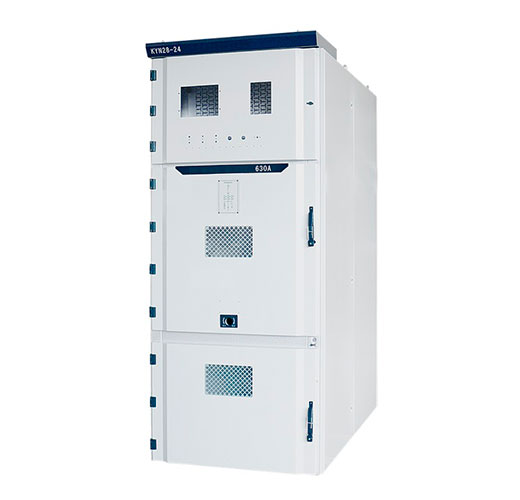
Air-insulated switchgear is still the most widely installed type of switchgear in the world. This guide explains how AIS works, which designs and components you will meet, and how to install, test, maintain and troubleshoot it in everyday practice.
What is air-insulated switchgear?
In air-insulated switchgear, the main insulating medium between live parts, and between live parts and earth, is atmospheric air at normal pressure. Busbars and conductors are held on solid insulators, and the required dielectric strength comes from distance: the higher the voltage, the larger the clearance.
AIS exists in two very different forms:
- Outdoor AIS at high voltage (typically 66 kV up to 800 kV): open substations with disconnectors, live-tank or dead-tank breakers, instrument transformers and surge arresters mounted on steel structures.
- Indoor metal-enclosed AIS at medium voltage (typically 3.6 kV to 40.5 kV): factory-built panels to IEC 62271-200, installed in switchrooms of substations, plants and buildings.
The rest of this guide focuses mainly on indoor MV AIS, which is what most contractors and plant engineers work with.
How AIS works
An AIS panel separates its functions into compartments. Load current flows from the main busbar, through the switching device, to the outgoing cable. Air clearances and insulators withstand the system voltage and transient overvoltages, while the switching device – today almost always a vacuum circuit breaker – interrupts load and fault currents.
When a protection relay detects a fault from its current transformer signals, it sends a trip command. The breaker opens in a few cycles, the arc is extinguished inside the sealed vacuum interrupter at a current zero, and the faulty circuit is disconnected. The air inside the enclosure never takes part in arc interruption; it only insulates.
Main types and classifications
By installation of the switching device
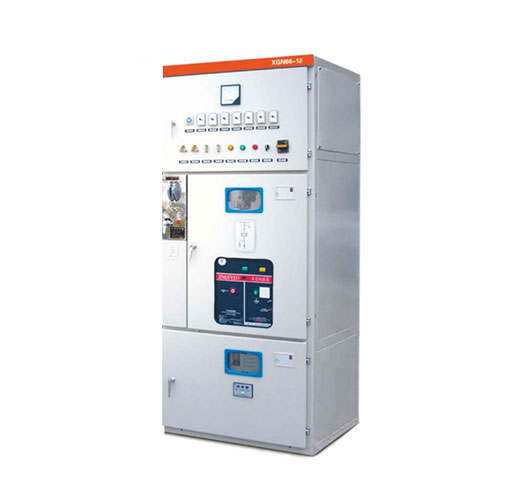
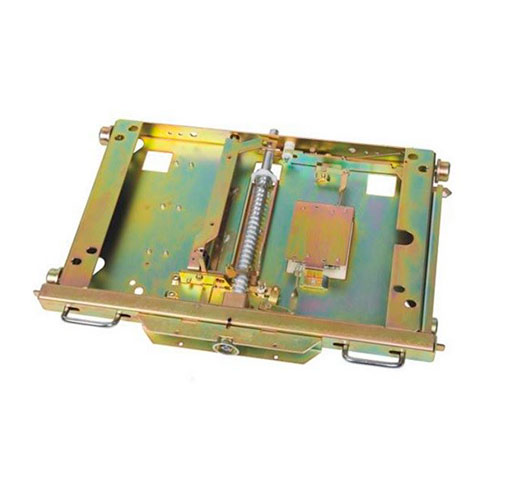
- Withdrawable (draw-out) switchgear: the breaker sits on a truck that can be racked between service, test and disconnected positions. It allows a breaker to be replaced in minutes and gives a visible isolating gap. Designs are either mid-mounted (the truck sits at mid-height of the panel) or floor-rolled (the truck runs on the floor).
- Fixed-type switchgear: the breaker or load break switch is bolted in place and isolated by a separate disconnector. It costs less and is common in secondary distribution, but maintenance requires de-energizing more of the board.
By busbar arrangement
- Single busbar: simple and economical; a busbar fault stops the whole board.
- Sectionalized single busbar: a bus section breaker splits the board into two halves, each fed by its own incomer.
- Double busbar: each feeder can be switched to either busbar, used where very high availability is needed.
By service continuity class
IEC 62271-200 defines LSC1, LSC2, LSC2A and LSC2B. Most withdrawable AIS is LSC2B: busbar, breaker and cable compartments are separated so that one compartment can be opened while the others remain energized. The partition class (PM for metal, PI for insulating material) completes the description.
Components of an indoor AIS panel
| Compartment | Typical components | Function |
|---|---|---|
| Busbar compartment | Copper or aluminium busbars, support insulators, bushings | Distributes power between panels |
| Switching device compartment | Vacuum circuit breaker or contactor on truck, shutters, spouts | Switches load current and interrupts faults |
| Cable compartment | Cable terminations, current transformers, earthing switch, surge arresters, voltage indicators | Connects outgoing cables and measures current |
| LV compartment | Protection relay, meters, control switches, terminal blocks | Protection, control, metering and communication |
| Pressure relief system | Flaps and arc ducts | Releases internal arc gases away from operators |
Key items worth checking in a datasheet include the indoor vacuum circuit breaker ratings, the earthing switch short-circuit making capability, and the accuracy class of current and voltage transformers to IEC 61869.
Interlocks
Mechanical interlocks are the heart of AIS safety. Typical rules are: the truck cannot be moved while the breaker is closed; the earthing switch cannot be closed while the truck is in service position; the cable compartment door cannot be opened unless the earthing switch is closed. Shutters close automatically over the fixed contacts when the truck is withdrawn.
Strengths and limitations
AIS remains popular because it is well understood, easy to inspect and naturally free of F-gases. Its main limits are footprint and sensitivity to the environment.
- Strengths: lower purchase price, simple visual inspection, easy extension, fast breaker replacement on withdrawable designs, no gas handling, and full compliance with SF6 phase-out rules such as Regulation (EU) 2024/573.
- Limitations: larger panels, exposure to dust, humidity and condensation, and reduced insulation margin at high altitude (see the section on demanding sites below).
For a detailed side-by-side comparison with gas-insulated designs, see our article on choosing between AIS and GIS.
Adapting AIS to demanding sites
Because air insulation depends on its surroundings, the site has a direct influence on design. Three situations deserve special attention.
Tropical and humid climates
High humidity and daily temperature swings cause condensation on insulators, which leads to surface tracking and partial discharge. Effective countermeasures include thermostatically or hygrostatically controlled anti-condensation heaters in every compartment, insulation materials with good tracking resistance, sealed cable entries, and a switchroom with controlled ventilation or air conditioning. Corrosion-resistant enclosure coatings and tinned or plated busbar joints extend service life.
Mining and heavy industry
Mines, cement plants and steelworks bring conductive dust, vibration and frequent motor switching. Here, buyers typically specify higher IP ratings, robust withdrawable trucks, vacuum contactors for motor feeders, and protection relays with motor and earth-fault functions. Mobile or skid-mounted switchgear for underground mining also requires rugged frames and special earthing arrangements.
High altitude
Air density falls with altitude, so dielectric strength falls too. For sites above 1,000 m, the insulation level must be corrected – for example by selecting equipment with the next higher rated voltage or a design type-tested for the altitude. Current ratings may also need derating because cooling air is thinner.
Installation: step by step
1. Prepare the room and foundation
- Check that the floor or base frame is level within the manufacturer’s tolerance, typically a few millimetres over the length of the board.
- Confirm cable trenches, openings and arc gas exhaust routes match the layout drawing.
- Make sure the room is clean, dry and ventilated before the panels arrive.
2. Position and join the panels
- Lift only at the marked lifting points and keep panels upright.
- Set the first panel in place, align and bolt subsequent panels together, then anchor to the base frame.
3. Connect the main busbars
- Clean busbar contact surfaces and apply a thin film of the contact grease specified by the manufacturer.
- Use the supplied bolts, washers and torque values; record every joint.
- Fit insulating boots or sleeves where the design requires them, including end covers on the first and last panels.
4. Earthing, control wiring and cables
- Connect the earth busbar between panels and to the station earthing system at both ends of the board.
- Connect inter-panel control wiring and auxiliary supplies following the schematic.
- Terminate power cables to the cable manufacturer’s instructions, maintain phase clearances, and seal cable entries against vermin and moisture.
5. Final mechanical checks
- Doors open and close smoothly; all bolts are tight.
- Rack each truck through all positions and test every interlock.
- Remove tools, packing material and dust from all compartments.
Commissioning tests
Before energization, carry out and document at least the following:
- Insulation resistance of busbars, cables and secondary circuits.
- Power-frequency voltage test on the main circuit at site test level, where specified.
- Main circuit resistance (contact resistance) with a DC micro-ohmmeter.
- Circuit breaker open/close timing and operation from local and remote positions.
- Current and voltage transformer ratio, polarity and secondary loop checks.
- Protection relay settings verified by secondary injection, including trip to breaker.
- Functional checks of interlocks, indications, heaters and communication.
Preventive maintenance
Always follow the manufacturer’s manual; the intervals below are typical starting points and should be shortened in dusty, humid, coastal or mining environments.
| Interval | Task |
|---|---|
| Monthly / during patrols | Visual check, unusual noise or smell, heater and relay status, door seals |
| Annually | Infrared thermography under load, partial discharge survey, cleaning of accessible insulators |
| Every 3-5 years or per operation count | De-energized inspection, contact resistance, breaker timing, lubrication of mechanisms, interlock test, torque check of joints |
| Per manufacturer limits | Vacuum interrupter replacement after the rated number of operations or contact wear limit |
Condition monitoring makes this program smarter. Wireless temperature sensors on cable lugs and busbar joints, online partial discharge sensors and breaker monitoring relays allow maintenance to be planned according to real condition rather than the calendar.
Troubleshooting common problems
| Symptom | Likely cause | Action |
|---|---|---|
| Hot spot on a joint or termination | Loose bolt, oxidized contact surface, overload | De-energize, clean, re-torque; check load current |
| Tracking marks or crackling noise | Condensation, dirt, partial discharge | Clean and dry insulation, check heaters and ventilation, test insulation |
| Breaker fails to close | Spring not charged, closing coil fault, interlock not released, low auxiliary voltage | Check motor and spring indicator, coil continuity and supply voltage |
| Breaker fails to trip | Trip coil or circuit failure, mechanism binding | Remove from service; test trip circuit and lubricate mechanism |
| Truck difficult to rack | Misalignment, dirt on rails, interlock engaged | Clean and lubricate; verify interlock conditions |
| Unexpected relay trips | Wrong settings, CT polarity, genuine fault | Download event records, verify settings and CT wiring |
Where AIS is heading
AIS is benefiting from the SF6 phase-out. Because it uses air for insulation and vacuum for interruption, it is already F-gas-free and avoids gas monitoring, leak reporting and end-of-life recovery. Manufacturers are combining classic AIS with digital relays, IEC 61850 communication, low-power instrument sensors and motorized racking. For space-limited sites, solid-insulated and dry-air designs offer an SF6-free alternative with a smaller footprint.
Frequently Asked Questions
Does air-insulated switchgear contain SF6?
Modern MV AIS normally uses vacuum circuit breakers and contains no SF6. Some older designs used SF6 breakers inside air-insulated panels, so check the nameplate on existing equipment.
Can AIS be installed at high altitude?
Yes, but insulation must be corrected for the lower air density above 1,000 m. This usually means choosing a higher rated insulation level or a design specifically tested for the site altitude.
What is the difference between withdrawable and fixed AIS?
Withdrawable panels let the breaker be racked out and replaced quickly. Fixed panels have the breaker bolted in place, which is cheaper but requires more downtime for maintenance.
How long does AIS last?
With proper maintenance, MV AIS is commonly designed for a service life of 30 years or more. Breakers can often be replaced or retrofitted to extend the life of the panels.
Work with METTZ Group
METTZ Group designs, manufactures and commissions switchgear from 1 kV up to 220 kV, with versions for mining and tropical conditions, and supports projects through local partners in 29 countries. METTZ Group offers a wide range of air-insulated switchgear to suit many needs – from fixed-type panels for secondary distribution to withdrawable switchboards for utility substations and heavy industry. Check out our website to learn more, or contact METTZ Group today to work with a representative.
