
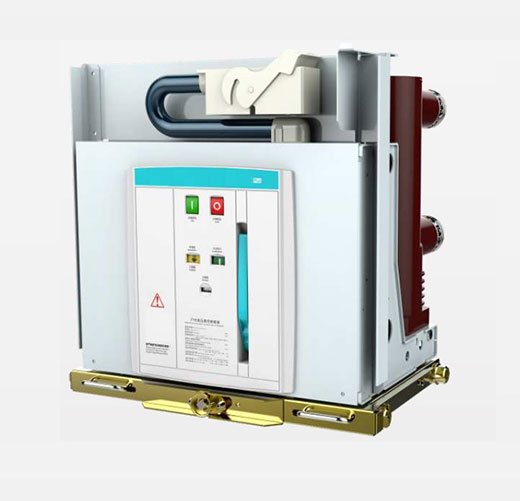
The arc-quenching medium decides how a circuit breaker performs, how often it needs service and what it does to the environment. This comparison puts vacuum, SF6, air and oil breakers side by side, clears up common mix-ups between low-voltage air breakers and MV vacuum breakers, and explains what F-gas rules mean for new projects.
Why the Quenching Medium Matters
Every breaker separates contacts under load or fault current and must extinguish the resulting arc before the recovery voltage re-establishes it. The medium around the contacts determines:
- How fast the gap regains dielectric strength after current zero
- How much the contacts erode per interruption
- How large the breaker must be for a given voltage
- Whether the medium needs monitoring, topping up or special handling at end of life
The Four Technologies at a Glance
| Criterion | Vacuum (VCB) | SF6 gas | Air (ACB / air-magnetic) | Oil (bulk / minimum oil) |
|---|---|---|---|---|
| Typical voltage range today | 3.6-40.5 kV (some up to 145 kV) | 12 kV to 800 kV and above | ACB: up to 1 kV AC (IEC 60947-2); air-magnetic MV designs are legacy | Legacy, mostly 3.3-36 kV and older HV lines |
| Arc quenching principle | Metal-vapor arc condenses at current zero in sealed vacuum (around 10-7 hPa) | Electronegative gas absorbs free electrons; puffer or self-blast design | Arc stretched and split in arc chutes in atmospheric air | Arc decomposes oil into hydrogen-rich gas that cools it |
| Medium handling | None – sealed for life | Gas density monitoring, leak checks, certified recovery | None | Oil testing, filtering and replacement |
| Maintenance level | Low | Low to medium | Medium (contacts, arc chutes) | High |
| Mechanical endurance | High; 10,000 operations common | Good; typically lower than vacuum at MV | Good at LV | Limited |
| Footprint at MV | Very compact | Compact, especially in GIS | Large | Large |
| Fire and explosion risk | Very low | Low | Low (hot gases vented from arc chutes) | High |
| Environmental impact | No greenhouse gas | SF6 global warming potential roughly 23,500 times CO2 | None | Oil spill and fire hazard |
| Best fit | Most new MV feeders, motors, capacitors, RMUs | HV transmission, existing GIS fleets | LV main and feeder protection | Not recommended for new projects |
Vacuum Breaker vs Air Circuit Breaker: Clearing Up the Confusion
The two are often compared, but they work at different voltage levels.
- Air circuit breakers (ACBs) are low-voltage devices, rated up to 1 kV AC (most commonly 400-690 V). They are the main incomers and large feeder breakers in LV switchboards and motor control centres, built to IEC 60947-2. Outdoor use is possible inside suitable enclosures.
- Vacuum circuit breakers are mainly medium-voltage devices to IEC 62271-100, used from 3.6 kV upward. They feed transformers, motors and cable networks.
- An ACB needs arc chutes to split and cool the arc; a VCB does not, because the arc is contained inside the interrupter.
- A vacuum interrupter cannot be “refilled”. If it loses vacuum, it is replaced. In practice, ceramic interrupters keep their vacuum for decades.
A typical installation uses both: an MV VCB on the transformer primary and an ACB on the LV secondary feeding low-voltage cabinets.
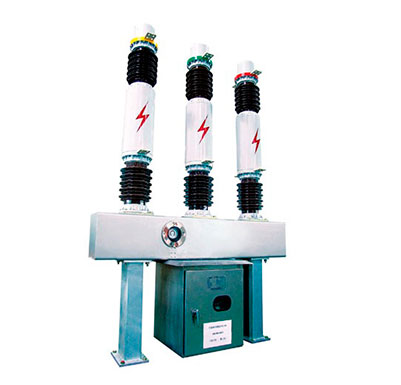
Vacuum vs SF6 at Medium Voltage
At 12-40.5 kV both technologies are mature, and the choice now hinges on environment and life-cycle cost rather than raw performance.
Where vacuum leads
- No gas to monitor, report or recover
- Higher number of operations without maintenance
- Better suited to frequent switching such as motors and capacitor banks
- Simpler end-of-life handling
Where SF6 still appears
- Extending or matching existing SF6 switchgear fleets
- Very compact GIS where the gas also acts as main insulation
- Transmission voltages, where SF6-free alternatives are only now reaching the market
Small currents switched by vacuum can produce current chopping and overvoltages on inductive loads. Modern CuCr contacts keep chopping currents low, and surge arresters handle the remaining risk on motors and dry-type transformers.
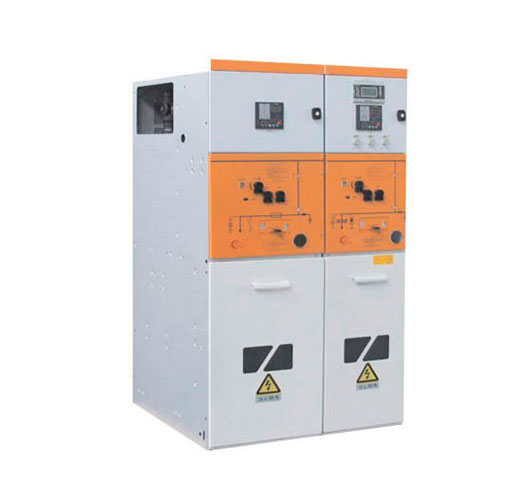
The SF6 Phase-Out: What Changes for Buyers
SF6 is the most potent greenhouse gas listed under the Kyoto Protocol and stays in the atmosphere for thousands of years. Regulators are moving it out of new switchgear.
- European Union. The revised F-gas Regulation (EU) 2024/573 bans placing on the market new MV switchgear that relies on fluorinated gases in stages: up to and including 24 kV from 1 January 2026, and above 24 kV up to 52 kV from 1 January 2030. HV equipment follows from 2028 (up to 145 kV) and 2032 (above 145 kV), with limited exceptions.
- Other regions. Several US states and other countries are introducing reporting duties, leak limits or phase-down rules for SF6.
- Utilities and investors. Many now specify SF6-free equipment in tenders regardless of local law, to meet their own climate targets.
For MV projects, the most mature SF6-free path is vacuum interruption combined with air, dry-air or solid-insulated switchgear. Existing SF6 assets can continue in service, but should have documented leak checks and a plan for certified gas recovery at decommissioning.
Quick Selection Guide
- LV up to 1 kV: air circuit breaker or molded-case breaker
- New MV, 3.6-40.5 kV: vacuum circuit breaker
- Extension of existing SF6 MV switchgear: match the installed technology, but check local F-gas rules first
- HV transmission: SF6 or emerging SF6-free designs, evaluated case by case
- Oil breakers: plan replacement during the next refurbishment
Frequently Asked Questions
Is a vacuum circuit breaker better than an SF6 breaker?
At medium voltage, vacuum usually wins on maintenance, switching endurance and environmental impact. SF6 remains common at transmission voltages.
Can an air circuit breaker be used at 11 kV?
Modern ACBs are low-voltage devices up to 1 kV. At 11 kV, a vacuum breaker is the standard choice.
Do I have to remove existing SF6 switchgear?
Generally no. Current rules focus on new equipment, but leak control, record keeping and proper gas recovery at end of life still apply.
Why are oil circuit breakers no longer specified?
They carry fire risk, need regular oil maintenance and are larger than vacuum alternatives with the same rating.
Work with METTZ Group
METTZ Group offers a wide range of vacuum circuit breakers to suit many needs – from compact indoor units for switchgear and ring main units to outdoor and mining designs, alongside SF6 breakers for existing installations. Check out our website to learn more, or contact METTZ Group today to work with a representative.
