
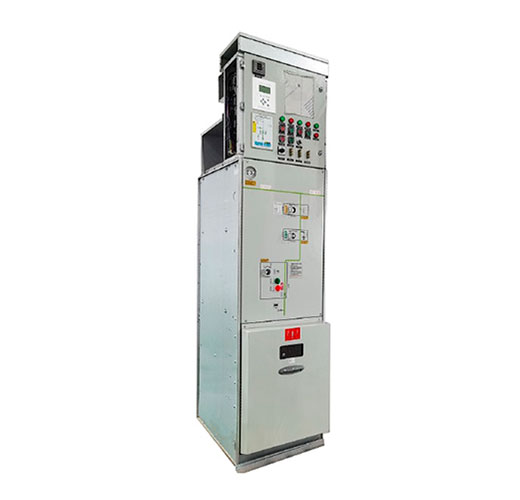
The ring main unit is the workhorse of underground cable distribution. Adding sensors, motor operators and communications turns it into a smart RMU that can locate faults and restore supply in minutes instead of hours. This article covers how RMUs work, the insulation options available today, and what “smart” really adds.
What a Ring Main Unit Does
A ring main unit (RMU) is a compact, factory-assembled set of medium-voltage switchgear, typically rated 12, 24 or 36/40.5 kV. It sits at each node of a cable ring and feeds a distribution transformer or a customer substation.
In an open-ring network, cables loop from substation to substation and back to the source. One switch in the ring stays open as a normally open point. If a cable section fails, it is isolated by opening the switches on both sides, and the open point is closed to feed the remaining customers from the other direction.
Typical functional units
- Cable switch (C) – a three-position load break switch (closed – open – earthed) for the incoming and outgoing ring cables
- Transformer protection with switch-fuse (F) – a load break switch with current-limiting HV fuses whose strikers trip the switch
- Circuit breaker (V) – a vacuum circuit breaker with a protection relay, often self-powered, for larger transformers or feeder protection
- Metering, bus sectionalizer or cable riser units in extensible designs
Common configurations combine these as CCF, CCV, CCCF and similar, in non-extensible blocks or modular extensible panels. RMUs are designed and type-tested under IEC 62271-200, with switching devices meeting IEC 62271-100, -102, -103 and -105, and internal arc classification (IAC) protecting operators.
Insulation Types: Gas, Air and Solid
| Type | Insulation and switching | Strengths | Points to check |
|---|---|---|---|
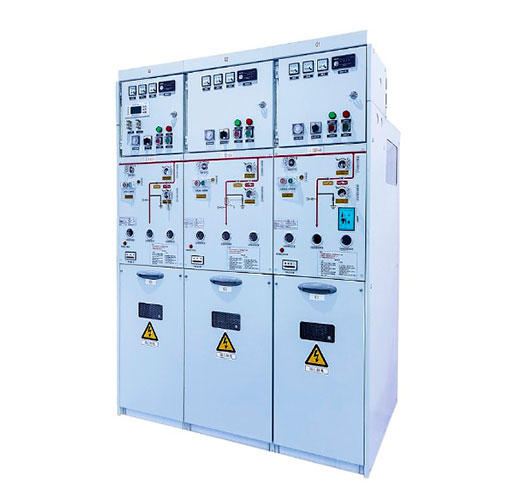
| SF6 gas-insulated | Live parts in a sealed stainless-steel tank filled with SF6; SF6 or vacuum switching | Very compact, insensitive to dust and humidity, large installed base | F-gas regulations; new SF6 MV switchgear up to 24 kV restricted in the EU from 2026 |
| Alternative-gas or dry-air insulated | Sealed tank with dry air, nitrogen or other low-GWP gas; vacuum switching | SF6-free, similar footprint concept | Slightly larger tank or higher pressure |
| Air-insulated | Open air insulation in a metal enclosure, vacuum or air load break switches | Simple, no gas handling, easy inspection | Larger footprint; sensitive to pollution and condensation |
| Solid-insulated | Vacuum interrupters and conductors encapsulated in epoxy or other solid insulation, with earthed outer screen | SF6-free, compact, resistant to humidity, altitude and pollution | Cable termination quality and partial discharge control are critical |
Note that solid-insulated RMUs use epoxy resin or similar solid dielectrics. Oil-insulated RMUs survive only as legacy equipment.
See METTZ ranges for gas-insulated switchgear and solid-insulated switchgear.
What Makes an RMU “Smart”
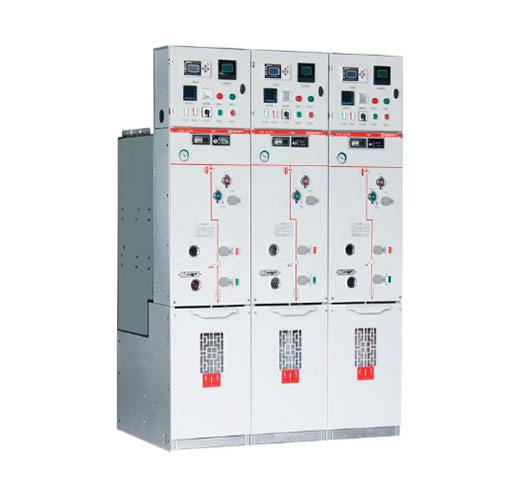
A conventional RMU is operated by hand. A smart RMU adds equipment that lets it be monitored and controlled remotely as part of distribution automation:
- Motor operators on switches and breakers for remote opening and closing
- Fault passage indicators that detect whether fault current flowed through each cable
- Sensors – low-power current and voltage sensors (IEC 61869-10/-11), cable and busbar temperature, gas density in sealed tanks, partial discharge and door/position status
- Remote terminal unit (RTU) or feeder terminal unit (FTU) that collects data and executes commands
- Communications using IEC 60870-5-104, IEC 61850, DNP3 or Modbus over fiber, 4G/5G or private radio
- Back-up power from batteries or supercapacitors so switching works during an outage
- Cybersecurity measures such as encrypted links and role-based access, often aligned with IEC 62351 and IEC 62443
How Smart RMUs Cut Outage Times
The biggest benefit is FLISR – fault location, isolation and service restoration.
- A cable fault trips the feeder breaker at the primary substation.
- Fault passage indicators in each RMU report whether fault current passed through them.
- The control center, or a local automation scheme, identifies the faulted section between two RMUs.
- Motorized switches on both sides of the faulted section open remotely.
- The feeder breaker recloses, and the normally open point closes to back-feed the far side.
Customers outside the faulted section are typically restored within minutes, without waiting for crews to drive to each RMU. The crew then goes directly to the faulted cable.
Other benefits
- Load and voltage data from each node for planning and loss reduction
- Condition-based maintenance driven by temperature, gas density and partial discharge trends
- Safer operation – switching done remotely, away from the equipment
- Easier integration of rooftop solar, EV charging and battery storage on distribution feeders
Where Smart RMUs Are Used
- Urban and suburban underground cable networks
- Industrial parks, ports, airports and metro systems
- Hospitals, data centres and commercial complexes with dual or ring supplies
- Solar and wind farm collection grids and battery storage sites
- Compact and prefabricated substations
Choosing a Smart RMU: Key Questions
- What voltage, rated current and short-circuit rating (e.g. 20 kA for 3 s or 1 s) does the network need?
- Which functional units and how many ways – and must the RMU be extensible later?
- Gas-insulated, air-insulated or solid-insulated, considering local F-gas rules and site environment?
- Switch-fuse or VCB protection for the transformer?
- Which protocol and SCADA system must it talk to, and is it smart-ready now or fully automated from day one?
- Indoor, outdoor kiosk or compact substation installation, and what internal arc classification is required?
Frequently Asked Questions
What is the function of a ring main unit?
It switches and isolates the cables of a ring network and protects the transformer or customer feeder connected to it.
What is the difference between an RMU and switchgear?
An RMU is a type of compact MV switchgear, optimized for secondary distribution. Larger switchgear lineups serve primary substations and industrial plants with many breakers.
Can an existing RMU be made smart?
Often yes. Many RMUs can be retrofitted with motor operators, sensors and an RTU, provided the mechanism supports motorization.
Work with METTZ Group
METTZ Group offers a wide range of medium-voltage switchgear and ring main units to suit many needs – from compact gas- and solid-insulated RMUs to smart-ready units for distribution automation and prefabricated substations. Check out our website to learn more, or contact METTZ Group today to work with a representative.
