
“SF6 switchgear” and “GIS” are often used as if they meant the same thing. They do not: one describes a switching device, the other a complete switchgear assembly. This article explains the difference, the main breaker designs (live-tank and dead-tank), and when a project needs a standalone SF6 breaker, a GIS, or neither.
The short answer
- An SF6 circuit breaker is a single switching device that makes, carries and interrupts normal and fault currents, using SF6 gas to extinguish the arc and insulate the open contacts. It is covered by IEC 62271-100.
- Gas-insulated switchgear (GIS) is a complete assembly in which all live parts – busbars, circuit breakers, disconnectors, earthing switches, instrument transformers and often surge arresters – are enclosed in earthed metal compartments filled with insulating gas. It is covered by IEC 62271-203 above 52 kV and IEC 62271-200 at medium voltage.
In other words, a GIS usually contains circuit breakers, but a circuit breaker is not a GIS. An SF6 breaker can stand alone in an open-air substation with no gas-insulated equipment around it, and a GIS can use vacuum breakers with gas used only for insulation.
Where the confusion comes from
Three habits of speech cause most misunderstandings:
- “SF6 switchgear” is used loosely for anything containing SF6: breakers, ring main units with SF6 load break switches, or full GIS.
- “Gas breaker” is sometimes used for the breaker module inside a GIS bay, which is not a separate product.
- Product catalogs group “SF6 equipment” together, even though the devices are tested and specified under different standards.
When writing a specification or a tender, avoid “SF6 switchgear” on its own. State whether the scope is a breaker, a switch, an RMU, or a GIS assembly, and name the insulating and interrupting medium separately.
How an SF6 circuit breaker works
When the contacts part, an arc forms between them. SF6 is strongly electronegative: it captures free electrons and cools the arc, so the gap recovers its dielectric strength very quickly after current zero. Two interrupter principles dominate:
- Puffer: the moving contact drives a piston that compresses gas and blows it through the arc. It needs a powerful operating mechanism.
- Self-blast (thermal assisted): the arc’s own energy heats and pressurizes gas in a chamber, which then blows the arc out. Mechanism energy can be much lower, which allows spring mechanisms even at high ratings.
Gas pressure in the interrupter is typically several bar, far higher than in MV GIS insulation compartments.
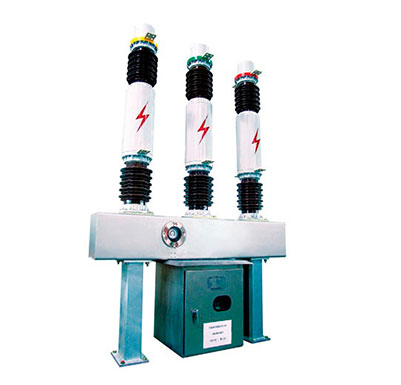
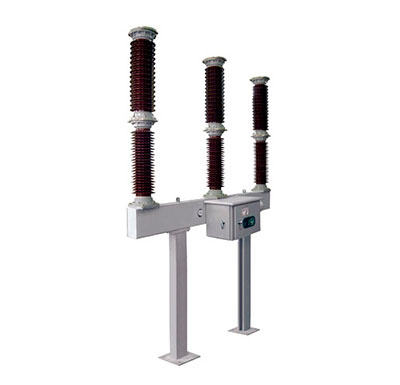
Live-tank and dead-tank SF6 breakers
Outdoor high-voltage SF6 breakers come in two forms, and the difference matters for substation layout.
| Feature | Live-tank breaker | Dead-tank breaker |
|---|---|---|
| Interrupter location | In an insulator column at line potential | In an earthed metal tank |
| Current transformers | Separate, freestanding CTs needed | Bushing-type CTs built into the breaker |
| Footprint and foundations | Slim, light, low cost per pole | Heavier, but saves space by integrating CTs |
| Seismic behavior | Tall columns need careful design | Low center of gravity, good in seismic zones |
| Typical markets | Europe, Asia and IEC markets in general | North America and ANSI/IEEE C37 markets, also used elsewhere |
| Relation to GIS | Pure AIS device | Shares the earthed-tank concept with GIS, but is still a standalone breaker |
A dead-tank breaker looks like a small piece of GIS, which adds to the confusion. The difference is that only the breaker and its CTs are enclosed; disconnectors, busbars and connections remain air-insulated.
At medium voltage, SF6 breakers are also made as indoor withdrawable or fixed units for air-insulated panels. Since the 1990s, however, vacuum breakers have largely replaced SF6 at MV.
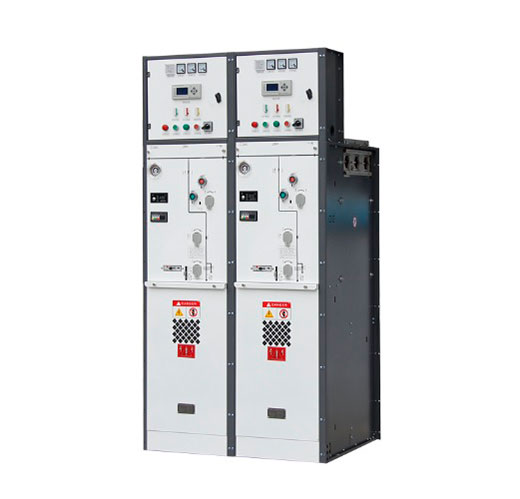
What makes a GIS different
A GIS replaces the open-air insulation of the whole bay with gas. This brings advantages a standalone breaker cannot offer:
- Space: a GIS bay can need around 10-20% of the area of an equivalent air-insulated bay at high voltage.
- Immunity to the environment: salt, dust, sand, humidity and pollution cannot reach the live parts.
- Safety: all live parts are behind earthed metal; operators cannot approach them.
- Modularity: bays are assembled from standard modules joined by flanges, each forming separate gas compartments.
The trade-offs are higher equipment cost, more gas per bay, specialist assembly, and longer repair times if an internal fault occurs. Our AIS vs GIS article covers this decision in more depth.
Side-by-side comparison
| Aspect | SF6 circuit breaker | Gas-insulated switchgear |
|---|---|---|
| What it is | One switching device | Complete switchgear assembly |
| Main IEC standard | IEC 62271-100 | IEC 62271-203 (HV), IEC 62271-200 (MV) |
| Role of gas | Arc interruption and insulation of the gap | Insulation of all live parts; interruption only inside its breakers |
| Interrupter type | SF6 (puffer or self-blast) | SF6 at HV; mostly vacuum at MV |
| Typical setting | Outdoor AIS substations, indoor MV panels, generator circuits | Indoor and outdoor substations where space or environment is critical |
| Gas quantity | A few kg to tens of kg per breaker | Tens to thousands of kg per substation |
| Installation | Mounted on structures and connected by air-insulated conductors | Flanged modules assembled and gas-filled on site (HV), factory-sealed panels (MV) |
When to use each
A standalone SF6 breaker fits when
- You are building or extending an outdoor air-insulated substation with enough space.
- You need to replace an old oil or air-blast breaker in an existing bay.
- Voltages are above the range where vacuum breakers are widely available, typically above 72.5-145 kV.
A GIS fits when
- Land is scarce or expensive: city centers, industrial plants, underground substations.
- The site is polluted, coastal, at high altitude or in an extreme climate.
- Safety and minimal maintenance over the life of the substation are priorities.
Neither may be the best answer when
- You work at medium voltage: vacuum circuit breakers in air-insulated, solid-insulated or SF6-free gas-insulated panels are now the standard choice.
- The project is in the EU: Regulation (EU) 2024/573 bans new F-gas MV switchgear up to 24 kV from 2026 and phases out SF6 at higher voltages between 2028 and 2032, with limited exemptions. SF6-free breakers and GIS using vacuum interruption with dry air or alternative gas mixtures are available at a growing range of ratings.
How to word the specification
Clear terminology in tender documents avoids costly misunderstandings. A few practical rules:
- For a standalone breaker, write “outdoor SF6 circuit breaker, live-tank (or dead-tank), to IEC 62271-100”, followed by rated voltage, normal current, breaking current, operating sequence and mechanism type. State whether CTs are included.
- For a GIS, write “gas-insulated metal-enclosed switchgear to IEC 62271-203 (or IEC 62271-200)”, then list the bays, busbar arrangement, insulating gas, interrupting medium, ratings and monitoring.
- For distribution units, name the device inside: “ring main unit with load break switches and vacuum circuit breaker feeder”, rather than “SF6 RMU”.
- Always ask for the gas mass per breaker or per bay. It drives F-gas obligations, handling equipment and end-of-life cost.
Frequently Asked Questions
Is every GIS filled with SF6?
No. Most installed GIS uses SF6, but new designs use dry air, nitrogen or mixtures based on fluoronitrile or fluoroketone, often with vacuum interrupters.
Can an SF6 breaker be installed in an air-insulated substation?
Yes. This is the most common use of HV SF6 breakers. Live-tank and dead-tank breakers are both air-insulated substation equipment.
Is a dead-tank breaker a GIS?
No. It encloses only the interrupter and its CTs in an earthed tank. The rest of the bay remains air-insulated.
Which is better for medium voltage?
For most MV applications, vacuum circuit breakers are preferred. SF6 is still used in some MV GIS and RMUs for insulation, but SF6-free options are now available.
Work with METTZ Group
METTZ Group offers a wide range of switching equipment to suit many needs – from SF6 circuit breakers and vacuum circuit breakers to complete gas-insulated switchgear for substations up to 220 kV. Check out our website to learn more, or contact METTZ Group today to work with a representative.
