
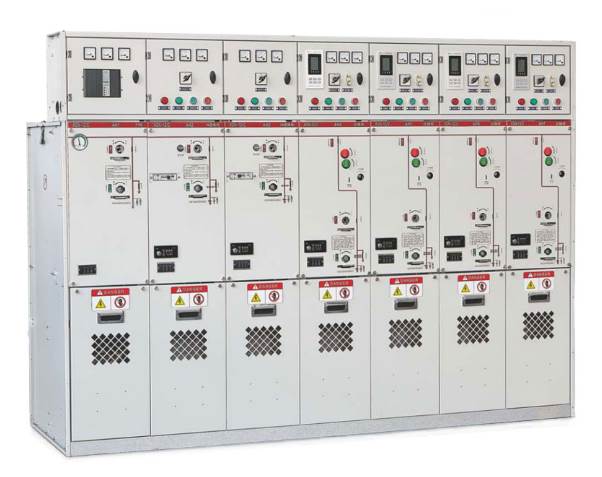
“Gas-insulated switchgear” covers everything from a 12 kV ring main unit to a 550 kV transmission bay. This article sorts the main GIS types by construction and voltage level, explains where hybrid modules fit, and lists the ratings that belong in a substation specification so that tenders are comparable.
If you are new to the technology, our article on how GIS works covers the basics, and our AIS vs GIS guide compares the two approaches. Here the focus is on choosing between GIS designs and specifying them correctly.
Classifying GIS: four useful questions
Most GIS products can be described by four characteristics:
- Voltage level: medium voltage (above 1 kV up to 52 kV, IEC 62271-200) or high voltage (above 52 kV, IEC 62271-203).
- Enclosure arrangement: all three phases in one tank, or each phase in its own tube.
- Degree of integration: a full GIS substation, or a hybrid module combining gas-insulated devices with air-insulated busbars and connections.
- Insulating and switching medium: SF6, an SF6-free gas such as dry air or a fluoronitrile or fluoroketone mixture, with SF6 puffer, self-blast or vacuum interrupters.
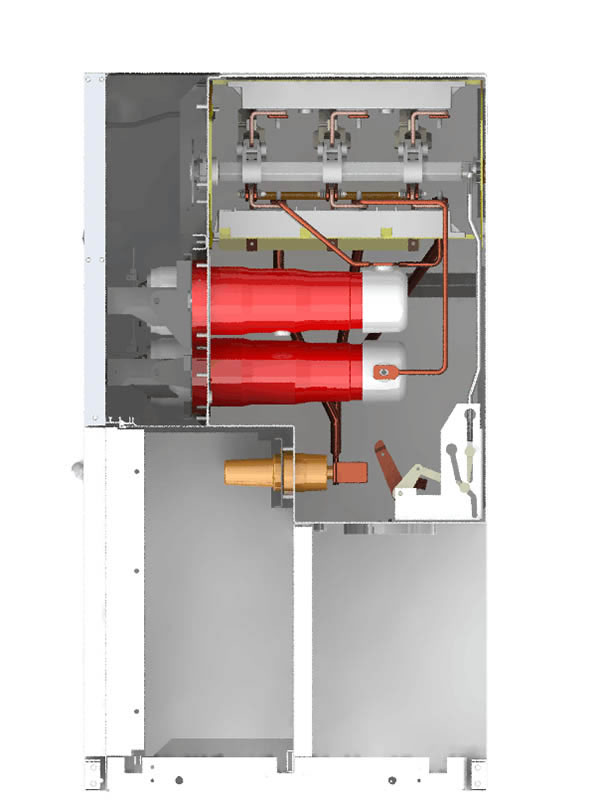
Three-phase enclosed vs single-phase enclosed GIS
| Feature | Three-phase enclosed | Single-phase (isolated-phase) enclosed |
|---|---|---|
| Construction | All three conductors share one earthed enclosure | Each phase has its own earthed tube |
| Typical voltage range | All MV GIS; HV up to about 145-170 kV, some designs to 245 kV | Usually 245 kV and above, sometimes from 72.5 kV |
| Footprint | Most compact, fewer flanges and seals | Larger, but smaller enclosures per phase |
| Fault behavior | Phase-to-phase faults are possible inside the enclosure | Internal faults are phase-to-earth only, which limits damage |
| Transport and weight | Heavier single units | Lighter modules, easier transport at high ratings |
| Enclosure currents | Low, as phase fields largely cancel | Induced enclosure currents must be managed by bonding |
For most sub-transmission substations (66-132 kV), three-phase enclosed bays give the best balance of space and cost. At 220 kV and above, single-phase enclosure becomes standard because of the conductor spacing and short-circuit forces involved.
MV GIS vs HV GIS
Medium-voltage GIS
MV GIS is built as factory-sealed panels, usually in laser-welded stainless steel tanks with the gas at slightly above atmospheric pressure. Variants include:
- Secondary distribution units such as ring main units, with load break switches and fuse-switch or breaker feeders for transformers.
- Primary distribution switchgear up to 40.5 kV, single or double busbar, with vacuum circuit breakers and three-position disconnector/earthing switches in gas.
- Special versions for wind turbines, railway traction supply, mining and offshore platforms, where compactness and sealing against dust and humidity matter most.
Most MV GIS today interrupts current in vacuum, while the gas serves only as insulation. That is why many manufacturers can switch MV ranges to dry air or other SF6-free insulation more easily than HV ranges.
High-voltage GIS
HV GIS is modular: breaker, disconnector, earthing switch, current and voltage transformers, surge arresters and busbars are separate gas compartments joined by flanges. Gas pressures are higher, typically several bar absolute, and the bays are assembled on site. Standard rated voltages under IEC include 72.5, 145, 245, 420 and 550 kV, with 126 and 252 kV common in Chinese practice and 800 and 1,100 kV used in ultra-high-voltage grids.
Hybrid and mixed-technology modules
Between AIS and full GIS sit hybrid modules, sometimes called mixed-technology switchgear (MTS). A single gas-insulated unit contains the circuit breaker, disconnectors, earthing switches and current transformers for one bay, connected to conventional air-insulated busbars and lines through bushings. IEC 62271-205 covers such compact switchgear assemblies above 52 kV.
Hybrid modules suit:
- Extending or refurbishing an existing AIS substation without rebuilding the busbars.
- Rural or space-limited sites where a full GIS is not justified but a conventional bay is too large.
- Fast-track and temporary substations, because modules arrive pre-tested.
Two related products also appear in substation projects: gas-insulated lines (GIL, IEC 62271-204) for high-current connections, and compact containerized or prefabricated GIS substations for quick deployment.
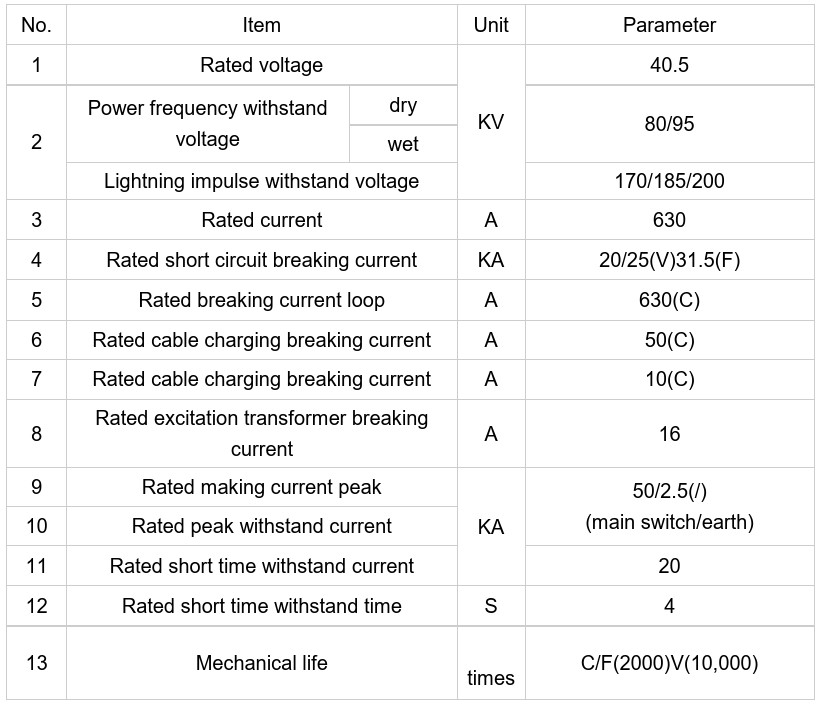
The key ratings to specify
A clear specification lists the following values, all as defined in IEC 62271-1 and the product standards.
Voltage and insulation level
- Rated voltage (Ur): the highest system voltage, for example 12, 24, 40.5, 72.5, 145 or 245 kV.
- Rated power-frequency withstand voltage (Ud) and lightning impulse withstand voltage (Up, BIL): for example 28/75 kV at 12 kV, 50/125 kV at 24 kV, 275/650 kV at 145 kV and 460/1,050 kV at 245 kV. From 300 kV upward, the switching impulse level is also specified.
- Altitude: above 1,000 m, external insulation such as bushings needs correction; the gas-insulated parts are not affected.
Current ratings
- Rated normal current (Ir): 630-4,000 A for MV, typically 1,250-5,000 A for HV busbars and feeders. Specify busbar and feeder values separately.
- Rated short-time withstand current (Ik) and duration (tk): common values are 25, 31.5, 40, 50 and 63 kA for 1 s or 3 s.
- Rated peak withstand current (Ip): 2.5 × Ik at 50 Hz or 2.6 × Ik at 60 Hz.
- Breaker ratings under IEC 62271-100: short-circuit breaking current, making current, operating sequence, and classes such as E2, M2 and C2 where relevant.
Gas system
- Type of gas and its global warming potential, rated filling pressure and minimum functional pressure, both referred to 20 °C.
- Maximum leak rate per compartment and year, and gas compartment arrangement (for example, separate compartments for each busbar section).
- Density monitoring: two-stage alarms, digital sensors and communication interface.
Safety and environment
- Internal arc classification (IAC): for MV, for example IAC AFLR 25 kA 1 s, indicating which sides of the panel are accessible and protected.
- Loss of service continuity (LSC2) and partition class for MV panels.
- Ambient temperature range, especially the minimum, since SF6 at high pressure may liquefy below about -30 to -40 °C. Heaters or gas mixtures are needed for colder climates.
- Indoor or outdoor installation, pollution and humidity class, and seismic qualification (IEC 62271-207) where required.
Control, monitoring and interfaces
- Local control cabinet, interlocking philosophy and IEC 61850 integration.
- Online monitoring of gas density, partial discharge (UHF sensors) and breaker condition.
- Cable termination type (plug-in cone sizes per EN 50181 for MV, IEC 62271-209 for HV), transformer connections and bushings for overhead lines.
Choosing the right type: quick guide
| Project | Usual choice |
|---|---|
| Urban 10-35 kV distribution substation, basement or kiosk | MV GIS or RMU, increasingly SF6-free |
| 66-132 kV city substation with limited land | Three-phase enclosed HV GIS, indoor |
| 220 kV and above, transmission node | Single-phase enclosed HV GIS |
| Extension of an outdoor AIS yard | Hybrid module per bay |
| Coastal, desert or heavily polluted site | GIS, indoor or outdoor, to keep insulation away from contamination |
| Wind, solar and battery storage collectors | Compact MV GIS feeders with breakers and fast protection |
Under EU Regulation 2024/573, new F-gas switchgear is being phased out in steps, from MV up to 24 kV in 2026 to the highest HV ratings by 2032. For projects in or supplying the EU, include the insulating gas and its GWP as a mandatory tender item.
Frequently Asked Questions
What is the difference between IEC 62271-200 and IEC 62271-203?
IEC 62271-200 covers AC metal-enclosed switchgear from above 1 kV up to 52 kV. IEC 62271-203 covers gas-insulated metal-enclosed switchgear above 52 kV.
Is three-phase enclosed GIS less safe?
No. It is fully type-tested, including internal arc tests. The main difference is that an internal fault can involve more than one phase, which is why single-phase enclosure is preferred at the highest voltages and fault levels.
When does a hybrid module make sense?
When an AIS substation needs new or replacement bays in limited space, or when the full cost of GIS is not justified but space and outage time must be minimized.
Which ratings are most often missed in GIS specifications?
Minimum ambient temperature, separate busbar and feeder current ratings, internal arc classification, the type of insulating gas, and the cable termination interface.
Work with METTZ Group
METTZ Group offers a wide range of gas-insulated switchgear to suit many needs – from compact distribution panels to complete substation solutions up to 220 kV, including versions for mining and tropical conditions. We also supply air-insulated switchgear where it is the better fit. Check out our website to learn more, or contact METTZ Group today to work with a representative.
