
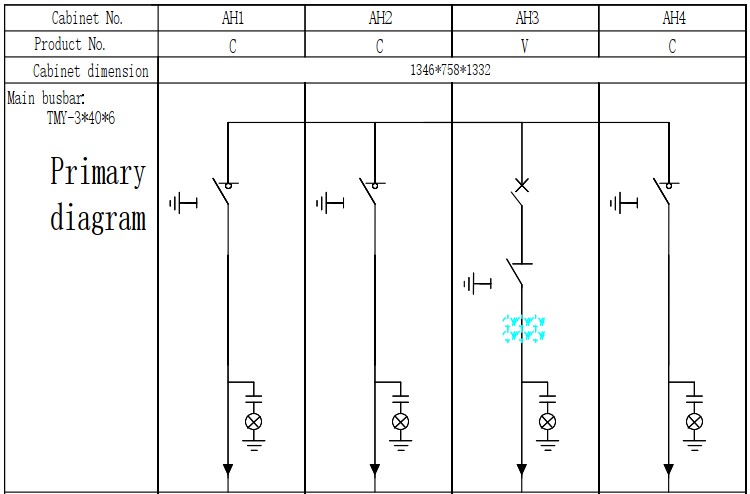
Ring main unit datasheets are full of letter codes such as CCF, CCV or CVV. Each letter is a functional unit, and the order describes the primary scheme of the switchgear. This guide decodes the letters, explains loop-in/loop-out and T-off connections, and shows how to choose the right scheme for a transformer, a customer substation or a renewable plant.
The Three Letters You Need to Know
Most RMU configurations are built from three basic functional units. Manufacturers sometimes use their own symbols, but the following convention is the most widely used:
| Letter | Functional unit | Main device | What it can do | Typical use |
|---|---|---|---|---|
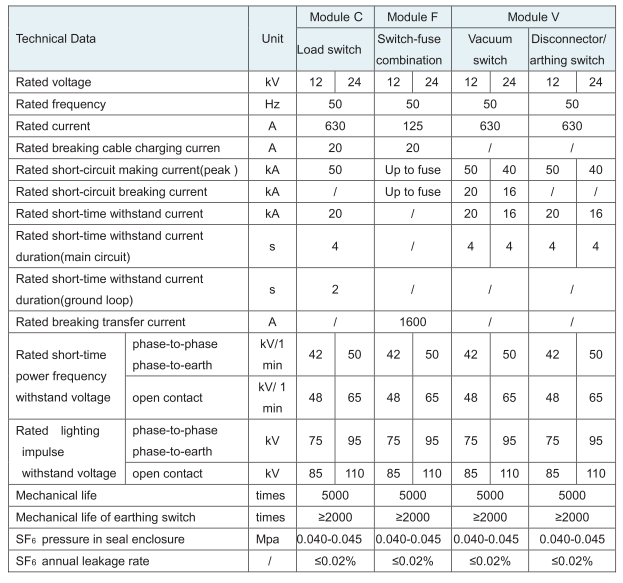
| C | Cable switch | Three-position load break switch (closed – open – earthed) to IEC 62271-103, with earthing switch to IEC 62271-102 | Makes and breaks load current, makes onto a fault, earths the cable. Cannot break short-circuit current. | Incoming and outgoing ring cables |
| V | Vacuum circuit breaker unit | VCB to IEC 62271-100 with disconnector/earthing switch, CTs and a protection relay (often self-powered) | Breaks load and short-circuit current, provides overcurrent and earth-fault protection | Larger transformers, customer substations, outgoing feeders |
| F | Switch-fuse combination | Load break switch with current-limiting HV fuses to IEC 60282-1, combined per IEC 62271-105, earthing on both sides of the fuses | Switches load; fuses clear short circuits; a blown fuse striker trips the switch on all three phases | Distribution transformers up to around 1 MVA at 10-12 kV |
Other letters appear in extensible ranges: D or De for a direct cable connection without a switch, M for a metering unit with CTs and VTs, S or Sb for a busbar sectionalizer and R for a riser. Always check the manufacturer’s legend before comparing offers.
Loop-In/Loop-Out and T-Off
Two terms describe how an RMU sits in the network:
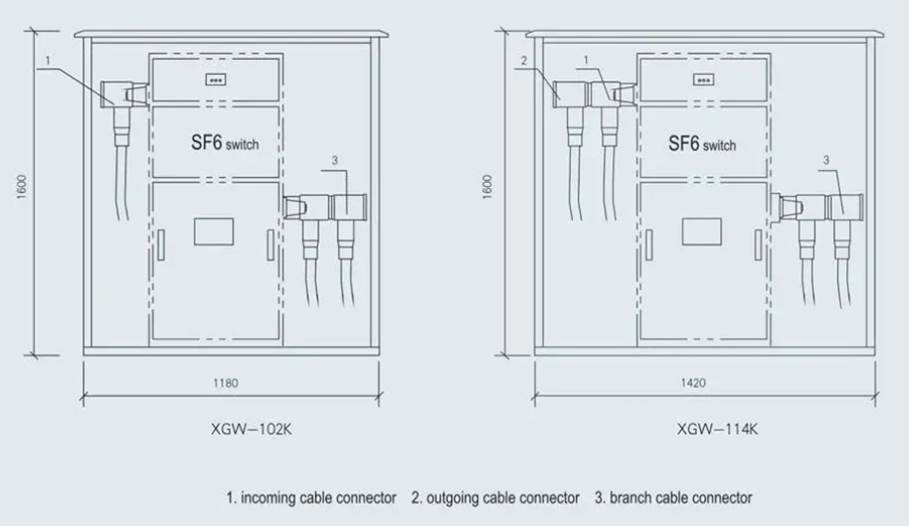
- Loop-in/loop-out – the ring cable comes into the RMU through one cable switch and leaves through another. The busbar between them is part of the ring, so the main circuit passes through every substation. This is why almost every RMU starts with “CC”.
- T-off (tee-off) – a third unit branches off the busbar to supply a load: a transformer, a customer or a spur cable. The T-off unit carries protection (F or V) because a fault on the transformer must be cleared without tripping the whole ring.
So a CCF unit reads as: loop-in (C), loop-out (C), and a fuse-protected T-off to the transformer (F). Because the ring switches only handle load current and the T-off has its own protection, a transformer fault blows the local fuses while the ring stays energized.
The Common Schemes Compared
| Scheme | Units | Typical application | Strengths | Points to check |
|---|---|---|---|---|
| CC / CCC | Two or three cable switches | Ring node without a transformer, branch point, normally open point | Simple, compact, low cost | No protection on the branch; fault on a spur trips the feeder |
| CCF | Two cable switches + switch-fuse | Standard secondary substation with one distribution transformer | Economical, very fast fuse clearing, limits let-through energy | Transformer size limited by fuse range; blown fuses must be replaced |
| CCV | Two cable switches + circuit breaker | Larger transformers, customer substations, transformer with frequent switching | Adjustable relay protection, selectivity with upstream relays, remote trip, no fuse stock | Higher cost; relay settings and CT sizing must be engineered |
| CVV | One cable switch + two circuit breakers | End of a line or spur feeding two protected outgoing circuits, small industrial or renewable collection points | Two protected outgoing feeders in one compact unit | Not a loop-in/loop-out design: the site is fed from one direction only |
| CCFF / CCVV | Two cable switches + two protected T-offs | Substations with two transformers, or a transformer plus a customer feeder | Redundancy at the LV side, compact double-transformer substation | Check busbar and ring switch current at full load |
| CCCF and larger | Three or more cable switches + protection | Network nodes where a ring branches into a spur and also feeds a transformer | Flexible switching between several cables | Larger footprint; consider an extensible design |
Fuse or Breaker? Choosing Between F and V
The biggest decision in most RMU specifications is whether the transformer T-off uses fuses or a circuit breaker.
Choose F (switch-fuse) when
- The transformer is within the range covered by the manufacturer’s fuse selection tables, typically up to about 1,000 kVA at 10-12 kV, or somewhat more at 20-24 kV.
- The network operator’s standard design uses fuses, so fuse stock and procedures exist.
- Lowest cost and maximum compactness are priorities.
- Very fast clearing of high transformer faults is desired. Current-limiting fuses interrupt within the first half-cycle.
Choose V (circuit breaker) when
- The transformer rating exceeds the fuse range, or several transformers or a cable spur are fed from the T-off.
- The utility or customer requires adjustable overcurrent and earth-fault protection, for example for selectivity with the primary substation relay.
- The circuit is switched often, as with some industrial loads or renewable plants.
- Remote tripping is needed, for example from transformer temperature, gas or pressure relays, or from a SCADA command.
- Avoiding fuse replacement after every fault is valuable, such as at remote sites.
Self-powered relays, which take their energy from the CTs, make the V unit almost as simple to install as a fuse unit, with no auxiliary battery required for basic protection.
Non-Extensible vs Extensible Designs
A non-extensible RMU has all its functions in one sealed tank, for example a three-way CCF block. It is the cheapest and smallest option, but its scheme is fixed for life.
Extensible or modular designs use individual sealed modules that can be coupled on site through busbar connectors. They allow schemes such as CCVM (with metering) or CCVVC, and future extension when a second transformer or a new feeder is added. For growing sites, the modest extra cost of extensibility is usually worthwhile.
Practical Examples
- Urban kiosk with a 630 kVA transformer at 10 kV – CCF is the classic choice: two ring cables and a fuse-protected transformer.
- Office building with a 1,600 kVA transformer at 10 kV – CCV, because the transformer is beyond the practical fuse range and the owner wants adjustable protection.
- Solar park inverter station – CCV or CVV in the collection ring, with circuit breakers for frequent switching and remote trip.
- Industrial site with two transformers – CCVV or CCFF, often in an extensible design to allow a third transformer later.
Specification Tips
- Draw the single-line diagram first, then translate it into letters. Do not start from a catalog code.
- Confirm the network’s fault level, the cable cross-sections and the bushing types for each cable.
- For F units, ask for the fuse selection table for your transformer rating and voltage.
- For V units, define the relay functions, CT ratios and whether a self-powered relay is sufficient.
- Decide on motorization and sensors now, even if automation comes later. Retrofitting is possible but more expensive.
- Check the insulation medium against current F-gas rules if the project is in the EU or follows similar policies.
Frequently Asked Questions
What does CCV mean on an RMU?
CCV means two cable switches for the ring (loop-in and loop-out) plus one vacuum circuit breaker unit that protects the T-off, usually a transformer.
What is the difference between CCF and CCV?
Both protect a transformer T-off. CCF uses a switch with current-limiting fuses. CCV uses a vacuum circuit breaker with a protection relay, which suits larger transformers and adjustable protection.
Can a cable switch clear a cable fault?
No. Ring cable switches can make onto a fault but cannot break short-circuit current. Faults on the ring are cleared by the feeder breaker at the primary substation.
What is a T-off in a ring main unit?
It is the branch from the RMU busbar that supplies a load, such as a transformer or customer, and carries its own fuse or breaker protection.
Work with METTZ Group
METTZ Group offers a wide range of medium-voltage switchgear to suit many needs – from CCF and CCV ring main units to extensible multi-panel schemes, built with our own load break switches, vacuum circuit breakers and HV fuses. Check out our website to learn more, or contact METTZ Group today to work with a representative.
