
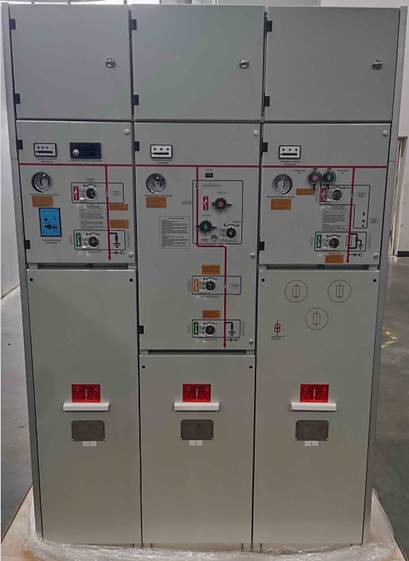
In electrical engineering, the RMU full form is Ring Main Unit. It is the compact medium-voltage switchgear found in almost every secondary substation, kiosk and building transformer room. This guide explains in plain terms what an RMU does, what is inside it, the ratings you will see on a datasheet and why utilities rely on it.
RMU Full Form and a One-Line Definition
RMU = Ring Main Unit. A ring main unit is a factory-assembled, type-tested, metal-enclosed set of medium-voltage switching devices that connects a distribution transformer or a customer to an MV cable ring. It is usually rated 12, 24 or 36/40.5 kV and is designed to the switchgear standard IEC 62271-200.
The name comes from the network it serves. In a “ring main”, underground cables run from a primary substation through several secondary substations and back to the same or another primary substation, forming a loop. Each secondary substation has an RMU that lets the ring pass through and taps power for the local transformer.
Why Distribution Networks Use Rings
In a purely radial network, a cable fault cuts off every customer downstream until the cable is repaired, which can take hours or days. A ring gives every substation two possible supply paths.
Most rings are operated “open”: one switch somewhere in the loop is kept open as the normally open point, so each half of the ring is fed radially. This keeps protection simple. When a cable section fails:
- The feeder circuit breaker at the primary substation trips and the half-ring goes dark.
- Crews or automation locate the faulty section between two RMUs.
- The RMU switches at both ends of that section are opened, isolating the fault.
- The breaker is reclosed and the normally open point is closed, so customers beyond the fault are fed from the other side.
Only the faulty cable section stays out of service. With manual switching this restoration takes tens of minutes. With motorized, remotely controlled RMUs it can take seconds to a few minutes, a topic we cover in our article on smart ring main units.
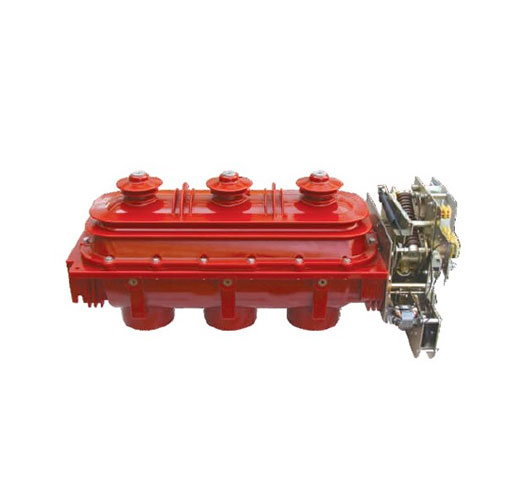
What Is Inside a Ring Main Unit
A typical RMU combines two or more functional units in one enclosure. The most common building blocks are:
- Cable switch (ring switch) – a load break switch to IEC 62271-103 that can make and break load current and make onto a fault. It is usually a three-position device: closed, open and earthed.
- Earthing switch – earths the cable for safe work, often with short-circuit making class E2 under IEC 62271-102.
- Transformer protection unit – either a switch-fuse combination to IEC 62271-105 with current-limiting HV fuses, or a vacuum circuit breaker to IEC 62271-100 with a protection relay.
- Insulated busbar – connects the functional units inside the tank or enclosure.
- Cable bushings – standardized plug-in or bolted interfaces for separable cable connectors, so cables can be connected quickly and safely.
- Operating mechanisms – spring-assisted manual mechanisms, optionally with motor operators for remote control.
- Indicators and accessories – position indicators, voltage presence indicators (IEC 62271-213), gas pressure gauge on gas-insulated designs, fault passage indicators, padlocking facilities and interlocks.
Common configurations are written as letter codes such as CCF (two cable switches plus a fuse-protected transformer feeder) or CCV (two cable switches plus a circuit breaker). Those schemes are explained in detail in our separate guide to RMU primary schemes.
Typical Ratings at a Glance
| Parameter | Typical values |
|---|---|
| Rated voltage | 12 kV, 24 kV, 36 kV or 40.5 kV |
| Rated current, ring switches and busbar | 630 A |
| Rated current, transformer feeder | 200 A (switch-fuse) or 200-630 A (circuit breaker) |
| Short-time withstand current | 16, 20 or 25 kA for 1 s or 3 s |
| Internal arc classification | Commonly IAC AFL or AFLR 16-20 kA 1 s |
| Degree of protection | Tank IP67 on sealed designs; enclosure typically IP2X-IP3X |
Always check the actual values on the manufacturer’s datasheet and match them to the network voltage, fault level and installation conditions.
Insulation Types
- SF6 gas-insulated – the most widespread design for decades: very compact and sealed for life. SF6 is a potent greenhouse gas, and the EU F-gas Regulation (EU) 2024/573 restricts new SF6 MV switchgear, starting with equipment up to 24 kV from 2026 and extending to 52 kV from 2030.
- Alternative-gas and dry-air insulated – sealed tanks filled with clean air or other low-GWP gas mixtures, with vacuum interrupters for switching.
- Solid-insulated – live parts encapsulated in epoxy resin with vacuum interrupters, no insulating gas at all.
- Air-insulated – open air insulation in a metal enclosure, simple and economical but larger and more sensitive to humidity and dust.
Older oil-insulated ring main units are still found in some networks, but they are no longer the preferred technology for new projects.
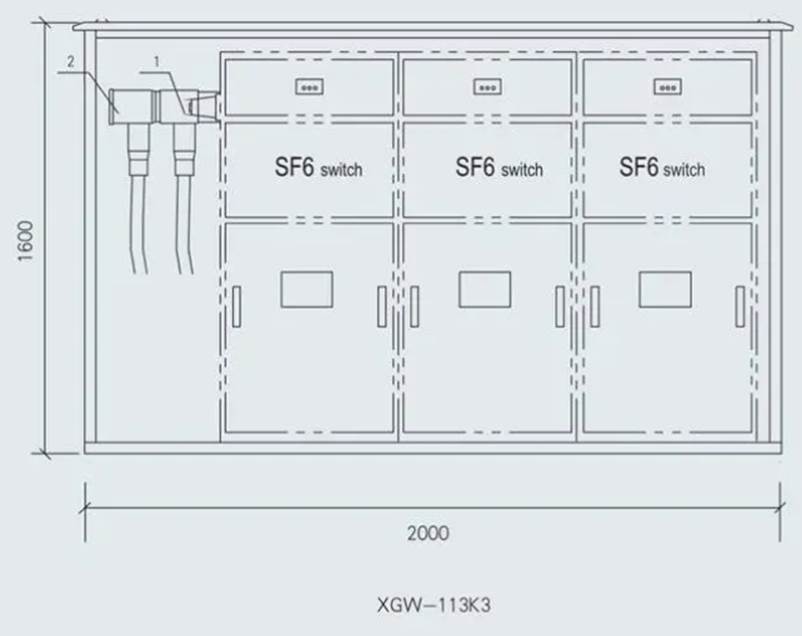
Where RMUs Are Used
- Urban and suburban secondary substations, kiosks and pad-mounted substations
- Commercial buildings, hospitals, shopping centers and campuses
- Industrial plants with an internal MV ring
- Solar parks and wind farms, where RMUs connect inverter stations and turbines into collection rings
- Data centers, EV charging hubs, airports, railways and ports
- Mining and infrastructure projects with rugged, compact switchgear needs
Benefits of a Ring Main Unit
- Higher supply continuity – faults are isolated to one cable section and supply is restored from the other side of the ring.
- Compact footprint – a three-way RMU is often only about 1 m wide, which suits kiosks and crowded urban sites.
- Operator safety – sealed live parts, integrated earthing, mechanical interlocks and internal arc classification.
- Low maintenance – sealed tanks need no work on the primary circuit for the life of the unit. Mechanisms and indicators still need periodic checks.
- Fast installation – the unit is delivered factory-tested and connected with plug-in cable terminations.
- Ready for automation – motor operators, sensors and an RTU can be added for remote control and fault location.
Limitations to keep in mind
An RMU is optimized for distribution duty. Its ring switches cannot interrupt short-circuit current, busbar ratings rarely exceed 630 A, and non-extensible designs cannot be enlarged later. For primary substations, large industrial incomers or feeders above these ratings, conventional circuit-breaker switchgear is the better fit.
Frequently Asked Questions
What is the RMU full form in electrical engineering?
RMU stands for Ring Main Unit, a compact MV switchgear assembly used to connect transformers and customers to a cable ring network.
Is an RMU the same as a circuit breaker?
No. An RMU is an assembly. Its ring switches are load break switches, and its transformer feeder may use fuses or a circuit breaker.
What voltage is an RMU?
Ring main units are medium-voltage equipment, typically rated 12, 24 or 36/40.5 kV for networks from about 6 to 35 kV.
Does an RMU need maintenance?
The sealed primary parts are largely maintenance-free, but mechanisms, interlocks, indicators, cable terminations and the room environment should be inspected regularly.
Work with METTZ Group
METTZ Group offers a wide range of medium-voltage switchgear to suit many needs – from compact ring main units in gas-insulated and solid-insulated designs to complete prefabricated substations for urban, industrial, mining and tropical projects. Check out our website to learn more, or contact METTZ Group today to work with a representative.
