
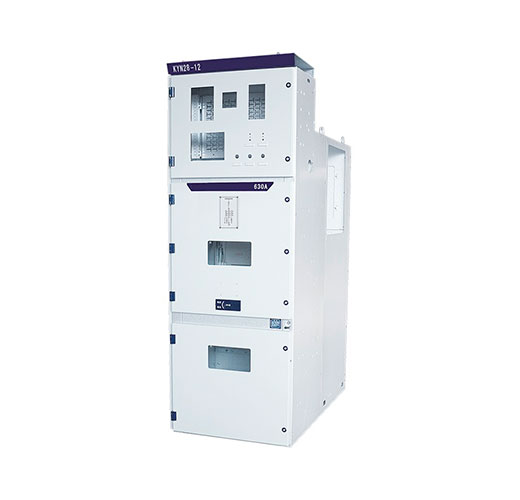
“Metal-clad” and “metal-enclosed” sound like two grades of steel box, but they are defined construction types in the North American standards, and IEC replaced both words with performance classes years ago. This guide explains what each ANSI/IEEE term really requires, how to translate it into IEC 62271-200 language (LSC2B, PM/PI, IAC), and how to write a specification that buyers on either side of the Atlantic will read the same way.
Why the Terms Cause So Much Confusion
Many comparison tables online state that metal-enclosed switchgear is “low voltage only” or that it lasts a tenth as many operations as metal-clad. Neither is true. The difference is about how the inside of the line-up is divided and what can be removed, not about voltage or breaker endurance. Three points clear up most of the confusion:
- In ANSI/IEEE practice, metal-enclosed is the umbrella term. Metal-clad is a specific, stricter subset of metal-enclosed switchgear.
- Both types exist in the medium-voltage range (roughly 4.76 kV to 38 kV in ANSI ratings).
- IEC 62271-200 calls all AC switchgear from above 1 kV up to and including 52 kV “metal-enclosed”. It does not use “metal-clad” as a category at all. Instead it classifies service continuity, partition material and internal arc performance.
The ANSI/IEEE View
Metal-clad switchgear (IEEE C37.20.2)
To be called metal-clad under IEEE C37.20.2, an assembly must have all of the following features:
- A removable (draw-out) main switching device, normally a circuit breaker, with self-aligning primary and secondary disconnects.
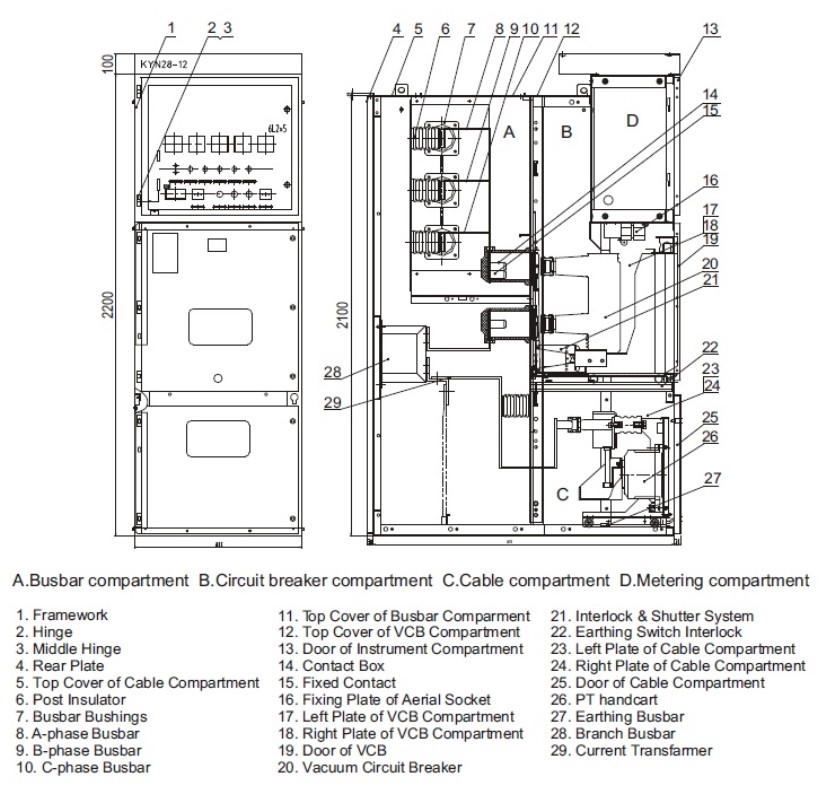
- Major primary parts in separate grounded metal compartments: the breaker, the main bus, and the incoming/outgoing cable or bus connections, plus voltage transformers and control power transformers where fitted.
- Automatic shutters that cover the primary stabs when the breaker is moved out of the connected position.
- Insulated primary bus and connections: conductors are covered with insulating material, not just held on insulators in air.
- Mechanical interlocks that enforce the correct operating sequence, such as preventing the breaker from being racked in or out while closed.
- Low-voltage devices isolated by grounded metal barriers: relays, meters and control wiring sit in their own compartment, away from primary circuits.
Typical ANSI ratings are 5, 15, 27 and 38 kV classes, with continuous currents of 1200, 2000 and 3000 A, and higher with forced cooling.
Metal-enclosed interrupter switchgear (IEEE C37.20.3)
Metal-enclosed interrupter switchgear (often shortened to MEI) is built around load-interrupter switches, usually combined with current-limiting power fuses for fault protection. It may use circuit breakers in some designs, but they are typically fixed rather than draw-out. The standard requires a grounded metal enclosure and interlocks, but it does not require:
- a full metal compartment around every major component,
- insulated bus, or
- a withdrawable main device with shutters.
The result is a simpler, smaller and less expensive line-up that suits transformer primaries, feeder sectionalizing and many commercial or light-industrial services. For low-voltage assemblies, North American practice uses a separate standard, IEEE C37.20.1, for metal-enclosed low-voltage power circuit breaker switchgear.
Arc resistance is a separate rating
Neither metal-clad nor metal-enclosed construction guarantees that people standing in front of the gear are safe during an internal arc. That is tested separately to IEEE C37.20.7, which assigns accessibility types such as Type 1 (front only), Type 2 (front, back and sides) and suffixes B and C for an open instrument compartment and arc containment between compartments.
The IEC View: IEC 62271-200 Classes
The 2003 edition of IEC 62271-200 dropped the old IEC terms “metal-clad”, “compartmented” and “cubicle”, because they described construction but not what users actually care about. Today an IEC switchgear rating describes four things.
1. Loss of service continuity (LSC)
LSC tells you what else must be de-energized when you open an accessible compartment of one functional unit.
- LSC1: other functional units, or the busbar, must be switched off. Typical for very compact fixed designs.
- LSC2: the busbar and all other functional units can stay in service.
- LSC2A: as LSC2, but the cable compartment of the unit being worked on must also be de-energized.
- LSC2B: as LSC2, and in addition the cable compartment can remain energized while the switching-device compartment is opened. This needs separate busbar, switching-device and cable compartments.
2. Partition class (PM or PI)
- PM: partitions and shutters between open compartments and live parts are metallic and earthed.
- PI: at least some partitions or shutters are made of insulating material.
3. Accessibility of compartments
Each compartment is labelled interlock-controlled, procedure-based, tool-based or non-accessible. This tells operators who may open it and under what conditions.
4. Internal arc classification (IAC)
IAC states who is protected (A = authorized personnel only, B = general public), which sides are accessible (F = front, L = lateral, R = rear), and the tested arc current and duration. A typical marking reads IAC AFLR 25 kA 1 s.
Mapping ANSI Terms to IEC Classes
There is no official one-to-one conversion, because ANSI prescribes construction while IEC rates performance. The table shows the closest practical equivalents.
| Feature | ANSI metal-clad (C37.20.2) | ANSI metal-enclosed interrupter (C37.20.3) | Closest IEC 62271-200 description |
|---|---|---|---|
| Main device | Draw-out circuit breaker | Load-interrupter switch, often with fuses; usually fixed | Withdrawable breaker vs fixed switch or switch-fuse |
| Compartments | Separate breaker, bus, cable and LV compartments | Not all required | LSC2B (metal-clad style) vs LSC1 or LSC2A |
| Partitions and shutters | Grounded metal, automatic shutters | Not required between all parts | PM vs PI |
| Bus insulation | Insulated bus required | Bare bus allowed | Not specified; state it in the tender |
| Internal arc | Optional, to C37.20.7 | Optional, to C37.20.7 | Optional IAC rating, e.g. AFLR 31.5 kA 1 s |
| Typical use | Utility and industrial main distribution, motor and generator feeders | Transformer primaries, sectionalizing, commercial services | Same split applies |
In short, a withdrawable IEC panel rated LSC2B-PM with an IAC rating is functionally the closest thing to ANSI metal-clad gear. A fixed load-break switch panel rated LSC2A or LSC1, often PI, is closer to metal-enclosed interrupter switchgear. Note that an IEC rating says nothing about insulated busbars, so specify them separately if your users expect that ANSI feature.
Practical Differences on Site
Service continuity and maintenance
With draw-out breakers in LSC2B compartments, a faulty breaker can be racked out and swapped for a spare in minutes, while the busbar and neighbouring feeders stay live. Fixed-switch designs usually need a longer outage, and sometimes a bus outage, for the same work.
Footprint and cost
Full compartmentalization takes space. Metal-clad style panels are often deeper and heavier, and they cost more per feeder. Metal-enclosed switch-fuse panels are compact and can be a sensible choice where feeders are few and fault levels moderate.
Protection capability
A circuit breaker with protective relays can trip on overcurrent, earth fault, differential and many other functions, and it can reclose. A fuse-switch combination clears faults fast but must have its fuses replaced after operating, and it offers fewer protection options.
How to Choose
- Choose metal-clad style (withdrawable, LSC2B-PM) for main incoming switchboards, generator and large motor feeders, data centres, hospitals, process plants and utility primary substations, where downtime is expensive and switching is frequent.
- Choose metal-enclosed switch or switch-fuse panels for transformer feeders in secondary distribution, small commercial services and sites with simple radial feeds.
- Always specify IAC separately when people work in or pass through the switchroom. Construction type alone does not prove arc safety.
- Write both languages into international tenders, for example: “withdrawable vacuum circuit breaker, LSC2B, PM, IAC AFLR 25 kA 1 s, insulated busbars”.
Frequently Asked Questions
Is all metal-clad switchgear also metal-enclosed?
Yes. In ANSI/IEEE terminology metal-clad is a subset of metal-enclosed switchgear with additional requirements for compartments, shutters, insulated bus and a draw-out main device.
Does IEC 62271-200 recognize metal-clad switchgear?
Not as a category. Since 2003 IEC uses LSC, partition class, accessibility and IAC instead. A withdrawable LSC2B-PM panel is the usual equivalent.
Is metal-enclosed switchgear only for low voltage?
No. Metal-enclosed interrupter switchgear is common up to 38 kV, and IEC applies the term to all switchgear above 1 kV and up to 52 kV.
Does metal-clad mean arc-resistant?
No. Arc resistance is a separate tested rating: IEEE C37.20.7 in ANSI markets and IAC under IEC 62271-200.
Work with METTZ Group
METTZ Group offers a wide range of medium-voltage switchgear to suit many needs, from compact load-break switch panels to withdrawable vacuum circuit breaker line-ups, including air-insulated and solid-insulated designs. Check out our website to learn more, or contact METTZ Group today to work with a representative.
