
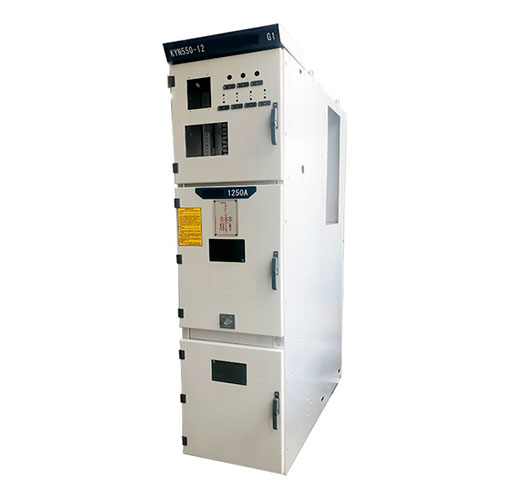
A medium-voltage switchgear nameplate packs the whole electrical design into a few lines of symbols. This guide explains each rating defined in IEC 62271-1 and IEC 62271-200, shows typical values, and lists the checks to make before connecting a panel to your network.
Why the Nameplate Matters
The nameplate is the manufacturer’s legal statement of what the equipment has been type-tested to do. Engineers use it to confirm that a panel matches the network voltage, the load current and the fault level at its location. Inspectors use it to verify compliance. Maintenance teams use it to order spares and check limits years later. Misreading one value, for example the short-time current duration, can leave a panel underrated for the fault it may one day have to survive.
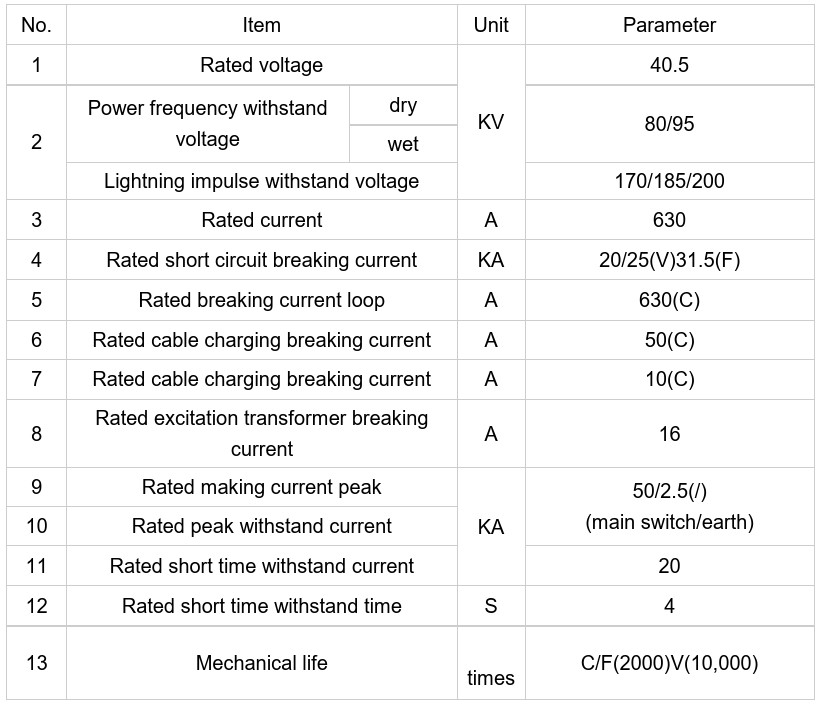
The Core Ratings at a Glance
| Symbol | Name | What it tells you | Typical values |
|---|---|---|---|
| Ur | Rated voltage | Highest system voltage the equipment is designed for | 7.2, 12, 17.5, 24, 36, 40.5 kV |
| Ud | Rated power-frequency withstand voltage | 1-minute AC test voltage the insulation must withstand | 28 kV at 12 kV; 50 kV at 24 kV; 70 kV at 36 kV |
| Up | Rated lightning impulse withstand voltage (BIL) | Peak of a 1.2/50 µs impulse the insulation must withstand | 75 kV at 12 kV; 125 kV at 24 kV; 170 kV at 36 kV |
| fr | Rated frequency | System frequency | 50 or 60 Hz |
| Ir | Rated normal current | Continuous current without exceeding temperature limits | 630, 1250, 2500, 3150 A |
| Ik | Rated short-time withstand current | RMS fault current the equipment carries without damage | 16, 20, 25, 31.5, 40 kA |
| tk | Rated duration of short circuit | How long Ik can be carried | 1 s (preferred) or 3 s |
| Ip | Rated peak withstand current | First peak of the fault current | 2.5 × Ik at 50 Hz; 2.6 × Ik at 60 Hz |
Voltage Ratings: Ur, Ud and Up
Rated voltage, not system voltage
Ur is the maximum voltage of the system, not its nominal value. A 10 kV or 11 kV network uses 12 kV equipment; a 20 kV or 22 kV network uses 24 kV equipment; a 33 kV network uses 36 kV equipment (40.5 kV in some markets). Choosing equipment with Ur equal to the nominal voltage is a common and serious mistake.
Insulation level
Ud and Up together form the rated insulation level. IEC 62271-1 offers more than one impulse level for some voltages (for example 60 kV or 75 kV at 12 kV). The higher value is normally chosen for overhead-line-connected or lightning-exposed networks. Many nameplates also give the higher values that apply across the isolating distance of disconnectors.
In ANSI markets the equivalent term is BIL, and metal-clad switchgear to IEEE C37.20.2 uses classes such as 4.76 kV / 60 kV BIL, 15 kV / 95 kV BIL, 27 kV / 125 kV BIL and 38 kV / 150 kV BIL.
Altitude
Insulation ratings apply up to 1,000 m. If the nameplate or documentation states a higher site altitude, check that the insulation was corrected for it.
Current Ratings: Ir, Ik, tk and Ip
Rated normal current
Ir applies at the standard ambient (40 °C maximum, 35 °C 24-hour average) and at the stated IP rating. A panel may carry several values: one for the main busbar and one for each feeder. Compare them with the real load plus growth margin.
Short-time and peak withstand
Ik and tk describe thermal strength. Because thermal stress (I²t) scales directly with time at the same current, “25 kA 3 s” withstands three times the thermal energy of “25 kA 1 s”. Ip describes mechanical strength against electromagnetic forces at the first current peak. Both must be equal to or higher than the values calculated for the installation point.
For a circuit breaker panel, the nameplate also gives the rated short-circuit breaking current Isc and the rated short-circuit making current, which equals Ip. These belong to the switching device and are proven under IEC 62271-100. Our range of vacuum circuit breakers lists these values for each model.
Safety and Service Classifications
IAC: internal arc classification
A marking such as IAC AFLR 25 kA 1 s means the panel has passed an internal arc type test protecting authorized personnel (A) at the front, lateral sides and rear (FLR), at 25 kA for 1 s. “IAC AF” protects the front only. If no IAC is shown, the panel was not tested for internal arcs.
LSC: loss of service continuity
The LSC category tells you what stays energized when one compartment is opened for access:
- LSC1: other functional units may have to be de-energized.
- LSC2: the busbar and other functional units can stay in service while a main-circuit compartment of one unit is opened. Variants such as LSC2A and LSC2B, used in many datasheets, indicate whether cable compartments can also stay energized.
Partition class
PM means metallic partitions and shutters between compartments; PI means insulating ones. PM gives earthed barriers between open and live compartments.
Other common markings
- Degree of protection, for example IP4X for the enclosure and IP2X for partitions.
- Service conditions, such as “minus 5 indoor” or “minus 25 outdoor”.
- Insulating gas type, mass and global warming potential for gas-insulated units; EU F-gas rules require this information to be labelled.
- Rated supply voltage of auxiliary and control circuits, such as 110 V DC or 220 V AC.
- Standard reference, serial number, year of manufacture and total mass.
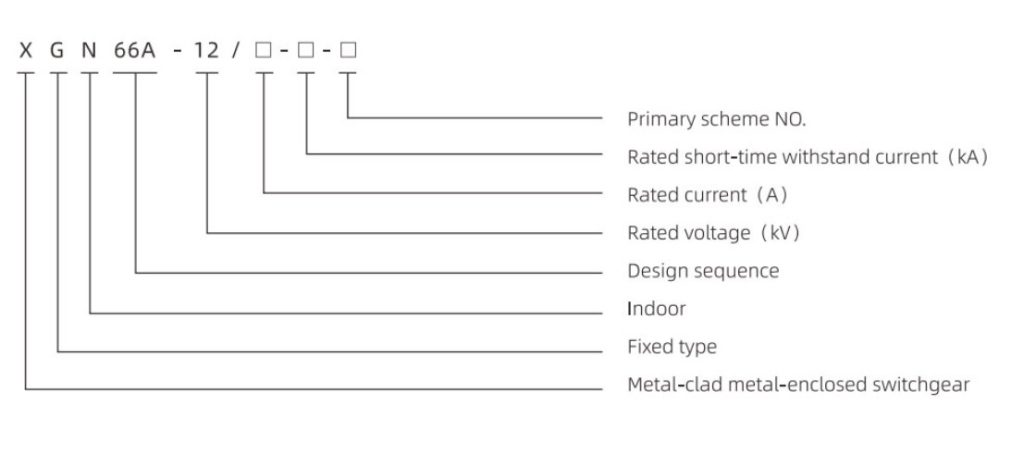
Sample Nameplate, Decoded
| Line on the plate | Interpretation |
|---|---|
| IEC 62271-200 | Metal-enclosed switchgear, 1 to 52 kV |
| Ur 24 kV / Ud 50 kV / Up 125 kV | Suitable for a 20 kV or 22 kV network |
| fr 50 Hz | 50 Hz system |
| Ir 1250 A (busbar) / 630 A (feeder) | Continuous current limits |
| Ik 25 kA / tk 3 s / Ip 63 kA | Withstands a 25 kA fault for 3 s with a 63 kA first peak |
| IAC AFLR 25 kA 1 s | Arc-resistant on all accessible sides for authorized staff |
| LSC2, PM | Busbar stays live during feeder compartment access; metallic partitions |
| IP4X | Protected against 1 mm objects |
Five Checks Before You Connect
- Ur is equal to or above the highest system voltage, and Up suits the lightning exposure.
- Ir covers the maximum load at the real ambient temperature.
- Ik, tk and Ip match or exceed the calculated fault level and protection clearing time.
- IAC and LSC fit the room layout and operating philosophy.
- The nameplate data match the type test reports and the purchase specification.
The same logic applies to other equipment in the room. Transformers, for example, carry different data such as impedance and vector group; see our power transformers for comparison.
Frequently Asked Questions
Is BIL the same as Up?
Yes, in practice. BIL is the ANSI/IEEE term; IEC calls it the rated lightning impulse withstand voltage, Up.
Why is Ip 2.5 times Ik?
The first peak of a fault current includes a DC offset. For the standard time constant of 45 ms at 50 Hz, the peak is about 2.5 times the RMS value; at 60 Hz the factor is 2.6.
Can I use a 1 s rated panel where protection clears in 0.5 s?
Yes, if the backup protection also clears within 1 s. The rated duration must cover the slowest realistic clearing time, including backup.
What if the nameplate has no IAC marking?
The panel has not been tested for internal arc containment. Consider additional measures such as arc flash relays and access restrictions.
Work with METTZ Group
METTZ Group offers a wide range of medium-voltage switchgear to suit many needs – from 12 kV distribution panels to 40.5 kV arc-resistant lines, each supplied with full nameplate data and test documentation. Check out our website to learn more, or contact METTZ Group today to work with a representative.
