
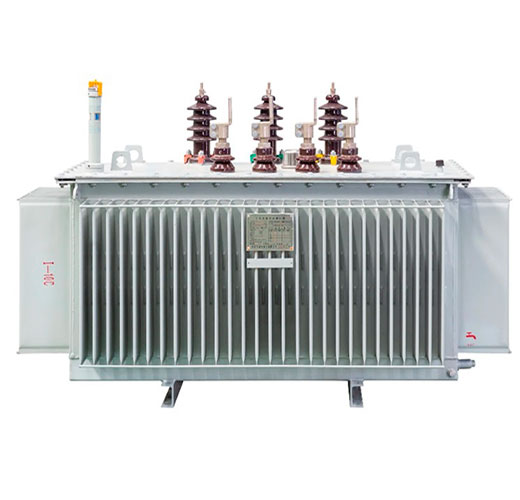
Transformers are on every street, in every substation and inside most buildings, yet few people outside the power industry know what they actually do. This guide explains the principle, the main parts, the common types and the numbers that matter when you buy one, without assuming an engineering degree.
What a Transformer Does in One Sentence
A transformer changes the voltage of an alternating current (AC) supply, either up or down, while keeping the frequency the same and passing almost all of the power through.
When voltage goes up, current goes down in the same proportion, and the other way round. Power (voltage × current) stays nearly constant, minus small losses. That is the whole trick, and it is why long-distance electricity supply is possible.
Why the Grid Cannot Live Without Transformers
Cable and line losses grow with the square of the current. Send the same power at ten times the voltage and the current falls to one tenth, so resistive losses fall to one hundredth. That is why power stations raise voltage to 110-500 kV for transmission.
Homes, shops and most machines, however, run on 230/400 V (or 120/240 V in North America). Between the two levels sit several transformer stages, each one bringing the voltage closer to what equipment can safely use. Transformers also provide galvanic isolation: the primary and secondary circuits are not electrically connected, which helps contain faults and set up a safe earthing arrangement on the low-voltage side.
The Physics, Without the Jargon
The working principle is electromagnetic induction, described by Faraday’s law: a changing magnetic field induces a voltage in any coil it passes through.
- AC flowing in the primary winding creates a magnetic field that reverses direction 50 or 60 times per second.
- A laminated steel core guides almost all of that changing magnetic flux through the second coil.
- The changing flux induces a voltage in the secondary winding. Connect a load, and current flows.
The ratio of turns sets the ratio of voltages. A transformer with 1,000 turns on the primary and 40 on the secondary turns 10 kV into roughly 400 V. Because the process depends on a changing field, a transformer does not work on steady direct current (DC). A DC supply would simply drive a large current through the primary resistance and overheat it.
What Is Inside a Transformer
Core
The core is built from thin sheets of grain-oriented electrical steel, insulated from each other to limit eddy currents. Some energy-saving designs use amorphous metal ribbon instead, which can cut no-load losses by up to about 70% compared with conventional steel.
Windings
Windings are made of copper or aluminum conductors, wrapped in paper, enamel or resin insulation. The high-voltage winding has many turns of thinner conductor; the low-voltage winding has fewer turns of heavier conductor or foil.
Insulation and cooling
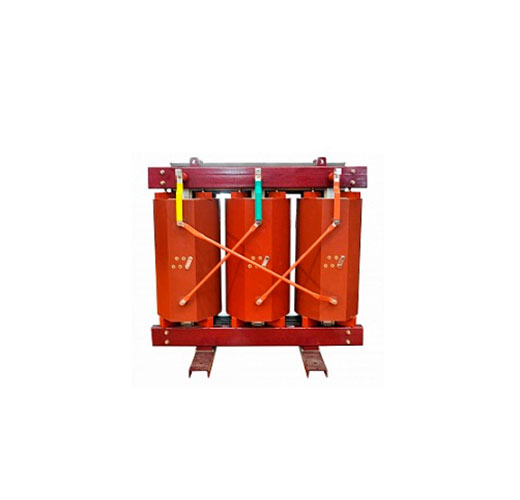
Heat from losses must be removed. In liquid-immersed units, the core and windings sit in a sealed tank of mineral oil or ester fluid that both insulates and carries heat to radiators. In dry-type units, windings are cast in epoxy resin or impregnated with varnish and cooled by air.
Accessories
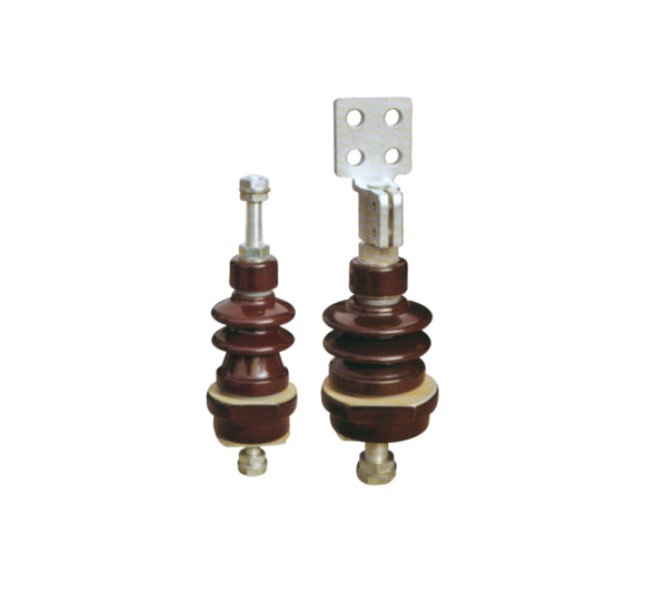
Bushings bring the conductors safely through the tank or enclosure. A tap changer adjusts the turns ratio by a few percent to correct the output voltage. Temperature sensors, pressure relief devices and, increasingly, online monitoring units protect the transformer and report its condition.
Common Types at a Glance
| Type | What it does | Typical place |
|---|---|---|
| Step-up (generator) transformer | Raises generator voltage for transmission | Power plants, wind and solar farms |
| Power transformer | Links transmission and sub-transmission voltages | High-voltage substations |
| Distribution transformer | Steps medium voltage (e.g. 10-35 kV) down to 400 V | Poles, kiosks, building substations |
| Instrument transformer (CT/VT) | Scales current or voltage for meters and relays | Switchgear and substations |
| Special transformers | Rectifier, furnace, earthing, traction and isolation duties | Industry, railways, data centres |
Transformers are also classed by phase. Single-phase units serve light rural and residential loads; three-phase units carry almost all industrial and commercial power.
Losses and Efficiency: Why They Matter to Buyers
Large transformers are among the most efficient machines ever built, often above 99%. Even so, they run around the clock for 30 years or more, so small losses add up to large energy bills.
- No-load (core) losses occur whenever the transformer is energized, even with no load. They depend on core material and design.
- Load (copper) losses rise with the square of the load current and heat the windings.
Regulators now set minimum performance. In the European Union, the Ecodesign regulation for transformers reached its stricter Tier 2 limits in July 2021, capping both loss types for most distribution and power units. The IEC 60076 series defines how losses, temperature rise and other ratings are specified and tested, and IEC TS 60076-20 offers a framework for energy efficiency. Many utilities outside Europe now ask for similar loss levels in their tenders, and buyers increasingly compare offers using total cost of ownership (purchase price plus capitalized losses) rather than price alone.
How to Read a Transformer Nameplate
- Rated power (kVA or MVA): the continuous apparent power the unit can deliver within its temperature limits.
- Rated voltages: for example 11/0.4 kV, primary first.
- Vector group: for example Dyn11, describing winding connections and phase shift.
- Short-circuit impedance (%): limits fault current and affects voltage drop.
- Cooling class: for example ONAN for oil-natural air-natural, or AN for a dry-type unit.
- Insulation and temperature class: limits that protect the insulation over its service life.
Where Transformers Are Heading
Demand for transformers has grown sharply with renewable generation, battery storage, EV charging hubs and data centres. Three trends stand out: lower-loss cores (including amorphous metal) to meet efficiency rules, biodegradable ester fluids that reduce fire and spill risk, and digital monitoring that streams temperature, load and gas data to the operator so problems can be caught early.
Frequently Asked Questions
Can a transformer change AC to DC?
No. A transformer only changes AC voltage levels. Converting to DC needs a rectifier, which is often fed by a dedicated rectifier transformer.
Why do transformers hum?
The core steel changes shape very slightly as the magnetic field reverses (magnetostriction). This vibration at twice the supply frequency produces the familiar hum.
How long does a transformer last?
A well-loaded, well-maintained unit typically serves 30-40 years. Insulation life depends mainly on operating temperature and moisture.
Is a bigger transformer always better?
No. An oversized unit runs at light load most of the time, so its no-load losses dominate. Correct sizing gives the lowest lifetime cost.
Work with METTZ Group
METTZ Group offers a wide range of transformers to suit many needs – from compact dry-type distribution units to oil-immersed power transformers up to 220 kV, including versions for mining and tropical conditions. Check out our website to learn more, or contact METTZ Group today to work with a representative.
