
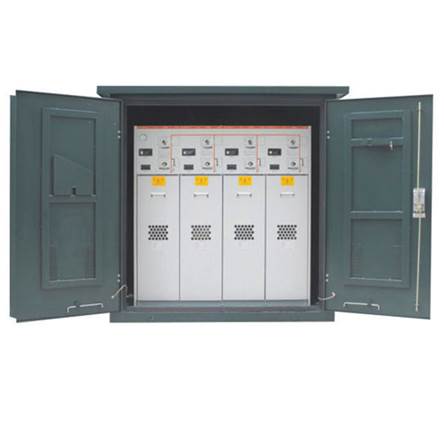
City networks need medium-voltage switchgear that is compact, safe around the public and reliable for decades. Two families dominate: the ring main unit (RMU) and metal-clad switchgear. They are not competitors so much as tools for different points in the network. This article compares them on ratings, space, safety, maintenance and cost, and shows where each one fits best.
Two Different Jobs in the Same Network
An urban MV network has a clear hierarchy. Primary substations take power from the HV grid (for example 110 kV) and distribute it at 10-20 kV through dozens of outgoing feeders. Those feeders run as cable rings through hundreds of secondary substations, each with a transformer that supplies a block of homes, offices or shops at low voltage.
- Metal-clad switchgear lives mainly at the primary substation and at large consumers. It switches and protects every feeder with a circuit breaker.
- Ring main units live at the secondary substations along the ring. They pass the ring through and protect one or two transformers.
Understanding that split avoids most specification errors: an RMU is undersized as a primary substation board, and metal-clad switchgear is oversized and over-priced in a street kiosk.
Quick Definitions
Ring main unit
A compact, factory-assembled, usually sealed MV switchgear assembly to IEC 62271-200, typically with two load break switches for the ring cables and a fuse-switch or circuit breaker for the transformer. Ratings are typically 12-40.5 kV, 630 A and 16-25 kA.
Metal-clad switchgear
Switchgear in which the main components, such as the circuit breaker, busbars and cable connections, sit in separate compartments with earthed metal partitions, and the circuit breaker is normally withdrawable. In IEC 62271-200 terms this corresponds to partition class PM with loss of service continuity category LSC2B. In ANSI markets “metal-clad” is a formal category defined by IEEE C37.20.2. Our separate article on metal-clad vs metal-enclosed switchgear explains the terminology in depth.
Side-by-Side Comparison
| Criterion | Ring main unit | Metal-clad switchgear |
|---|---|---|
| Typical location | Secondary substations, kiosks, building transformer rooms | Primary substations, large industrial and commercial incomers, data center MV boards |
| Main switching device | Load break switches; fuse-switch or VCB for the transformer | Circuit breaker (usually vacuum) on every feeder |
| Busbar rated current | Typically 630 A | 1,250 A to 4,000 A |
| Short-circuit rating | 16-25 kA | 25-50 kA |
| Number of circuits | 2-5 functional units | From a few to several dozen panels |
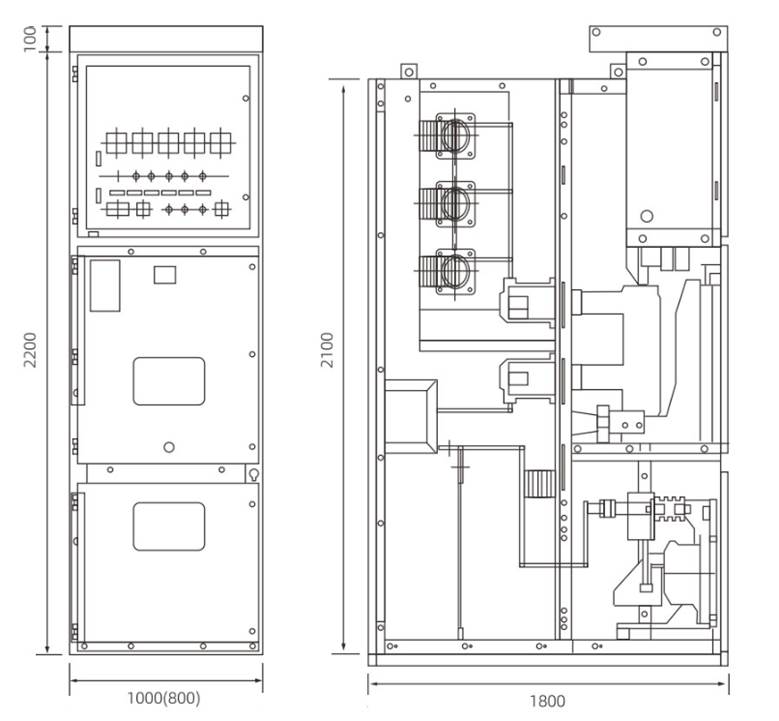
| Footprint | About 1-1.5 m wide for a 3- or 4-way unit, shallow depth | Each panel 600-1,000 mm wide, deeper, plus front space for breaker withdrawal |
| Insulation | Mostly sealed: gas, dry air or solid insulation | Usually air-insulated with metal partitions; gas-insulated versions exist |
| Service continuity during maintenance | Limited; work on one function may require de-energizing the unit | High; one breaker can be withdrawn while the busbar and other feeders stay live |
| Protection | Fuses or self-powered relays for the transformer | Full numerical relays per feeder, busbar protection, metering |
| Maintenance | Low; sealed primary circuit | Regular breaker and contact maintenance, but easy access |
| Cost per circuit | Low | Higher |
Why RMUs Dominate the Urban Edge
Most of the MV equipment in a city sits in secondary substations, and there the RMU’s advantages matter most:
- Space – urban plots are expensive. A compact RMU fits in a small kiosk, a basement corner or a prefabricated substation alongside the transformer and LV board.
- Safety near the public – sealed, earthed enclosures, interlocked operation and internal arc classification (for example IAC AFL) protect people even in a kiosk next to a sidewalk.
- Environmental immunity – sealed tanks are not affected by dust, humidity, condensation or flooding in the way open air-insulated equipment is.
- Low maintenance at many sites – a network operator may run thousands of secondary substations. Equipment that needs only periodic visual checks keeps operating costs down.
- Automation-ready – motorized RMUs with fault passage indicators and RTUs allow remote fault isolation and restoration in minutes.
Where Metal-Clad Switchgear Is the Right Answer
Metal-clad switchgear earns its higher price where many circuits meet and high currents flow:
- Primary substations feeding 10-30 outgoing cable rings, with transformer incomers, a bus coupler and metering.
- Large consumers such as hospitals, data centers, airports, metro systems and industrial plants that take supply at MV and distribute internally to many transformers and motors.
- Applications with frequent switching of motors, capacitor banks or generators, where vacuum circuit breakers and contactors are needed on each circuit.
- Critical sites that must keep most of the board energized while one breaker is maintained or replaced. A withdrawable breaker can be swapped in minutes.
Safety: Different Approaches, Same Goal
Both families can achieve a high level of operator safety, but they get there differently.
- RMUs rely on sealing and simplicity: live parts are inside an earthed tank, operation is from the front through interlocked mechanisms, and there are few moving parts to maintain.
- Metal-clad switchgear relies on compartmentalization: metallic partitions and automatic shutters keep live busbars out of reach when a breaker is withdrawn, and an internal arc in one compartment is contained and vented away from the operator.
For both, specify an internal arc classification suited to the room and access type, check that pressure relief can be vented safely in the building, and confirm all mechanical interlocks during factory acceptance tests.
The SF6 Question in Cities
Many installed RMUs use SF6 insulation, while metal-clad switchgear is usually air-insulated with vacuum breakers. With the EU F-gas Regulation (EU) 2024/573 restricting new SF6 MV switchgear, starting with equipment up to 24 kV from 2026, many urban operators are moving to SF6-free RMUs with dry-air or solid insulation and vacuum interruption. When you compare offers, compare the insulation medium as well as the footprint and price.
Decision Guide
| If your site… | Choose |
|---|---|
| Is a secondary substation on a cable ring with one or two transformers | RMU (CCF, CCV or CCFF) |
| Has limited space or is a public-facing kiosk | RMU, possibly in a prefabricated substation |
| Needs more than about five MV circuits or busbar current above 630 A | Metal-clad switchgear |
| Requires full relay protection, metering and selectivity on every feeder | Metal-clad switchgear |
| Is a large consumer with an RMU-based utility connection and an internal MV board | Both: an RMU at the utility interface and metal-clad switchgear for internal distribution |
Frequently Asked Questions
Can a ring main unit replace metal-clad switchgear?
Only for small installations. RMUs are limited in current, short-circuit rating and number of circuits, and their ring switches cannot break fault current.
Is metal-clad switchgear safer than an RMU?
Not inherently. Both can be type-tested for internal arc and fitted with full interlocking. Safety depends on correct specification, installation and operation.
Which is cheaper for a city secondary substation?
An RMU. It costs much less per circuit and needs a smaller building or kiosk.
Can RMUs be automated like metal-clad boards?
Yes. Motor operators, sensors and an RTU make RMUs remotely controllable, which is now standard in many urban networks.
Work with METTZ Group
METTZ Group offers a wide range of medium-voltage switchgear to suit many needs – from compact ring main units for city kiosks to air-insulated circuit-breaker line-ups for primary substations, plus complete prefabricated substations. Check out our website to learn more, or contact METTZ Group today to work with a representative.
