
“Should we use an RMU or a VCB panel?” is one of the most common questions on medium-voltage projects. The two are often compared as if they were alternatives, but they are built for different jobs, and an RMU can even contain a vacuum circuit breaker. This article clears up the confusion, compares the two side by side and gives a practical way to decide.
First, Clear Up the Terms
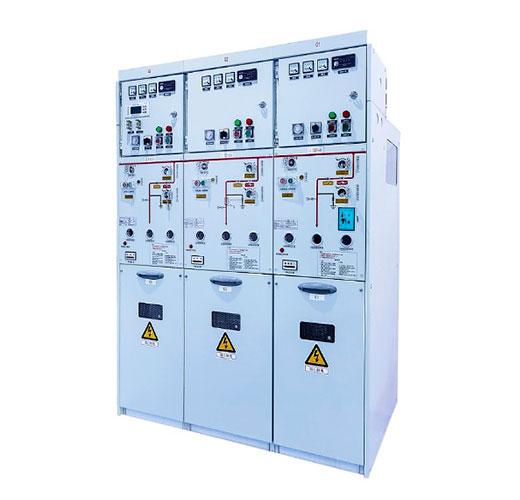
RMU (Ring Main Unit) is a compact, usually sealed MV switchgear assembly designed to connect a transformer or customer to a cable ring. Its ring connections use load break switches. Its transformer connection uses either a switch-fuse combination or a circuit breaker.
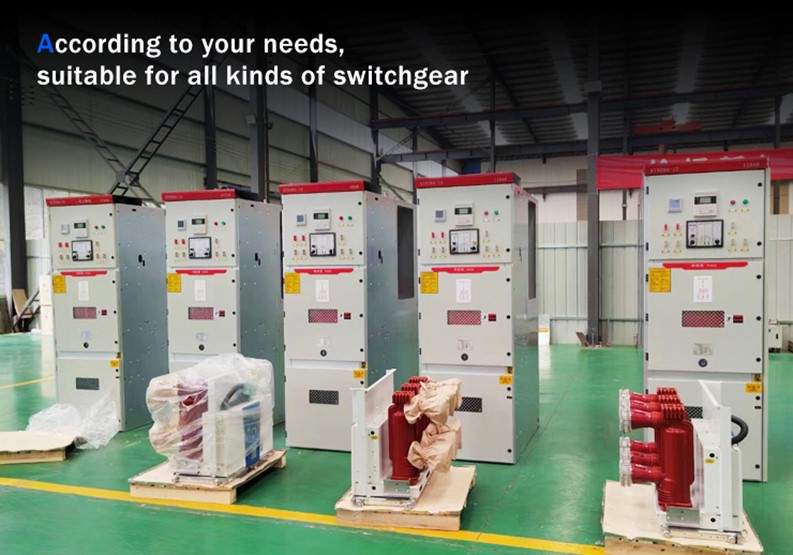
VCB panel is the everyday name for a medium-voltage switchgear panel built around a vacuum circuit breaker. The panel holds the VCB (fixed or withdrawable), current and voltage transformers, a protection relay, busbars, a cable compartment and an earthing switch. Several panels are lined up to form a switchboard.
So the real comparison is between a load-break-switch-based compact unit and circuit-breaker-based switchgear. A CCV ring main unit contains a VCB for its transformer feeder, but it is still an RMU: compact, with limited ratings and switch-based ring connections. For a broader look at switches versus breakers as devices, see our article on load break switches vs circuit breakers.
Side-by-Side Comparison
| Feature | RMU | VCB panel / VCB switchgear |
|---|---|---|
| Main switching device | Load break switches (IEC 62271-103); fuse-switch (IEC 62271-105) or VCB for the T-off | Vacuum circuit breaker (IEC 62271-100) on each circuit |
| Breaks short-circuit current? | Ring switches: no (they can make onto a fault). T-off: via fuses or VCB | Yes, on every circuit |
| Typical breaking/short-time rating | 16-25 kA | 25-40 kA, higher on request |
| Typical rated current | 630 A ring, 200-630 A T-off | 630-4,000 A |
| Protection | Fuses or a simple, often self-powered relay | Full numerical protection and control relay per panel |
| Insulation | Sealed gas, dry air or solid insulation | Usually air-insulated; gas- and solid-insulated versions exist |
| Size | Very compact; a complete 3-way unit is about 1-1.5 m wide | One panel per circuit, each typically 600-1,000 mm wide and deeper |
| Expandability | Fixed (non-extensible) or limited modular extension | Easy to add panels to the line-up |
| Maintenance | Minimal on sealed parts; check mechanisms and indicators | Periodic breaker servicing; withdrawable design gives easy access |
| Auxiliary supply | Often not needed for basic operation | Usually needs a DC battery system for relays and tripping |
| Cost | Lower per circuit | Higher per circuit, more functionality |
What the RMU Does Best
- Secondary substations on cable rings, where it loops the ring through and protects a transformer up to around 1-2 MVA.
- Sites with tight space, such as kiosks, compact substations, basements and wind turbine towers.
- Locations without permanent staff or auxiliary supply, thanks to sealed construction and self-powered protection.
- Large-scale network roll-outs, where standardized, low-maintenance units keep costs down across hundreds of sites.
What the VCB Panel Does Best
- Main incomers and outgoing feeders of primary substations, industrial plants and large buildings.
- High fault levels and high currents, where load break switches and fuses are not enough.
- Motor, generator and capacitor bank circuits that need frequent switching and dedicated protection functions.
- Complex protection schemes: directional, differential or distance protection, automatic transfer, load shedding and full metering.
- Maximum service continuity: with withdrawable breakers, one circuit can be maintained while the others stay energized.
Common Misunderstandings
“VCB panels are always more environmentally friendly”
Not automatically. Vacuum interruption avoids SF6 for switching, but the insulation medium matters too. Many RMUs now combine vacuum interrupters with dry-air or solid insulation and contain no SF6 at all. Compare the actual design, especially under the EU F-gas Regulation (EU) 2024/573.
“An RMU cannot protect anything”
Its ring switches cannot clear faults, but the T-off is fully protected by current-limiting fuses or a VCB with a relay. Faults on the ring itself are cleared by the circuit breaker at the primary substation.
“A VCB panel is just a bigger RMU”
The architecture is different: separate compartments, a circuit breaker on every circuit, instrument transformers and relays. That gives more capability, but also more space, cost and engineering.
Installation and Lifecycle Considerations
The choice also shapes the building around the equipment. An RMU usually arrives as a single factory-tested block and can be installed in a prefabricated kiosk within a day, with plug-in cable terminations. A VCB line-up needs a switchroom with a cable trench or raised floor, front space for breaker withdrawal, a pressure-relief path for internal arc gases and a DC battery system.
Over a 30- to 40-year life, a VCB panel offers easier repair and upgrade: breakers, relays and CTs can be replaced individually. A sealed RMU tank is usually replaced as a whole if the primary circuit fails, but such failures are rare.
How to Decide
Answer these questions in order:
- Where is the equipment in the network? A node on a cable ring feeding a transformer points to an RMU. A busbar feeding many circuits points to VCB switchgear.
- What is the fault level and load current? Above about 25 kA or 630 A on the busbar, choose VCB switchgear.
- How many circuits are needed now and in ten years? More than four or five MV circuits usually favors a panel line-up.
- What protection does the utility or the process require? Simple transformer protection suits an RMU. Selectivity studies, motor protection or busbar protection suit VCB panels.
- What space, staff and auxiliary supply are available? Remote, unattended and space-limited sites favor an RMU.
- What is the total cost of ownership? Include the building or kiosk, the battery system, maintenance visits and downtime, not only the equipment price.
Typical outcomes
| Project | Typical choice |
|---|---|
| Residential secondary substation, 630 kVA | RMU, CCF |
| Commercial building, 2 × 1,250 kVA transformers, utility ring connection | RMU at the utility interface (CCVV or extensible) |
| Factory with MV motors and six transformers | VCB switchgear line-up, possibly fed from a utility RMU |
| Solar park collection system | RMUs (CCV/CVV) at inverter stations, VCB switchgear at the main substation |
| Data center MV distribution | VCB switchgear with redundant incomers and automatic transfer |
In many projects the answer is “both”: an RMU where the site connects to the utility ring, and VCB switchgear for the internal distribution.
Frequently Asked Questions
Does an RMU have a VCB?
It can. RMU configurations with a “V” unit, such as CCV, include a vacuum circuit breaker for the transformer or outgoing feeder. The ring connections still use load break switches.
Which is more reliable, an RMU or a VCB panel?
Both are highly reliable when correctly specified. RMUs have fewer moving parts and sealed primary circuits. VCB panels offer more protection and easier maintenance access.
Can I use a VCB panel in a secondary substation?
Yes, but it is usually larger and more expensive than necessary for a single transformer on a ring.
What voltage range do both cover?
Both are medium-voltage equipment, commonly rated 12, 24 and 36/40.5 kV.
Work with METTZ Group
METTZ Group offers a wide range of medium-voltage switchgear to suit many needs – from compact ring main units for cable rings to indoor vacuum circuit breakers and complete VCB switchgear line-ups for substations, industry and mining. Check out our website to learn more, or contact METTZ Group today to work with a representative.
