
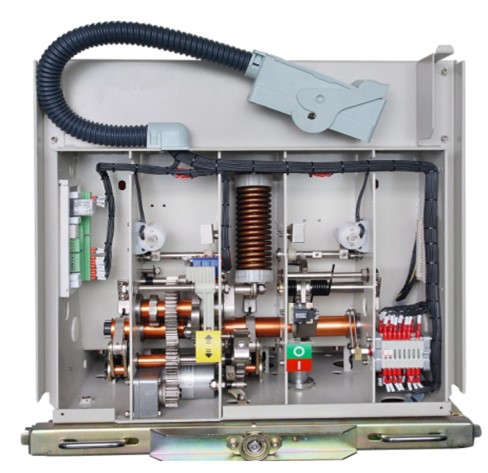
The vacuum interrupter breaks the arc, but it is the operating mechanism that opens and closes the contacts at the right speed, every time, sometimes after years of standing still. This article explains how spring-stored energy mechanisms and permanent-magnet actuators work, compares them side by side and lists the checks that keep a vacuum circuit breaker ready to trip.
What the Operating Mechanism Has to Do
A vacuum circuit breaker needs only a short contact stroke, roughly 8-12 mm at 12 kV, but the motion must be precise:
- Closing: bring the contacts together fast enough to limit pre-arcing, close against the electromagnetic forces of a short-circuit current, and compress the contact pressure springs to give the required contact force.
- Latching: hold the contacts firmly closed during normal service and through-fault currents.
- Opening: part the contacts at the right initial speed, typically around 1 m/s or more at 12 kV, so the dielectric strength of the gap recovers faster than the system voltage rises after current zero.
- Reclosing: perform the rated operating sequence, commonly O-0.3 s-CO-3 min-CO, or O-0.3 s-CO-15 s-CO for auto-reclosing duty.
- Safety: open reliably even if auxiliary power is lost, and prevent pumping (repeated close-open cycles under a standing close command).
Two mechanism families dominate MV vacuum breakers today: spring-stored energy mechanisms and permanent-magnet actuators.
Spring-Stored Energy Mechanisms
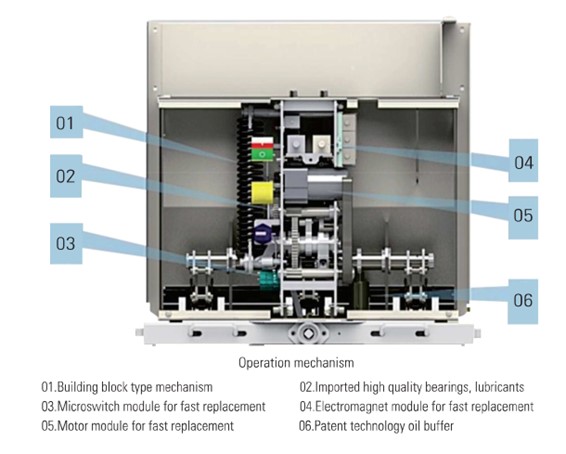
Main parts
- Closing spring: a helical or torsion spring that stores the energy for one closing operation.
- Charging motor and gearbox: a small universal or DC motor recharges the closing spring within about 10-15 s after each close. A manual charging handle is provided for loss of auxiliary supply.
- Opening springs: charged during the closing stroke, so a closed breaker always holds enough energy to open.
- Latches and trip shaft: hold the springs charged and the breaker closed until released.
- Closing coil and shunt trip coil: small solenoids that release the latches on command.
- Auxiliary devices: undervoltage release, secondary trip coil, auxiliary switches, operation counter, spring-charged indicator, anti-pumping relay and limit switches.
How it works
After the motor charges the closing spring, a latch holds it. A close command energizes the closing coil, the latch releases and the spring drives the main shaft through a linkage, closing all three poles and charging the opening springs at the same time. The motor immediately recharges the closing spring. Because one closing charge and one opening charge are stored, the breaker can perform an O-CO sequence without waiting for the motor.
When the protection relay sends a trip command, the shunt trip coil knocks out the trip latch and the opening springs drive the contacts apart. Opening times of 30-60 ms are typical.
Strengths and weaknesses
Spring mechanisms are proven over decades, work with any auxiliary voltage, can be operated fully by hand and are understood by maintenance crews worldwide. On the downside they have many parts (latches, rollers, gears, pins), need lubrication, and their timing can drift if grease hardens after long periods without operation.
Permanent-Magnet Actuators
Main parts
- Magnetic actuator: a moving armature inside a magnetic circuit with permanent magnets and one or two coils.
- Capacitor bank: stores energy for close and open operations; charged from the auxiliary supply.
- Electronic controller: manages capacitor charging, coil pulses, position sensing and self-diagnostics.
- Opening spring(s): in many designs, assist opening and provide the contact force reserve.
- Manual emergency trip: a mechanical lever to open the breaker without electrical supply.
How it works
In a bistable actuator, permanent magnets hold the armature at either end of its travel, so the breaker stays open or closed without any latch. To close, the controller discharges a capacitor into the closing coil; the armature moves, compresses the contact springs and is held by the magnets. To open, a pulse in the opposite coil (or reverse current in a single coil) weakens the holding flux and the springs and coil drive the armature back. Monostable designs hold only the closed position magnetically and use a spring to open.
Strengths and weaknesses
With typically one main moving part, magnetic actuators reach very high mechanical endurance, often tens of thousands to 100,000 operations, with almost no lubrication. Timing is highly repeatable and the controller can report its status. However, the breaker depends on charged capacitors and a working controller; manual closing is usually not possible; and the electronics must be protected from surges and extreme temperatures.
Side-by-Side Comparison
| Feature | Spring-stored energy | Permanent-magnet actuator |
|---|---|---|
| Energy storage | Mechanical springs | Capacitors plus permanent magnets |
| Number of moving parts | Many (latches, gears, linkages) | Few, often one main armature |
| Typical mechanical endurance | 10,000 operations (M2), more for special designs | Often 30,000-100,000 operations |
| Lubrication | Required, periodic | Minimal |
| Manual operation | Manual charge, close and open | Usually manual open only |
| Dependence on electronics | Low | High (controller, capacitors) |
| Timing consistency over years | Good, may drift with old grease | Very good |
| Self-diagnostics | Add-on sensors required | Often built into controller |
| Best suited for | General substations, industry, mining, retrofits, sites with limited electronics support | Frequent switching: capacitor banks, arc furnaces, reclosers, motor starting |
Control Coils: Small Parts, Big Responsibility
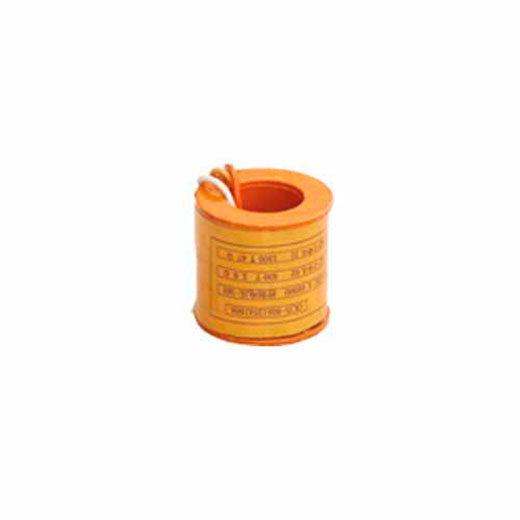
In a spring mechanism, the closing coil and shunt trip coil are the link between the protection relay and the breaker. IEC 62271-1 sets the voltage ranges within which they must operate correctly: closing releases from 85% to 110% of rated supply voltage, and shunt opening releases from 70% to 110% on DC (85% to 110% on AC). Undervoltage releases must open the breaker when the supply falls below 35% and must not operate above 70% of rated voltage.
Common coil voltages are 24, 48, 110 and 220 V DC and 110 or 230 V AC. When ordering replacement control coils, match voltage, power, duty (pulse or continuous), plunger stroke and mounting exactly. A burnt coil is often a symptom: a stuck latch or a failed auxiliary contact can leave the coil energized far longer than its short-time rating.
Keeping Mechanisms Reliable
What to measure
- Opening and closing times and pole synchronism (typically within a few milliseconds between phases).
- Travel curve: contact speed, stroke, overtravel and rebound, using a travel transducer.
- Coil current signature: changes in shape reveal sticking plungers, latch friction or low supply voltage.
- Spring charging time and motor current.
- Main circuit resistance across each pole, usually in tens of micro-ohms; a rise indicates contact wear or loose connections.
- Minimum trip voltage: confirms the trip coil operates within the IEC range.
Maintenance practice
- Operate breakers that rarely switch at least once a year to keep lubricant and latches free.
- Clean and relubricate spring mechanisms with the specified grease at intervals set by the manufacturer or after a defined number of operations.
- For magnetic actuators, check capacitor health, charging time and controller alarms; replace capacitors at the end of their rated life.
- Check auxiliary switches and the anti-pumping function after any mechanism work.
- Record every result; trends are more useful than single readings.
Digital monitoring
Breaker monitoring modules now record trip times, coil currents, operation counts and accumulated interrupted current, and send them to SCADA. This allows condition-based maintenance and early detection of a slow trip before it matters.
Frequently Asked Questions
Can a vacuum circuit breaker be operated both manually and remotely?
Yes. Spring-operated breakers can be charged, closed and tripped by hand and remotely through coils. Magnet-actuated breakers are operated electrically, with a manual emergency trip.
Why do springs remain so widely used?
They store energy without electronics, are easy to understand and repair, and work reliably in harsh or remote sites where spare electronics may be scarce.
How often should the mechanism be serviced?
Follow the manufacturer’s schedule, typically an inspection every 1-2 years and full servicing every few years or after a set number of operations, whichever comes first.
What happens if a trip coil fails?
The breaker will not open on a protection command. Critical feeders often use a second trip coil and trip-circuit supervision relays to detect open circuits.
Work with METTZ Group
METTZ Group offers a wide range of vacuum circuit breakers and mechanism components to suit many needs – from spring-operated indoor breakers and mining versions to control coils, vacuum interrupters and embedded poles. Check out our website to learn more, or contact METTZ Group today to work with a representative.
