
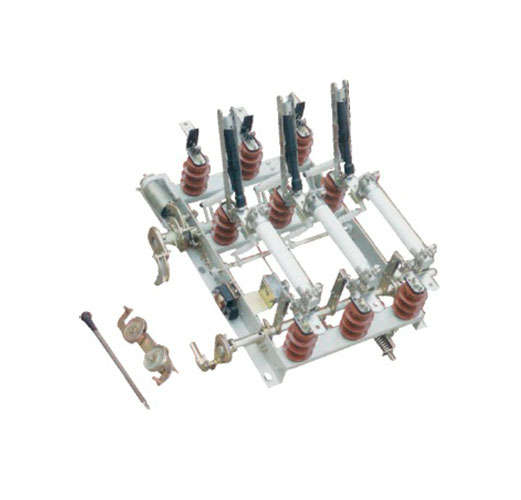
Both devices open and close medium-voltage circuits, but only one is built to break a short circuit. This article explains the difference in plain terms, shows how a switch-fuse combination closes the gap, and gives a decision checklist for feeders, transformers and ring main units.
The One-Sentence Difference
A load break switch (LBS) makes and breaks normal load currents; a circuit breaker makes and breaks normal currents and interrupts short-circuit currents up to its rated breaking capacity. Everything else follows from that.
Side-by-Side Comparison
| Feature | Load break switch | Circuit breaker |
|---|---|---|
| Main IEC standard | IEC 62271-103 (switches 1-52 kV) | IEC 62271-100 |
| Breaks load current | Yes, up to rated mainly active load-breaking current (e.g. 630 A) | Yes |
| Breaks short-circuit current | No | Yes, up to rated Isc (e.g. 20-31.5 kA) |
| Makes onto a short circuit | Yes, if it has a rated short-circuit making current (class E1-E3) | Yes, rated short-circuit making current |
| Carries short-circuit current | Yes, for its rated short-time (e.g. 1 s or 3 s) | Yes, for its rated short-time |
| Trips automatically on a fault | Only when combined with fuses having strikers | Yes, on command from a protection relay |
| Auto-reclosing | No | Yes, with suitable mechanism and relay |
| Cost and size | Lower, simpler | Higher; needs CTs, relay and auxiliary supply |
| Typical use | RMU cable rings, sectionalizing, small transformers with fuses | Incomers, feeders, large transformers, motors, generators |
How a Load Break Switch Works
An LBS has a quick-make, quick-break mechanism: a spring snaps the contacts open or closed independently of how fast the operator moves the handle. Arc control depends on the design:
- Vacuum LBS – interruption inside a small vacuum bottle, with air or solid insulation around it
- SF6 LBS – rotating-arc or puffer interruption in a sealed gas tank, common in older compact RMUs
- Air LBS – hard-gas or puffer chambers in open air-insulated panels and on overhead lines
Most MV switches are three-position devices (closed – open – earthed), which combines the load switch with an earthing switch and makes interlocking inherently safe.
Three ratings people mix up
- Short-circuit making – the switch can close onto an existing fault without welding, so the operator is protected.
- Short-time withstand – the closed switch carries fault current until an upstream device clears it.
- Short-circuit breaking – the switch does not have this rating. Only breakers and fuses do.
How a Circuit Breaker Works in an MV Panel
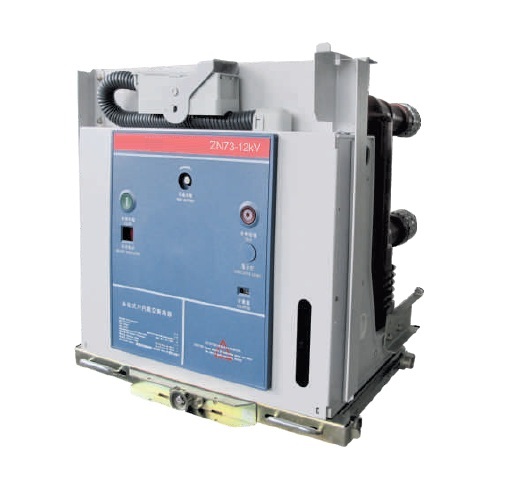
A circuit breaker panel includes current transformers, a protection relay and the breaker with its stored-energy mechanism. When the relay detects overcurrent, earth fault or another abnormal condition, it energizes the trip coil and the breaker clears the fault, usually within 40-60 ms of the trip command. The breaker can then be reclosed remotely once the fault is removed, without replacing any parts.
In new MV switchgear, the breaker is almost always a vacuum circuit breaker.
The Middle Ground: Switch-Fuse Combinations
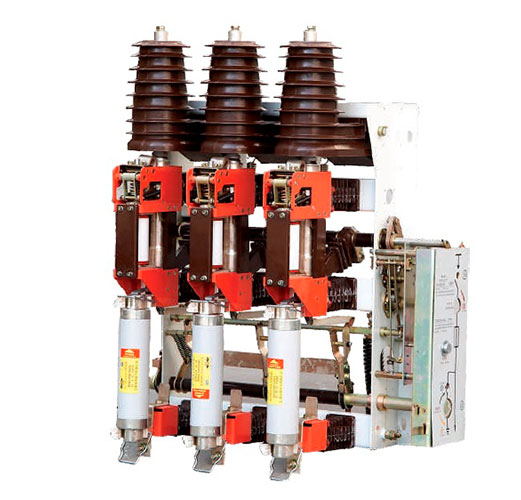
A load break switch fitted with current-limiting HV fuses (IEC 60282-1) becomes a switch-fuse combination under IEC 62271-105. The fuses clear high short-circuit currents very fast – often before the first current peak – and a striker pin in each fuse trips the switch so all three phases open together.
The combination is a cost-effective way to protect distribution transformers in RMUs and compact substations. Its limits:
- Fuses must be replaced after operating, ideally all three as a set.
- Low overloads and some earth faults below the fuse’s minimum breaking current are not cleared by the fuses alone.
- Selectivity with LV protection and transformer inrush must be checked carefully.
- Above a certain transformer size, commonly in the range of 1,000-2,000 kVA depending on voltage and utility practice, a breaker with relay protection is preferred.
Decision Checklist
- What must the device interrupt? Load current only → LBS. Fault current → breaker or fuse.
- What is the prospective fault level? Confirm short-circuit making and short-time ratings for the switch, and breaking capacity for the breaker or fuse.
- How is protection arranged? Upstream breaker, local fuses or local relay and breaker.
- How often will it switch? Frequent operation favors vacuum devices with high mechanical endurance classes.
- Is remote control needed? Both can be motorized; breakers add full relay-based automation and reclosing.
- What does the utility require? Many distribution codes specify the device type for transformer protection.
Typical Applications
- Ring main units: LBS for incoming and outgoing cable feeders; switch-fuse or VCB for the transformer tee-off.
- Overhead lines: pole-mounted LBS for sectionalizing; reclosers or outdoor VCBs for protection.
- Industrial substations: VCB incomers and motor feeders; LBS or switch-fuse for small transformers.
- Solar and wind collection grids: LBS for string or feeder isolation; breakers at the point of connection.
Frequently Asked Questions
Can a load break switch replace a circuit breaker?
Not on its own. It cannot break fault current. With correctly rated fuses it can protect smaller transformers, but it is not equivalent to a breaker with relays.
Is it safe to close a load break switch onto a fault?
Yes, if the switch has a rated short-circuit making current equal to or above the network fault level. That is why making class E2 or E3 is often specified.
What is the difference between a load break switch and a disconnector?
A disconnector provides a safe isolating gap but is operated without load. A load break switch can switch load current; a switch-disconnector does both.
Work with METTZ Group
METTZ Group offers a wide range of load break switches to suit many needs – from indoor three-position switches for RMUs and compact switchgear to outdoor units for overhead lines, alongside vacuum circuit breakers and earthing switches. Check out our website to learn more, or contact METTZ Group today to work with a representative.
