
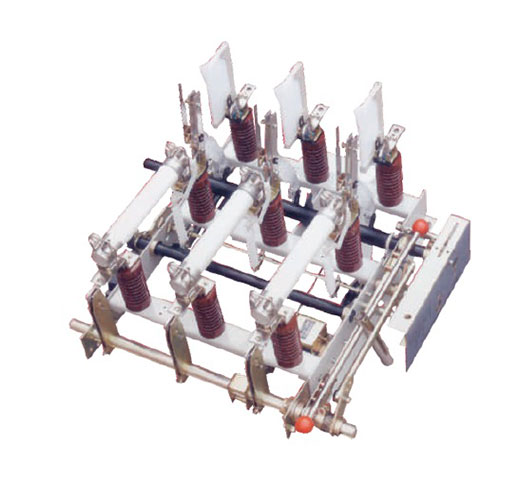
Before anyone touches a transformer, motor or busbar, the circuit must be isolated with a visible, lockable gap. This guide explains the difference between disconnectors, switch-disconnectors and circuit breakers, the IEC ratings to check, and where each device belongs from low-voltage panels to medium-voltage substations.
Three Devices, Three Jobs
The terms are often used loosely, which leads to wrong purchases and unsafe work practices. IEC standards define them clearly.
| Device | Switches load current? | Breaks short circuits? | Provides isolation? | Key standards |
|---|---|---|---|---|
| Disconnector (isolator) | No – operated off-load, or with negligible current | No | Yes, with a defined isolating distance | IEC 62271-102 (above 1 kV), IEC 60947-3 (LV) |
| Switch-disconnector | Yes, within its utilization category | No | Yes | IEC 60947-3 (LV), IEC 62271-103 (MV switches) |
| Fuse-switch-disconnector | Yes | Yes, through its fuses | Yes | IEC 60947-3 with IEC 60269 fuses |
| Circuit breaker | Yes | Yes, up to its rated breaking capacity | Only if declared suitable for isolation | IEC 60947-2 (LV), IEC 62271-100 (MV/HV) |
In short: a disconnector creates a safe gap; a switch-disconnector creates a safe gap and switches load current; a circuit breaker protects against faults. They are complementary, not interchangeable.
What Makes a Device “Suitable for Isolation”
Isolation means the circuit is separated from every source of supply so that work can be done safely. A device used for isolation must offer:
- A defined isolating distance between open contacts, tested to withstand a higher impulse voltage than the normal phase-to-earth insulation
- Reliable position indication – either visible contacts or a positively driven indicator that can only show “OFF” when all contacts are actually open
- Padlocking in the open position for lockout/tagout procedures
- Interlocks with circuit breakers, earthing switches and doors where required
Isolation alone is not enough for safe work at medium voltage. The full sequence is: disconnect, secure against reclosing, verify absence of voltage, earth and short-circuit, and protect against adjacent live parts. An earthing switch next to the disconnector handles the earthing step.
How a Switch-Disconnector Operates
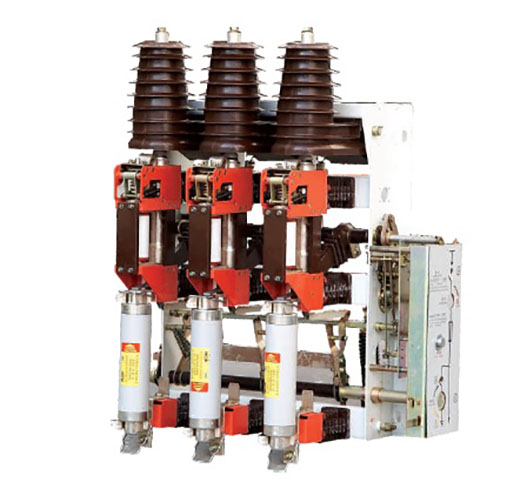
Most switch-disconnectors use a quick-make, quick-break mechanism. A spring stores energy as the handle moves and then snaps the contacts over, so the switching speed does not depend on the operator. Double-break contacts and small arc chambers handle the arc when switching load current.
Two operating options are common:
- Manual – rotary handle, door-coupled handle or front lever
- Motor-operated – for remote switching from a SCADA or building management system, with auxiliary contacts reporting position
A switch-disconnector can close onto a short circuit only within its rated short-circuit making capacity, and it relies on an upstream breaker or fuses to clear the fault. Claims that any disconnector can “close onto any short circuit with no risk” are wrong.
Low-voltage utilization categories
IEC 60947-3 rates LV switch-disconnectors by the type of load they can switch:
- AC-21 – resistive loads, including moderate overloads
- AC-22 – mixed resistive and inductive loads
- AC-23 – highly inductive loads such as motors
- DC-PV1 / DC-PV2 – DC switching in photovoltaic strings and arrays
Choosing the correct category is as important as the current rating. A switch rated 125 A in AC-21 may carry a much lower rating in AC-23.
Medium- and High-Voltage Disconnectors
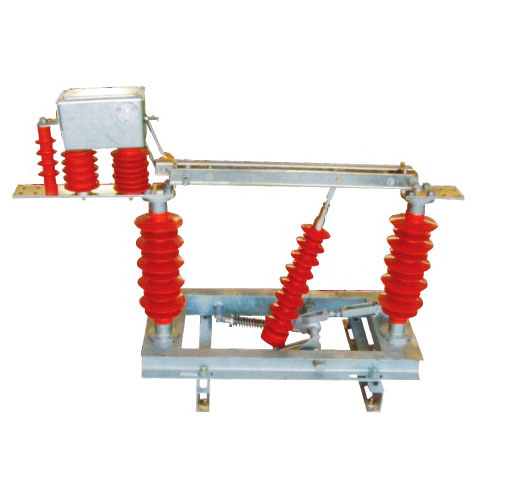
In substations, disconnectors isolate circuit breakers, transformers, busbars and lines. Typical designs include:
- Indoor disconnectors inside air-insulated switchgear panels, often combined with earthing switches
- Outdoor center-break, double-break and pantograph disconnectors for outdoor substations
- Pole-mounted disconnectors on overhead distribution lines
Because a disconnector cannot break load current, the circuit breaker must open first. Mechanical or electrical interlocks enforce this order: the breaker opens, then the disconnector opens, then the earthing switch closes. Where a section must be switched under load without a breaker, a load break switch is used instead.
Where Switch-Disconnectors Are Used
- Power distribution: main switches in LV distribution boards and switchboards; MV isolation in substations and ring main units
- Machinery and motor control centres: local isolators next to motors and machines; red-handle-on-yellow emergency switching devices on machinery as required by IEC 60204-1
- Solar PV and battery storage: DC switch-disconnectors at string combiner boxes and inverter inputs
- Data centres and telecom: isolation of UPS, PDU and busway feeds for maintenance
- Industry and mining: robust enclosed isolators for pumps, conveyors and crushers
- Buildings and infrastructure: hospitals, airports, schools and commercial buildings
Selection Checklist
- Rated operational voltage and current, including ambient temperature derating
- Utilization category (LV) or switching class (MV) matching the actual load
- Rated short-time withstand current and short-circuit making capacity at the installation point
- Coordination with the upstream breaker or fuses (conditional short-circuit current)
- Number of poles, including whether neutral switching is required
- Enclosure protection degree (IP) and mounting position
- Manual or motor operation, auxiliary contacts and padlocking
Frequently Asked Questions
Is a switch-disconnector the same as an isolator?
Not exactly. An isolator (disconnector) is operated off-load. A switch-disconnector adds the ability to switch load current while still meeting isolation requirements.
Can a switch-disconnector protect a circuit?
No. It has no overcurrent protection. Pair it with a circuit breaker or use a fuse-switch-disconnector.
Can a circuit breaker be used for isolation?
Only if the manufacturer declares it suitable for isolation, marked on the device. At MV, a separate disconnector or a withdrawable breaker is normally used.
Work with METTZ Group
METTZ Group offers a wide range of disconnectors and switching devices to suit many needs – from LV panel components to indoor and outdoor MV disconnectors, earthing switches and load break switches. Check out our website to learn more, or contact METTZ Group today to work with a representative.
