
Breakers get the attention, but the accessories around them decide whether a low-voltage switchboard survives a short circuit, runs cool and stays easy to maintain. Here is what each key accessory does, which specifications matter and what to check before you buy.
Why Accessories Matter
Under IEC 61439, the manufacturer of an assembly must verify its short-circuit strength, temperature rise, clearances, creepage distances and resistance to heat and fire. Many of those properties are set by passive parts: the supports holding the busbars, the plates the cables pass through, the hinges and locks on the doors. A switchboard built with a well-rated breaker but weak supports can still fail during the first serious fault.
Busbar Supports and Clamps
Busbar supports position the conductors, insulate them from the frame and hold them in place against electrodynamic forces. During a 65 kA fault, the force between parallel bars can reach several tonnes per meter, so the supports are a structural component as much as an insulator.
What to look for:
- Verified short-time withstand: the support arrangement should be part of a design verified at the board’s rated Icw and Ipk, for example 65 kA for 1 s or 50 kA for 3 s.
- Material: glass-fiber reinforced polyester (often called GPO-3) or similar thermoset compounds offer high mechanical strength and good tracking resistance.
- Fire behavior: flame rating UL 94 V-0 and a glow-wire test per IEC 60695-2-11 at the temperature required by IEC 61439 for parts holding current-carrying conductors.
- Flexibility: 3-pole and 4-pole versions, and slots that accept one to three bars per phase, allow the same support family to cover a wide current range.
Non-Magnetic Plates and Eddy Current Control
When heavy single-core cables or busbars of one phase pass through a steel plate, the alternating magnetic field induces eddy currents and hysteresis losses in the steel. The plate heats up, sometimes enough to damage insulation. The fix is simple: use non-magnetic materials, such as aluminium or stainless steel gland plates and partition sections, wherever high-current conductors pass through, or keep all three phases together in one opening so their fields cancel. Some designs also use aluminium sections in the top frame so the horizontal busbar can be pre-installed at the factory and connected quickly on site.
Comb Busbars and Pan Assemblies for Final Distribution
In final distribution boards, wiring dozens of MCBs and RCDs one by one is slow and error-prone. Comb busbars and pan assemblies replace that wiring with a pre-insulated copper bar that plugs directly into the device terminals.
- Ratings: pan assemblies are commonly used in boards up to about 250 A; check rated current, short-circuit withstand and the 18 mm module pitch match your devices.
- Copper quality: electrolytic copper with at least 99.9% purity keeps resistance and temperature rise low.
- Insulation: fully encapsulated bars with finger-safe ends reduce the chance of accidental contact during maintenance.
- Testing: ask for short-circuit, clearance and creepage, glow-wire, dry heat and cold tests, and RoHS compliance.
- Serviceability: plug-in designs let a technician replace one device or add a circuit without disturbing the neighbors.
Doors, Hinges, Locks and Interlocks
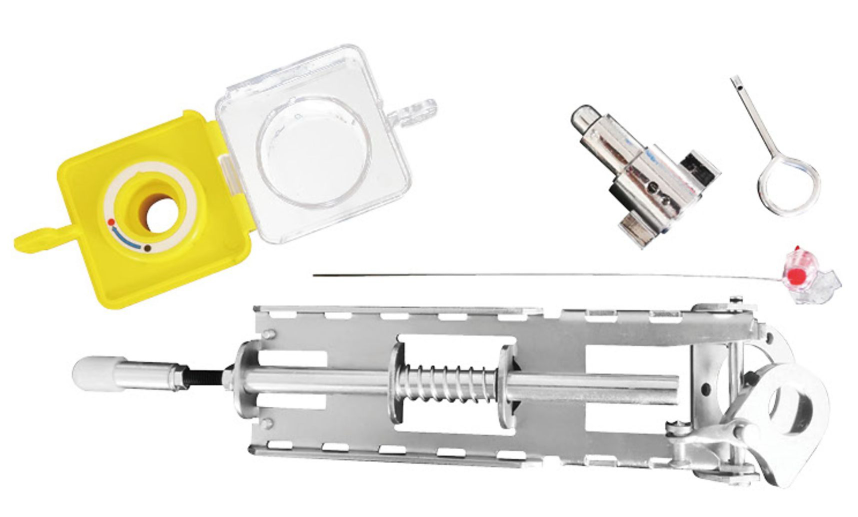
Mechanical hardware protects both people and the degree of protection (IP rating). Hinges must carry heavy doors loaded with meters and operating handles without sagging and breaking the gasket seal. Locks and handles should support padlocking and, where needed, key-transfer interlocks that force a safe operating sequence, for example preventing a bus coupler from closing while both incomers are closed. Door-coupled rotary handles let the operator switch a device without opening the door.
Shutters, Barriers and Separation Parts
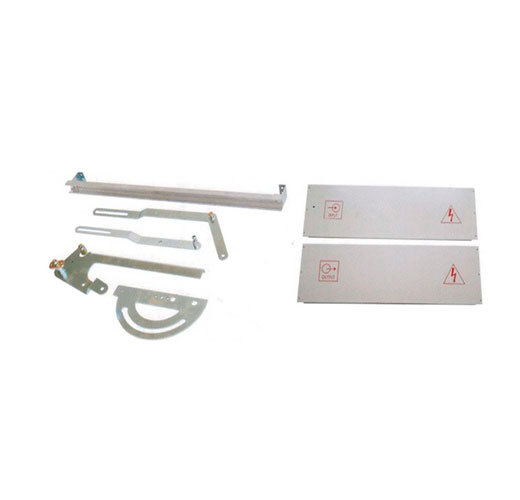
Partitions and automatic shutters create the forms of internal separation defined in IEC 61439-2. Shutters close over the busbar contacts when a withdrawable unit is removed, so a technician cannot touch live parts. Terminal shrouds and IP2X covers keep the board finger-safe when the door is open.
Monitoring and Safety Accessories
A growing share of the accessory list is electronic:
- Wireless temperature sensors on busbar joints and cable lugs detect loose connections months before they fail.
- Arc-flash detection with optical sensors and fast tripping limits arc energy to a fraction of what a conventional time delay allows.
- Surge protective devices to IEC 61643-11 protect electronics, inverters and EV chargers from lightning and switching surges.
- Humidity and condensation control with anti-condensation heaters and hygrostats, essential in tropical or mining sites.
- Communication gateways that collect breaker and meter data for a SCADA or building management system.
Quick Specification Checklist
| Accessory | Key specification | Evidence to request |
|---|---|---|
| Busbar supports | Icw/Ipk, material, V-0 rating | Design verification report for the assembly |
| Gland and partition plates | Non-magnetic where single-phase conductors pass | Drawings, material certificate |
| Comb busbar / pan assembly | Rated current, Icc, pitch, copper grade | Type test report, RoHS declaration |
| Locks and interlocks | Padlockable, key interlock sequence | Operating sequence diagram |
| Sensors and SPDs | Communication protocol, SPD type and Up | Datasheets, integration plan |
Frequently Asked Questions
Can I swap busbar supports for a different brand?
Only if the replacement has been verified in the same assembly design. Changing supports can invalidate the short-circuit verification under IEC 61439.
Why is a steel gland plate a problem for single-core cables?
The magnetic field of one phase induces eddy currents in the steel, which heats the plate. Use a non-magnetic plate or route all three phases through the same opening.
Are comb busbars suitable for main switchboards?
No. They are designed for final distribution boards with modular devices, typically up to about 250 A.
Work with METTZ Group
METTZ Group offers a wide range of LV cabinet components and accessories to suit many needs – from busbar supports and hardware to complete low-voltage cabinets and distribution boards. Check out our website to learn more, or contact METTZ Group today to work with a representative.
