
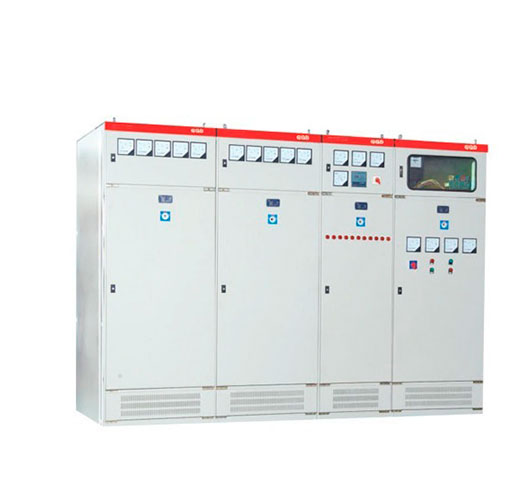
Low-voltage cabinets are often ordered by a model family name such as MNS, GCS, GCK or GGD. This guide explains what those names mean, how fixed and withdrawable designs differ, how IEC 61439 forms of separation affect safety and uptime, and how to match a cabinet type to your project.
Two Basic Choices: Fixed or Withdrawable
Before comparing model families, decide how the functional units (the breaker or starter for each circuit) are mounted. IEC 61439-2 recognizes three arrangements:
- Fixed: devices are bolted and wired in place. Replacing one requires the circuit, and often the section, to be de-energized. Lowest cost, simplest construction.
- Removable: units can be taken out and replaced while the board is live, but only after their own circuit is disconnected.
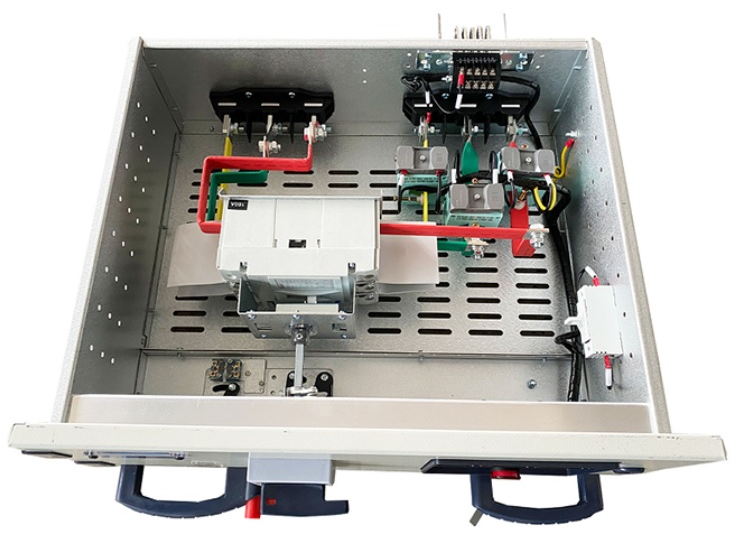
- Withdrawable: units sit in drawers or cassettes that slide between “connected”, “test” and “disconnected” positions, with mechanical interlocks. A failed feeder can be swapped in minutes.
Withdrawable designs cost more and take more space per circuit, but they pay off wherever downtime is expensive: process plants, water treatment, hospitals and data centers.
Forms of Internal Separation (IEC 61439-2)
Forms describe how barriers divide busbars, functional units and outgoing terminals inside the cabinet. Higher forms protect people from live parts and stop a fault in one unit from spreading.
| Form | What is separated | Practical effect |
|---|---|---|
| Form 1 | Nothing inside the enclosure | Whole board must be shut down for most work |
| Form 2 | Busbars separated from functional units | Busbars protected from accidental contact |
| Form 3 | Busbars and each functional unit separated; terminals shared | One unit can be worked on while others run |
| Form 4 | Busbars, each unit and each unit’s terminals all separated | Cables of one circuit can be reconnected with neighbors live |
Each form has sub-types (a and b) that depend on whether terminals sit in the same compartment as the unit and how barriers are built. Specify the form explicitly; “Form 4b” in one offer and “segregated” in another are not the same thing.
The Main Cabinet Families
MNS, GCS, GCK and GGD are widely used model designations, particularly for cabinets built in China and many export markets. Exact ratings vary by manufacturer and version, so the values below are typical ranges, not guarantees.
GGD: Fixed-Type Power Distribution Cabinet
GGD is a fixed-mounting design with a welded and bolted frame of cold-formed steel profiles, punched on a modular grid so components can be positioned flexibly. Access is front and rear. Typical ratings reach about 3,150 A on the main busbar with short-time withstand up to roughly 50 kA. GGD is a cost-effective choice for transformer incomers, capacitor sections and feeders in plants where planned shutdowns are acceptable.
GCK: Withdrawable Power Center and MCC
GCK combines power-center (PC) sections for incomers and large feeders with motor-control (MCC) sections built from drawer units. Busbars run horizontally at the top, with separate busbar, unit and cable compartments. Typical main busbar ratings are around 3,150-4,000 A. It is common in metallurgy, petrochemical and power-plant auxiliary systems where many motors are controlled from one line-up.
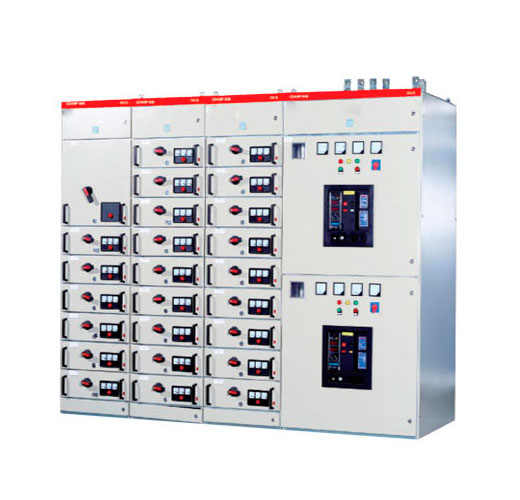
GCS: Drawer-Type Switchgear
GCS is a withdrawable design with a high density of drawer units, from half-module drawers for small motors up to multi-module drawers for larger feeders. A main busbar of up to about 4,000 A and short-time ratings in the 50-80 kA range are typical. GCS is a popular middle ground: more compact than GCK, with good interchangeability of drawers of the same size.
MNS: Modular Withdrawable System
MNS is a modular design originally developed in Europe and now widely manufactured. The frame uses C-section steel profiles on a standard modular grid, fixed with self-tapping screws or high-strength bolts instead of welding. Ratings typically reach 5,000-6,300 A on the main busbar with short-time withstand up to about 100 kA for 1 s, and degrees of protection from IP30 up to IP54. MNS suits large main switchboards and MCCs that need the highest circuit density, Form 3 or Form 4 separation and easy future expansion.
Older and Specialized Designs
PGL is an older open-frame, indoor distribution panel with rear access; it is mostly found in legacy installations. GCL is a withdrawable MCC design with five separate compartments (horizontal busbar, vertical busbar, functional units, cable room and neutral/earth bar). Beyond these families, many projects use purpose-built cabinets: soft-starter, variable-frequency drive, star-delta starter and PLC control cabinets.
Side-by-Side Comparison
| Type | Mounting | Typical main busbar | Typical Icw (1 s) | Best for |
|---|---|---|---|---|
| GGD | Fixed | Up to ~3,150 A | Up to ~50 kA | Budget projects, simple distribution |
| GCK | Withdrawable (PC + MCC) | ~3,150-4,000 A | ~50-80 kA | Heavy industry with many motors |
| GCS | Withdrawable drawers | Up to ~4,000 A | ~50-80 kA | General industry, commercial MCCs |
| MNS | Modular, fixed or withdrawable | Up to ~6,300 A | Up to ~100 kA | Large main boards, data centers, critical plants |
How to Choose
- Start from the fault level and current: transformer rating and short-circuit study set the minimum busbar and Icw ratings.
- Price downtime honestly: if a feeder outage costs more than the difference between fixed and withdrawable, choose withdrawable.
- Specify the form of separation your maintenance team needs to work safely with adjacent circuits live.
- Check the environment: dust, humidity and altitude affect IP rating, ventilation and derating, especially for mining and tropical sites.
- Plan for monitoring: leave room for meters, communication gateways and temperature sensors, even if they are added later.
- Ask for IEC 61439 design verification for the exact configuration offered, not just for the model family name.
Frequently Asked Questions
Are MNS, GCS and GGD international standards?
No. They are model designations. The governing standard for all of them is IEC 61439-1/-2 (or the national equivalent, such as GB/T 7251 in China).
Which form of separation do I need?
Form 2 is common for simple boards. Form 3b or Form 4b is typical for critical MCCs and main switchboards where circuits must be serviced live.
Can fixed and withdrawable sections be combined?
Yes. Many line-ups use fixed ACB incomer sections with withdrawable feeder or MCC sections.
Work with METTZ Group
METTZ Group offers a wide range of low-voltage cabinets to suit many needs – from fixed GGD-type distribution panels to withdrawable MNS- and GCS-type switchboards for industry, mining and tropical sites. Check out our website to learn more, or contact METTZ Group today to work with a representative.
