
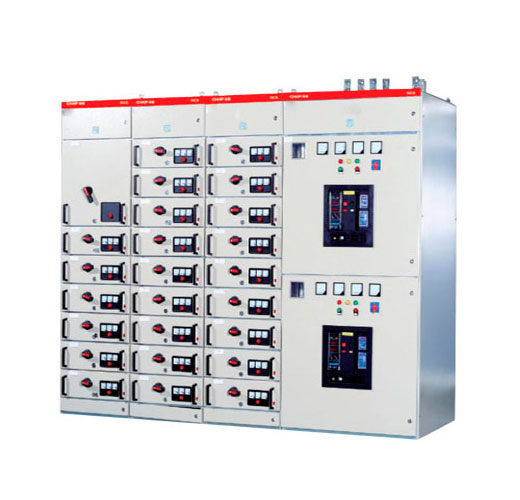
Every low-voltage switchgear panel, from a 63 A floor board to a 6,300 A main switchboard, does the same four jobs. This article walks through each one, the devices that perform it and the IEC rules that decide whether it is done properly.
How Power Flows Through the Panel
Power enters through the incomer, usually an air circuit breaker (ACB) on large boards or a moulded case circuit breaker (MCCB) on smaller ones, fed from a transformer or generator. It then travels along copper or aluminium busbars to outgoing feeders: MCCBs, fuse-switch units or motor starters. Some boards also have a bus coupler that connects two busbar sections, each with its own incomer. Feeders supply loads directly or feed downstream boards, where the cascade continues down to miniature circuit breakers (MCBs) on final circuits.
Each device in this chain has to perform one or more of the following functions. A panel that does all four well is safe to work on, clears faults quickly and tells the operator what is going on.
Function 1: Isolation
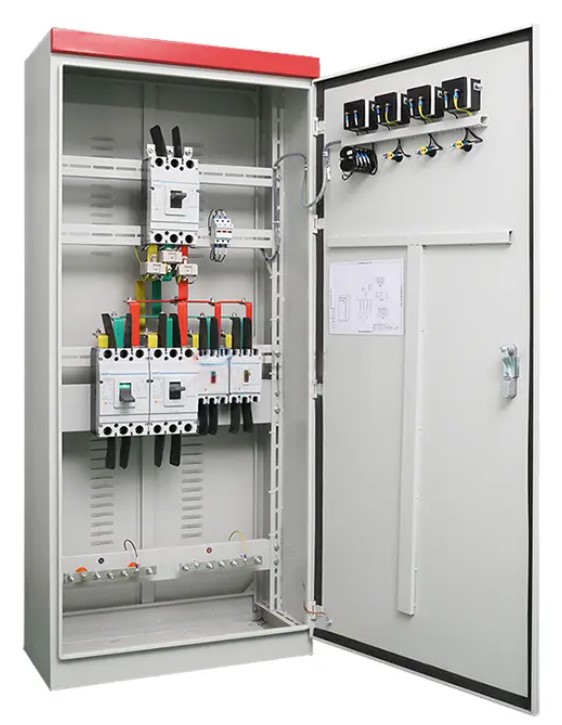
Isolation separates a circuit or a piece of equipment from every source of supply so that people can work on it safely. It is not the same as simply switching off. IEC 60947-1 and IEC 60947-3 set specific requirements for a device “suitable for isolation”:
- Contact gaps that withstand a defined impulse voltage when open.
- A reliable position indicator that shows “open” only when every contact really is open.
- Provision for locking in the open position, usually with a padlock, as part of a lock-out/tag-out procedure.
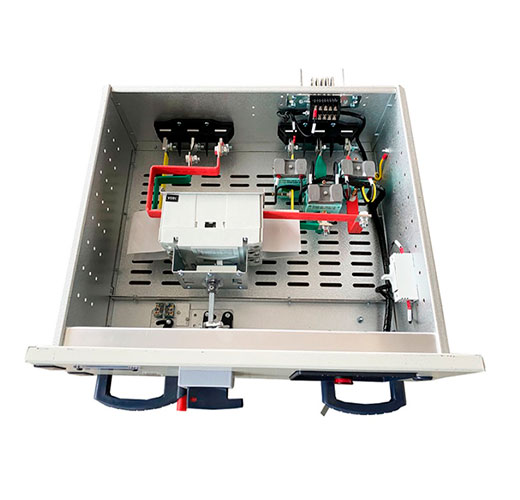
Switch-disconnectors, fuse-switch-disconnectors and most modern circuit breakers carry the isolation symbol on their nameplate. Good practice provides a means of isolation at the origin of each circuit, so one feeder can be serviced while the rest of the board stays live. Withdrawable units go further: pulling a drawer to the “disconnected” position gives a visible isolation gap.
Function 2: Protection
Protection detects abnormal current and disconnects the affected circuit before cables, busbars or connected equipment are damaged. Circuit breakers respond to current, not voltage; the main protection functions are:
| Fault | What happens | Typical protective device |
|---|---|---|
| Overload | Current somewhat above rating for minutes or hours; conductors overheat slowly | Thermal or long-time (L) trip of an MCB, MCCB or ACB; motor overload relay |
| Short circuit | Tens of kiloamperes within milliseconds; severe thermal and electrodynamic stress | Magnetic or instantaneous (I) trip, short-time (S) trip, current-limiting fuses |
| Earth fault | Current leaks to earth through insulation damage; fire and shock risk | Ground-fault (G) trip on electronic releases, RCDs |
| Shock risk to people | Small leakage currents through a human body | 30 mA RCDs (IEC 61008/61009) on final circuits |
Two design rules make protection work in practice. First, every device must have a breaking capacity (Icu/Ics under IEC 60947-2) at least equal to the prospective short-circuit current where it is installed. Second, the devices must be selective, also called discriminating: only the breaker closest to the fault should trip, leaving the rest of the installation in service. Selectivity is achieved by grading current settings and time delays, or by using breakers with zone-selective interlocking that communicate with each other.
Protection also covers the people operating the panel. Internal separation (Form 2 to Form 4 under IEC 61439-2), finger-proof IP2X barriers and arc-flash detection relays limit the energy someone could be exposed to during a fault.
Function 3: Switching and Control
Switching means turning circuits on and off under normal load conditions, locally or remotely. The panel supports three types:
- Functional switching: everyday operation of lighting, pumps, fans and production lines, often by contactors controlled from a PLC or building management system.
- Remote switching: motor-operated breakers and shunt releases let a control room open or close feeders, shed load or start a standby sequence without anyone entering the switchroom.
- Emergency switching: a dedicated stop button or trip circuit that disconnects a dangerous circuit at once. Emergency-stop devices for machines follow IEC 60947-5-5 and IEC 60204-1.
Switching devices are rated by utilization category, such as AC-1 for resistive loads, AC-3 for squirrel-cage motor starting or AC-23 for switch-disconnectors breaking motor loads. Matching the category to the load is what keeps contacts from wearing out early.
Function 4: Measurement and Monitoring
A fourth function has become as important as the classic three. Modern panels measure voltage, current, power, energy, power factor and harmonics, using current transformers and multifunction meters or breakers with built-in metering. Data travels over Modbus, Ethernet or wireless links to an energy management system. This supports:
- Cost allocation and sub-metering per tenant, line or EV charger group.
- Early warning of overloads and rising joint temperatures before they cause a trip.
- Power quality management, including correction with capacitor banks.
- Maintenance planning based on breaker operation counts and contact wear.
Checklist: Does Your Panel Do All Four?
- Can every outgoing circuit be isolated and locked off without shutting down the whole board?
- Do breaking capacities exceed the calculated fault level at each point?
- Has a selectivity study been carried out and are the trip settings recorded?
- Can critical feeders be switched remotely, and is there a clear emergency stop path?
- Are energy and alarm data available outside the switchroom?
Frequently Asked Questions
Is switching off a breaker the same as isolating a circuit?
Only if the breaker is marked as suitable for isolation and is locked in the open position. Otherwise, use a switch-disconnector or withdraw the functional unit.
Why did the upstream breaker trip instead of the local one?
That is a selectivity failure. The time-current curves of the two devices overlap, so trip settings or device selection need to be reviewed.
What is the difference between an incomer and a feeder?
The incomer brings power into the panel from a source; feeders send power out to loads or downstream boards.
Work with METTZ Group
METTZ Group offers a wide range of LV switchgear panels to suit many needs – from fixed-type distribution boards to withdrawable motor control centers with full metering. Check out our website to learn more, or contact METTZ Group today to work with a representative.
