
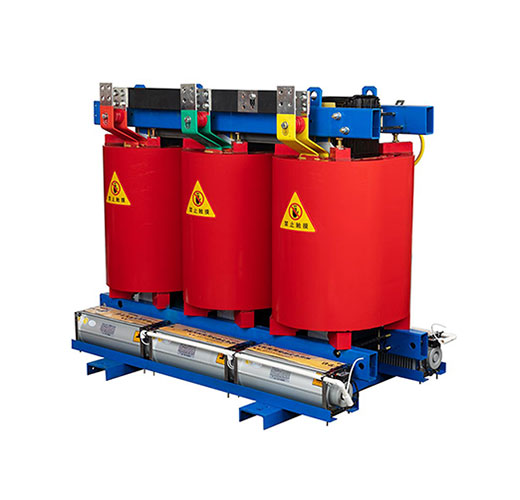
Dry-type transformers use air and solid insulation instead of oil, which makes them a natural fit for buildings, tunnels and other places where fire and spills are unacceptable. This overview covers how they work, the main design families, typical applications and the key points of an IEC 60076-11 specification.
What Makes a Transformer “Dry”
In a dry-type transformer, the core and windings are not immersed in any liquid. The windings are insulated with solid materials such as epoxy resin, polyester or aramid paper and varnish, and heat is carried away by the surrounding air. The governing standard is IEC 60076-11.
The operating principle is the same as any transformer: a laminated steel core links a high-voltage and a low-voltage winding, and the turns ratio sets the voltage ratio. The difference lies entirely in insulation and cooling.
Typical ratings run from about 50 kVA to 4,000 kVA, with larger units available, at primary voltages up to 36 kV in most catalogues. That covers the majority of medium-to-low-voltage distribution in commercial and industrial buildings.
Main Design Families
Cast resin (cast coil)
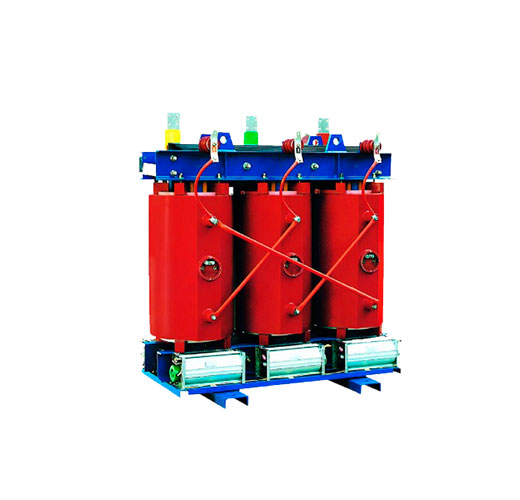
The high-voltage winding, and often the low-voltage winding too, is fully encapsulated in epoxy resin cast under vacuum in a mold. The result is a rigid, sealed coil that resists moisture, dust and short-circuit forces. Cast resin is the most common dry-type design for indoor substations and is covered in depth in our dry transformers range.
Vacuum pressure impregnated (VPI)
Windings are wound with high-temperature insulation, then impregnated with polyester or silicone varnish under vacuum and pressure and oven-cured. VPI coils are lighter and breathe more freely, giving good overload behavior and easy recycling, but they are more sensitive to condensation when de-energized in humid places. Vacuum pressure encapsulated (VPE) units add several coats for better environmental protection.
Open-wound and ventilated designs
Older or low-voltage designs with dipped and baked varnish insulation are still found in small isolation and control transformers. They are cheap but least resistant to dirt and moisture.
Low-loss core options
Any of these families can be paired with improved cores. Amorphous alloy cores cut no-load losses dramatically, which is valuable where a transformer is energized all year but lightly loaded, such as in offices, schools and solar plants at night.
Where Dry-Type Transformers Are Used
- Commercial buildings and hospitals: installed close to the load, even on upper floors, reducing low-voltage cable runs.
- Data centres: compact, low-fire-risk units feeding UPS and IT loads.
- Tunnels, metros and ships: where fire load and smoke must be minimal.
- Mines and industrial plants: indoor substations and mobile units in harsh conditions.
- Renewables: step-up units inside wind turbine towers and solar inverter stations.
- EV charging hubs: compact substations near parking areas.
Advantages and Limitations
| Advantages | Limitations |
|---|---|
| No flammable liquid; self-extinguishing materials | Higher purchase price than an equivalent oil unit |
| No oil pit, bund or fire wall required in most codes | Larger and heavier per kVA at higher ratings |
| No oil testing or leak risk; less routine maintenance | Usually needs an enclosure for outdoor use |
| Can be placed close to loads indoors | Lower overload capacity than oil (less thermal mass) |
| Good resistance to short-circuit forces (cast resin) | Practical upper limits on voltage and rating |
Be wary of claims that dry-type units always have lower losses. Losses depend on design and core material, not on insulation type. Under EU Ecodesign Tier 2, both dry and liquid-immersed transformers must meet maximum loss limits for their rating.
Key Specification Points Under IEC 60076-11
- Rated power, voltages and vector group, for example 1,000 kVA, 11/0.4 kV, Dyn11.
- Insulation thermal class: usually F (155 °C) or H (180 °C), which sets the permitted winding temperature rise.
- Environmental class E0/E1/E2 for condensation and pollution, climatic class C1/C2 for minimum ambient temperature, and fire behavior class F0/F1.
- Losses at no load and at rated load, guaranteed and tested.
- Partial discharge level, typically 10 pC or less at the test voltage for cast resin.
- Enclosure IP rating and noise level for the installation space.
- Cooling: AN (natural air) with optional AF fans for temporary extra capacity, often around 40%.
- Temperature monitoring: PT100 sensors in the low-voltage windings with a relay for alarm, trip and fan control, ideally with a digital interface to the building management system.
Installation Considerations
A dry-type transformer needs clean, ventilated space. Plan airflow so warm air leaves at high level and cool air enters at low level; poor ventilation is the most common cause of overheating. Keep safety clearances from the energized resin surface, since cast coils are not touch-safe while live. Coordinate the transformer with the upstream medium-voltage switchgear and downstream low-voltage cabinets so that inrush currents, protection settings and busbar connections all match.
Frequently Asked Questions
Can a dry-type transformer be installed outdoors?
Yes, in a suitable enclosure with the right IP rating, environmental class and anti-condensation heating.
Is the resin surface of a cast coil safe to touch?
No. The resin surface can carry a hazardous potential while energized. Treat it as a live part.
Which is better, cast resin or VPI?
Cast resin suits humid, polluted or unattended sites. VPI suits clean, dry indoor locations where weight, overload capacity and recyclability matter more.
Work with METTZ Group
METTZ Group offers a wide range of dry-type transformers to suit many needs – from compact cast resin units for commercial buildings to rugged designs for mining and tropical conditions. Check out our website to learn more, or contact METTZ Group today to work with a representative.
