
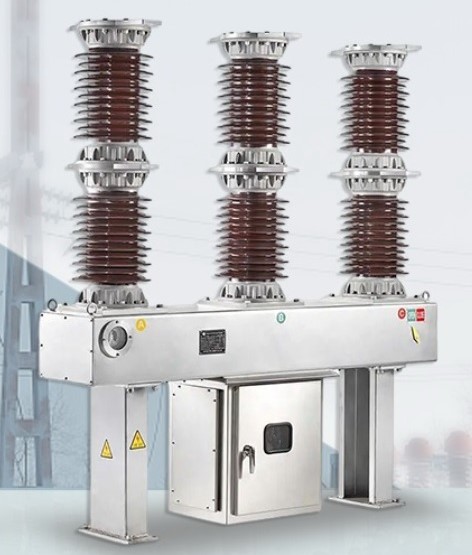
SF6 keeps gas-insulated switchgear compact and reliable, but a leak costs insulation margin, money and a large amount of greenhouse-gas emissions. This guide covers how leaks are detected and located, how gas is handled and reused under IEC rules, how to protect people from SF6 and its by-products, and what the F-gas rules now require.
Why SF6 leaks matter
Sulfur hexafluoride is non-toxic, non-flammable and an excellent insulator and arc-quenching medium. It is also the most potent greenhouse gas regulated under international climate agreements, with a 100-year global warming potential of roughly 23,000 to 25,000 times that of CO2, depending on the IPCC assessment used. It stays in the atmosphere for well over a thousand years.
A leak has three consequences:
- Technical: lower gas density reduces dielectric strength and, in breakers, interrupting capability. Below the minimum functional density the equipment must be blocked.
- Environmental and legal: every kilogram released equals more than 20 tonnes of CO2, and losses must be recorded and, in many jurisdictions, reported.
- Financial: top-ups, outage time and repairs, plus possible penalties.
Modern sealed equipment is designed for very low leakage, typically 0.5% per year or less for new switchgear under IEC 62271-1. Leaks usually come from damaged or aged seals, site-made flanges, gas pipework, valve fittings, density monitor connections, or corrosion on outdoor equipment.
First line of defense: the gas density monitor
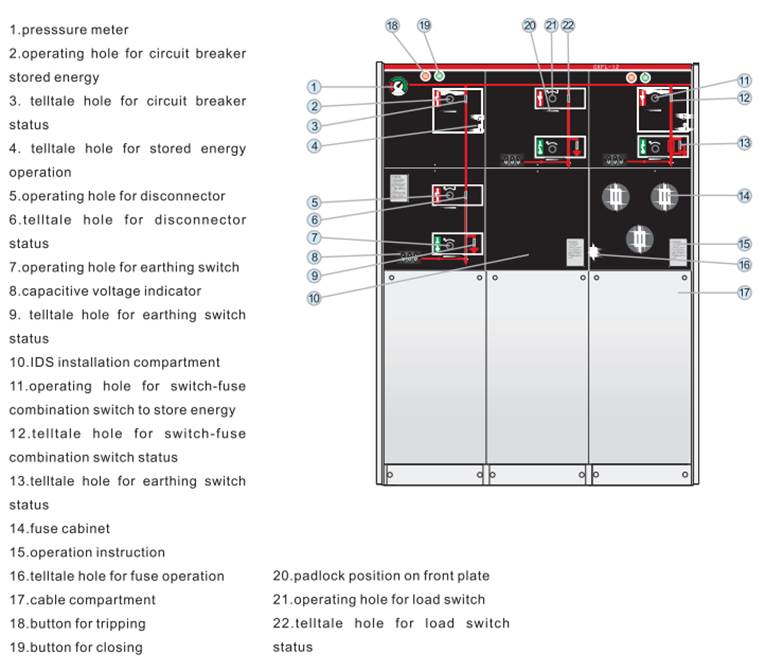
Every gas compartment should be supervised by a temperature-compensated density monitor. Because gas pressure changes with temperature, a plain pressure gauge can mislead; density (or pressure corrected to 20 °C) is what counts.
Typical monitors have two contact stages:
- Stage 1, refill alarm: density has fallen to the alarm level. The equipment can still operate safely, but the cause must be found and gas added.
- Stage 2, minimum functional density: the breaker is blocked or tripped according to the protection philosophy, because insulation or interrupting performance can no longer be guaranteed.
Digital density sensors that report pressure, temperature and density continuously are now common, often integrated into IEC 61850 substation automation. Their main benefit is trend analysis: a slow, steady decline over months reveals a small leak long before the first alarm, while daily swings that follow ambient temperature are normal.
Methods for SF6 leak detection and location
Once a density trend or alarm points to a compartment, the leak has to be located. The common methods are:
| Method | How it works | Best use |
|---|---|---|
| Electronic sniffer (negative-ion capture, infrared or electron-capture detector) | A probe moved slowly around joints senses SF6 in air at ppm level | Pinpointing leaks at flanges, valves and fittings |
| Optical gas imaging camera | An infrared camera tuned to the SF6 absorption band shows the gas plume as a visible cloud | Fast surveys of large or energized installations from a safe distance |
| Soap or leak-detection solution | Bubbles form where gas escapes | Confirming larger leaks on accessible, de-energized parts |
| Accumulation (bagging) method | The suspect area is wrapped; SF6 concentration rise over time gives the leak rate | Quantifying leakage after repair or during acceptance tests |
| Pressure decay / density trending | Long-term logging of compensated density | Detecting slow leaks and verifying repairs |
Optical gas imaging is particularly valuable because it works on energized equipment without approaching live parts. Sniffers should be calibrated regularly and used on a calm day, since wind disperses the gas.
Responding to a leak alarm
- Assess the alarm. Compare with the density trend and ambient temperature to rule out a sensor fault or a cold-weather effect.
- Protect people. For indoor switchrooms and basements, ventilate and check oxygen levels before entry. SF6 is about five times heavier than air and can displace oxygen in low spaces.
- Coordinate operations. Inform the control center; if density is approaching the lockout level, plan switching to take the compartment out of service.
- Locate the leak with an imaging camera or sniffer.
- Top up as an interim measure if allowed, recording the mass added.
- Repair: isolate and earth the section under permit-to-work and lockout/tagout, recover the gas, replace seals or components, evacuate, refill and recheck tightness.
Gas handling under IEC 62271-4 and IEC 60480
IEC 62271-4 sets out procedures for handling SF6 and its mixtures throughout the equipment life: filling, recovery, storage, transport, reuse and end-of-life disposal. The key principles are:
- Closed-circuit handling: gas is moved only with recovery and filling carts, hoses and couplings designed to avoid release. Deliberate venting is not acceptable.
- Recovery to low residual pressure before a compartment is opened, so that losses are minimal.
- Labelled, approved cylinders for used gas, kept separate from new gas, with records of quantities.
- Reuse after checking: IEC 60480 defines the quality criteria (for example moisture, air and CF4 content, purity and decomposition products) that recovered gas must meet before it goes back into equipment. Gas that fails can often be cleaned on site with filters, or returned to a gas supplier for reclamation. New gas is specified by IEC 60376.
Measure gas quality with portable analyzers for purity, dew point or moisture in ppmv, and SO2 as an indicator of decomposition. A high SO2 reading in a compartment without recent switching is a warning sign of internal partial discharge or arcing.
Personal safety: normal gas and arced gas
Normal-service SF6
Pure SF6 is not toxic, but it is an asphyxiant at high concentrations. The usual occupational exposure limit is 1,000 ppm (8-hour average). Keep floor-level ventilation running in switchrooms, fit oxygen or SF6 monitors where gas could collect, and never enter trenches or basements after a leak without checking the atmosphere.
Arced and decomposed SF6
Electric arcs and partial discharge break SF6 down. With traces of moisture and oxygen, this produces toxic and corrosive compounds such as SOF2, SO2F2, SF4 and HF, plus fine metal fluoride powders. Treat any compartment that has interrupted faults or suffered an internal arc as contaminated:
- Recover gas through filters that absorb decomposition products.
- Wear a full-face respirator with suitable filters, chemical-resistant gloves, disposable coveralls and eye protection when opening the compartment.
- Remove powders with a vacuum cleaner fitted with a HEPA filter, neutralize residues as instructed by the manufacturer, and dispose of filters and waste as hazardous material.
- Wash exposed skin and do not eat, drink or smoke in the work area.
All this must be combined with standard electrical safety: isolate every supply including back-feeds, prove dead, apply earths, and lock out stored energy in mechanisms before any work inside.
F-gas rules and record keeping
In the European Union, Regulation (EU) 2024/573 applies to SF6 in switchgear. Operators must keep records of gas quantities installed, added and recovered, use certified personnel for gas handling, and have leak checks performed on equipment that is not covered by continuous leak detection or a proven very low leak rate. The regulation also phases out new F-gas switchgear in stages: medium-voltage equipment up to 24 kV from 2026, up to 52 kV from 2030, and high voltage from 2028 to 2032 depending on rating, with narrow exemptions. Existing equipment can stay in service, but recovered gas must be reused or destroyed properly.
Outside the EU, rules vary. Several US states and the federal greenhouse gas reporting program require larger owners to report SF6 inventories and emissions, and many utilities set their own leak-rate targets. In every market, good records make compliance straightforward.
Preventive practices that reduce leaks
- Log density readings at least monthly, or install online monitoring on critical substations.
- Survey outdoor GIS and breakers with an imaging camera during routine inspections.
- Replace seals whenever a flange is opened, and protect outdoor flanges from corrosion.
- Combine leak surveys with infrared thermography and partial discharge checks to catch other defects.
- For new projects, evaluate SF6-free designs, such as vacuum switching with dry air or alternative gas insulation, to remove the problem at its source.
Frequently Asked Questions
What leak rate is acceptable for SF6 switchgear?
New sealed equipment is typically designed for 0.5% per year or less. Any steady downward density trend should be investigated, even if it is still above the alarm level.
Can a density monitor alarm be caused by cold weather?
A temperature-compensated monitor should not alarm from temperature alone. In very cold climates, however, SF6 can begin to liquefy, which lowers the gas-phase density. Heaters or gas mixtures are used in such conditions.
Is it safe to stand near a leaking GIS?
Outdoors, small leaks pose little direct risk to people. Indoors and in low spaces, check oxygen levels and ventilate first. If the gas may be arced, use respiratory protection.
Can recovered SF6 be reused?
Yes. If it meets the IEC 60480 criteria after testing, and filtering if needed, it can be refilled into equipment. Otherwise it is sent for reclamation or destruction.
Work with METTZ Group
METTZ Group offers a wide range of gas-insulated switchgear to suit many needs – from sealed MV panels to substation solutions up to 220 kV – along with solid-insulated and dry-insulated switchgear for SF6-free projects. Check out our website to learn more, or contact METTZ Group today to work with a representative.
