
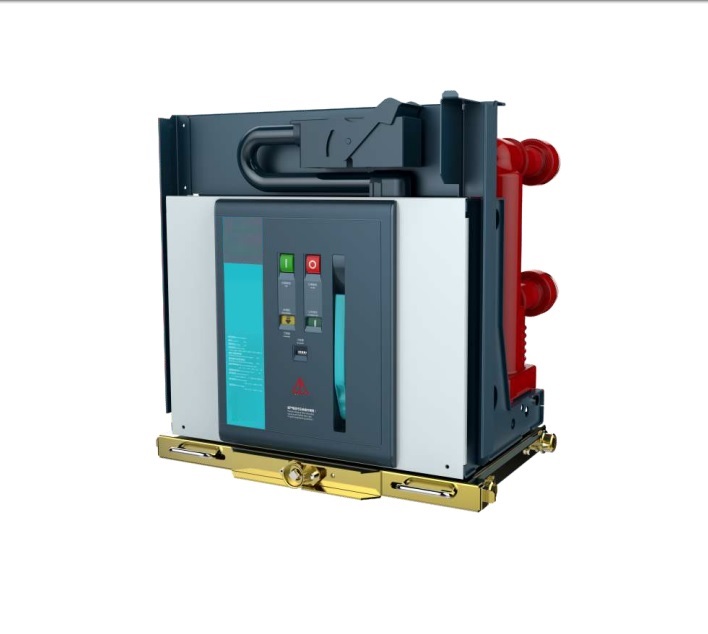
Two vacuum circuit breakers with the same voltage and current rating can have very different lifetimes. The difference lies in how the poles are built, what the contacts are made of and which endurance classes the design has been type-tested to. This article explains those three factors and how to read them on a datasheet.
The Building Blocks of a Modern VCB
The physics of arc interruption in vacuum is covered in our guide to how a vacuum circuit breaker works. Here the focus is on the hardware that decides durability. A typical medium-voltage VCB is made of five functional groups:
| Assembly | Main parts | What it means for service life |
|---|---|---|
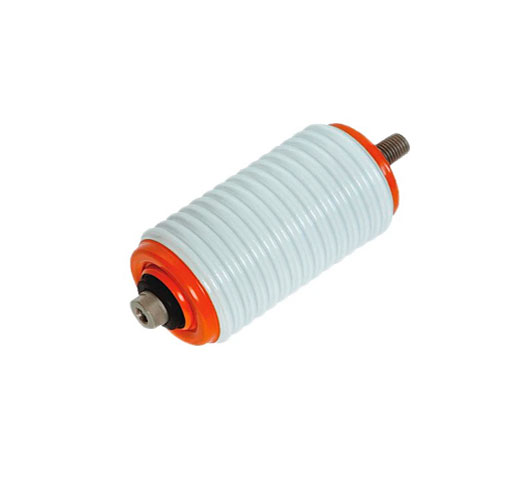
| Vacuum interrupter | Ceramic envelope, fixed and moving contacts, stainless-steel bellows, metal vapor shield | Sets electrical endurance and vacuum life; bellows set the mechanical limit of the interrupter |
| Pole | Embedded epoxy pole or assembled pole with insulating cylinder, terminals, flexible connector | Protects the interrupter from dust, moisture and impact; governs dielectric ageing |
| Drive train | Insulating push rod, contact pressure (wipe) spring, levers, shaft | Holds contact force constant as contacts erode; wear here causes bounce and overtravel |
| Operating mechanism | Spring stored-energy mechanism with motor charging, or permanent magnetic actuator | Usually defines the mechanical endurance class |
| Frame and secondary | Chassis or truck, auxiliary switches, coils, interlocks, primary disconnecting contacts | Racking wear, coil burnout and connector heating are common age-related failures |
Embedded versus assembled poles
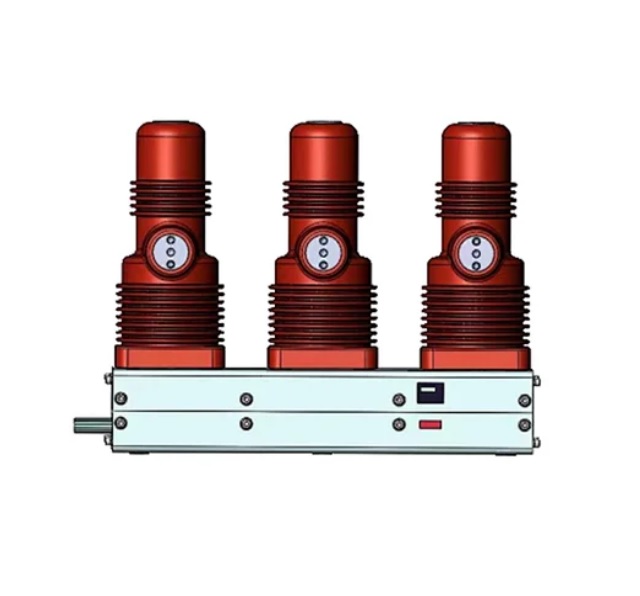
In an embedded pole, the interrupter is cast directly into epoxy resin by automatic pressure gelation (APG). The resin shields the ceramic from contamination and mechanical shock, removes the need for separate insulating supports and gives a compact, sealed pole. Outdoor designs use cycloaliphatic or hydrophobic epoxy, or silicone sheds, to resist UV and pollution. The trade-off is that the interrupter cannot be replaced on its own – the whole pole is exchanged. Assembled poles mount the interrupter between insulating supports; they allow interrupter replacement but leave the ceramic surface exposed, which matters in humid or dusty rooms.
Spring mechanism or magnetic actuator
Spring mechanisms are proven, independent of control voltage once charged, and repairable worldwide. Permanent magnetic actuators have very few moving parts and can achieve high mechanical endurance with little lubrication, but depend on a capacitor-based electronic controller. Both can meet the highest mechanical class; the choice usually comes down to switching frequency and the user’s maintenance culture.
Contact Materials: Why Copper-Chromium Won
Inside the interrupter, contact material is the single biggest factor in performance. It must conduct load current with low resistance, survive arc erosion, resist welding when closing onto a fault, keep current chopping low and recover dielectric strength fast after current zero. No pure metal does all of that.
| Material | Strengths | Weaknesses | Typical use today |
|---|---|---|---|
| Copper-chromium (CuCr, typically 25-50% Cr) | High breaking capacity, good weld resistance, low erosion, chopping current of a few amperes, strong dielectric recovery | Needs careful powder metallurgy or arc-melting processes | Standard for MV circuit breakers |
| Copper-bismuth and copper-lead alloys | Very low welding tendency | Higher chopping current and erosion; lower dielectric strength | Older designs, largely superseded |
| Silver-tungsten carbide (AgWC) | Very low chopping current, low erosion at small currents | Limited short-circuit breaking | Vacuum contactors for motor duty |
| CuCr with additives (e.g., tungsten, tellurium) | Tuned for lower chopping or higher voltage | Specialist, higher cost | High-voltage interrupters and special duties |
The chromium in CuCr acts as a getter: it absorbs residual gas molecules over the interrupter’s life, helping to keep the vacuum hard. Its relatively low vapor pressure reduces erosion, while the copper matrix carries current.
Contact geometry matters too
At high currents an arc tends to constrict into a single hot spot that erodes the surface. Two geometries prevent this:
- Transverse magnetic field (TMF) contacts – spiral or cup-shaped slots force the arc to rotate around the contact edge, spreading heat. Widely used up to about 31.5-40 kA.
- Axial magnetic field (AMF) contacts – a coil structure behind the contact face produces an axial field that keeps the arc diffuse across the whole surface. Preferred for high short-circuit currents and larger contact diameters.
Service Life Under IEC 62271-100
Service life is not a single number. IEC 62271-100 defines separate classes that are proven by type tests. When comparing breakers, check which ones are actually claimed.
| Class | What it covers | Requirement (summary) |
|---|---|---|
| M1 | Mechanical endurance, normal | 2,000 operating cycles |
| M2 | Mechanical endurance, extended, for frequent operation | 10,000 operating cycles with limited maintenance |
| E1 | Electrical endurance, basic | Standard short-circuit test duties only |
| E2 | Electrical endurance, extended (distribution breakers) | Additional series of breaking tests; interrupting parts need no maintenance during expected service life |
| C1 / C2 | Capacitive current switching | Low (C1) or very low (C2) probability of restrike |
| S1 / S2 | Network type | Cable networks (S1) or line-connected networks (S2) |
A well-specified distribution VCB today is typically M2-E2-C2. For very high switching rates – arc furnaces, some motor and capacitor duties – manufacturers offer designs tested well beyond 10,000 operations, sometimes 30,000 or more. The number of full-rated short-circuit interruptions before contact erosion reaches its limit is listed separately on the datasheet and is usually in the range of a few dozen operations.
Electrical life depends on the current interrupted
Contact erosion rises steeply with interrupted current. A breaker may handle tens of thousands of load-current operations but only dozens of full short-circuit interruptions. Manufacturers publish an electrical life curve (permissible operations versus breaking current); summing the “life used” for each recorded fault gives a realistic estimate of remaining contact life. Many digital protection relays and breaker monitors now perform that calculation automatically.
What Shortens a VCB’s Life in Practice
- Environment: condensation, conductive dust and corrosive gases attack insulation and mechanism surfaces long before the interrupter wears out.
- Lubrication neglect: hardened grease slows the mechanism, increasing opening time and contact bounce.
- Heating at connections: loose busbar joints or worn cluster contacts on a withdrawable truck cause local overheating that ages epoxy and seals.
- Duty mismatch: using an M1 breaker for daily motor or capacitor switching, or an unprotected breaker on highly inductive loads.
With the right class, a clean environment and routine mechanism care, a 20-30 year service life is a reasonable expectation for modern VCBs.
Frequently Asked Questions
What does M2-E2-C2 mean on a VCB nameplate?
It means the design has passed type tests for 10,000 mechanical operations, extended electrical endurance without maintenance of interrupting parts, and very low restrike probability when switching capacitive current.
Why is CuCr used instead of pure copper?
Pure copper welds easily and erodes fast under arcing. CuCr combines copper’s conductivity with chromium’s arc resistance, weld resistance and gettering effect.
Can a worn embedded pole be refurbished?
No. When contact wear reaches its limit or vacuum is lost, the whole embedded pole is replaced with the manufacturer’s approved part.
Does the mechanism or the interrupter usually wear out first?
Under normal distribution duty, the mechanism and secondary parts usually need attention first. Under heavy fault or switching duty, contact erosion may set the limit.
Work with METTZ Group
METTZ Group offers a wide range of vacuum circuit breakers to suit many needs – from indoor withdrawable units to outdoor and mining designs – together with vacuum interrupters, embedded poles and coils for maintenance and retrofits. Check out our website to learn more, or contact METTZ Group today to work with a representative.
