
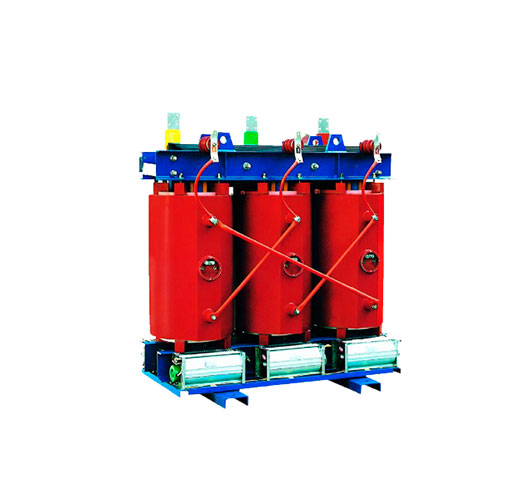
Cast resin transformers dominate indoor medium-voltage distribution, but their datasheets are full of codes such as E2, C2, F1 and class F/H. This guide explains how the coils are built, what each class really tests, and how to use that knowledge to compare offers.
Construction, Layer by Layer
The core
The magnetic core is stacked from cold-rolled grain-oriented silicon steel sheets, usually with step-lap mitered joints that reduce no-load loss and noise. After stacking, the core is clamped and coated with resin or varnish to protect against corrosion. For very low no-load losses, amorphous alloy cores are an option, at the cost of larger size and a more complex build.
The low-voltage winding
The LV winding is normally made from aluminum or copper foil, one turn per layer, with insulating film between layers. Foil windings handle short-circuit forces well because axial forces are almost balanced. The LV coil is usually pre-impregnated with resin and cured, rather than fully cast.
The high-voltage winding
The HV winding is wound from enameled or film-insulated conductor in several discs or layers, often reinforced with glass fiber mesh. It is placed in a steel mold, dried, and then filled under vacuum with epoxy resin mixed with silica or alumina filler. The vacuum removes air and moisture; the filler improves thermal conductivity and matches the expansion rate of the resin to the conductor, which prevents cracking.
The curing cycle is controlled precisely. Voids in the resin are the main source of partial discharge, so a well-cast coil is the foundation of long life.
Assembly and accessories
Coils are centered on the core with spacer blocks and elastic pads that absorb vibration. Cooling ducts between HV and LV coils allow air to flow upward through the winding. Standard accessories include off-circuit tap links on the HV coil, PT100 sensors in the LV winding, a temperature relay, and optional cross-flow fans.
Thermal Classes: F and H
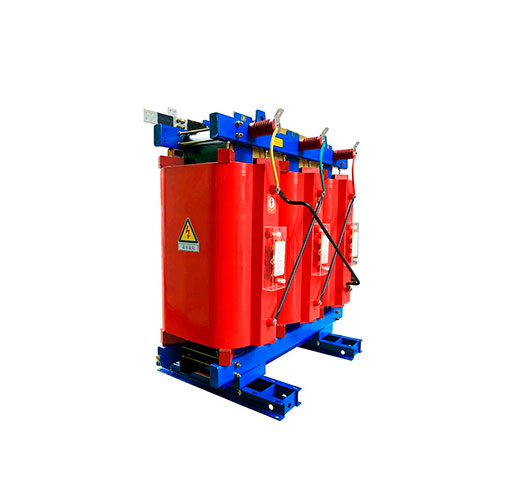
The thermal class describes the maximum temperature the insulation system can withstand for its design life. IEC 60076-11 links each class to a maximum average winding temperature rise above a 40 °C maximum ambient.
| Insulation system class | Reference temperature | Max. average winding rise |
|---|---|---|
| B | 130 °C | 80 K |
| F | 155 °C | 100 K |
| H | 180 °C | 125 K |
A common and sensible approach is to use class H insulation but design for a lower temperature rise, such as the 100 K of class F or even the 80 K of class B. Lower temperature means lower aging, more overload margin, and usually lower load losses because cooler copper or aluminum has lower resistance.
Environmental, Climatic and Fire Classes
Environmental classes E0, E1, E2
- E0: no condensation, negligible pollution. Clean, dry indoor rooms only.
- E1: occasional condensation and limited pollution.
- E2: frequent condensation or heavy pollution, or both. Tested by exposure in a humidity chamber followed by an induced voltage test.
Climatic classes C1, C2
- C1: operation down to -5 °C, transport and storage down to -25 °C.
- C2: operation, transport and storage down to -25 °C. A thermal shock test checks that the resin does not crack when cold.
Fire behavior classes F0, F1
- F0: no special fire requirements.
- F1: limited flammability. The test checks self-extinguishing behavior, heat release and the emission of smoke and corrosive gases.
For most indoor substations, tunnels, hospitals and data centres, E2, C2, F1 is the expected combination. Always ask for the type test reports, not just the label on the datasheet.
Testing: What to Ask For
- Routine tests on every unit: winding resistance, ratio and vector group, impedance and load loss, no-load loss and current, applied and induced voltage tests, and partial discharge measurement (typically ≤10 pC).
- Type tests on a representative design: temperature rise, lightning impulse, and the environmental, climatic and fire class tests.
- Special tests on request: sound level, short-circuit withstand, and measurement of harmonics behavior.
Strengths and Trade-Offs
Cast resin transformers offer strong resistance to humidity, dust and short-circuit stresses, very low fire load and minimal maintenance. They can be installed near the load in occupied buildings without oil containment.
The trade-offs are a higher price than equivalent oil units, more weight per kVA at large ratings, limited overload capacity, and harder recycling of the cured resin compared with VPI designs. Losses are not automatically lower than oil units; they depend on the core and winding design, so compare guaranteed figures against EU Ecodesign Tier 2 limits or your local equivalent.
Selection Tips
- Specify the actual load profile, including harmonics from drives, UPS or EV chargers.
- Choose a lower temperature rise if the room ventilation is uncertain or the site is hot.
- Specify fan cooling (AF) if short peaks are expected, but do not rely on it for base load.
- Request a temperature controller with digital output for remote monitoring.
- Match the enclosure IP rating and the anti-condensation heaters to the environment.
Frequently Asked Questions
Why are only the HV windings cast?
The HV winding faces the highest electrical stress, so full vacuum encapsulation gives the most benefit. The foil LV winding is robust and is usually impregnated instead.
Does class H mean the transformer runs hotter?
Only if it is designed for a 125 K rise. Many designs use class H materials with a lower rise for extra margin.
Can cast resin transformers be repaired?
A damaged cast coil cannot be rewound locally; it is replaced as a whole coil, which is why spare coils are sometimes held for critical sites.
Work with METTZ Group
METTZ Group offers a wide range of cast resin and dry-type transformers to suit many needs – from standard distribution units to versions for mining and tropical conditions, along with transformer components. Check out our website to learn more, or contact METTZ Group today to work with a representative.
