
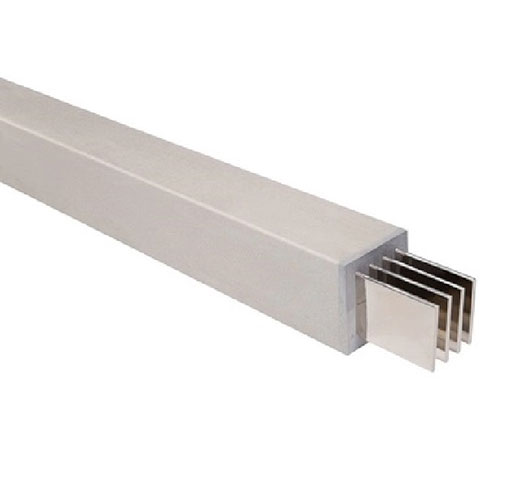
Busway, also called bus duct or busbar trunking, carries large currents through a building in a prefabricated metal enclosure instead of bundles of cable. This guide covers how it works, the main types, its key components and ratings, and how to decide between busway and cable.
What Busway Is
A busway is a factory-built assembly of insulated copper or aluminium conductors inside a protective steel or aluminium housing. Standard straight lengths, elbows, tees and tap-off points bolt together on site to form a complete distribution route. In IEC terms it is a busbar trunking system (BTS), covered by IEC 61439-6 as a type of low-voltage assembly. That means it is design-verified as a system, just like a switchboard, rather than assembled from loose parts.
Busway connects transformers to main switchboards, main switchboards to sub-boards, and, in plug-in versions, delivers power directly to machines, lighting or server racks along its length.
Busway vs Cable
Both deliver power from point A to point B. The differences show up in high-current, high-density or frequently changing installations:
| Criterion | Busway | Cable and tray |
|---|---|---|
| Current per run | Up to about 6,300 A in one compact enclosure | Several parallel cables per phase above ~600 A |
| Voltage drop | Low, because of closely spaced flat bars and low reactance | Higher on long runs; depends on laying arrangement |
| Space | Compact; one route instead of wide trays | Large trays, bending radius constraints |
| Installation | Bolted sections; fast and predictable | Pulling, dressing and terminating many cores |
| Changes and expansion | Add or move tap-off units, often while energized (plug-in types) | New cable run per new load |
| Fire load | Low, mostly metal and small amounts of insulation | Significant combustible insulation mass |
| Upfront cost | Higher for short or low-current runs | Lower for short or low-current runs |
As a rule of thumb, busway becomes attractive above roughly 1,000 A, on vertical risers in tall buildings, and wherever loads will be added or moved over the life of the facility.
Main Types of Busway
Sandwich (Compact) Busway
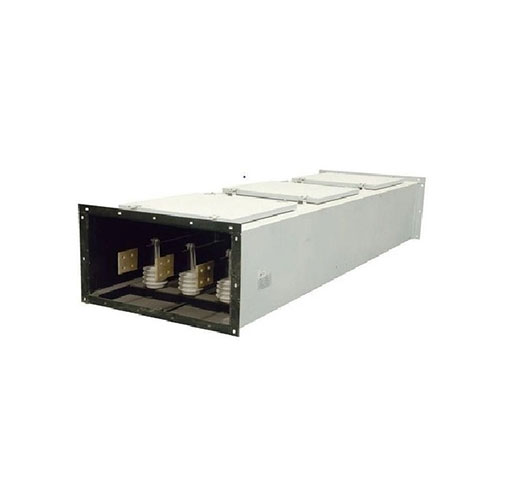
Insulated bars are pressed tightly together in a non-ventilated housing. Close spacing gives low impedance, good heat transfer to the enclosure and high short-circuit strength in a small cross-section. This is the most common type for LV feeders and risers from about 400 A to 6,300 A, in data centers, commercial buildings and heavy industry.
Air-Insulated (Ventilated) Busway
Bars are spaced apart and held by insulating supports, with air as the main insulation. It is usually used for low to medium currents and plug-in distribution in workshops and laboratories.
Cast-Resin Busway
Conductors are fully encapsulated in epoxy resin, reaching IP68. It suits outdoor routes, wet or corrosive areas, tunnels and transformer connections exposed to the weather.
Lighting and Track Busway
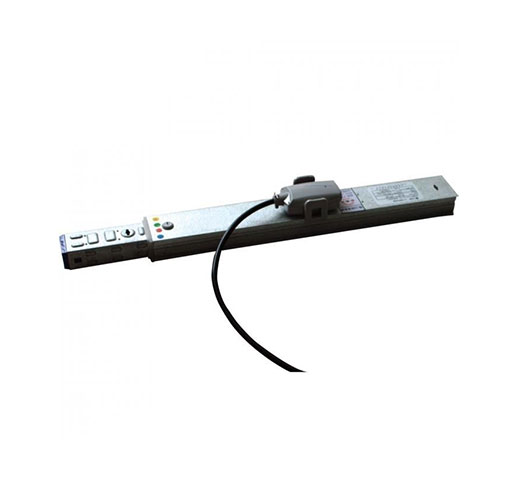
Low-current track systems, typically up to a few hundred amperes, let small tap-off boxes clip on anywhere along the run. Track busway is widely used above data center rows to feed rack PDUs, and in warehouses for lighting.
Medium-Voltage Bus Ducts
Non-segregated, segregated and isolated-phase bus ducts carry power at medium voltage between generators, transformers and MV switchgear in power plants and heavy industry. Their design and testing follow MV practice rather than IEC 61439-6.
Busway Components
- Conductors: copper for compactness and lower losses, aluminium for lower weight and cost. Three-phase, neutral and sometimes a separate PE bar; a 200% neutral is available where harmonic currents from IT loads are high.
- Housing: galvanized or painted steel, or extruded aluminium. The housing often serves as the protective earth conductor, so its continuity at every joint matters.
- Insulation: polyester film, epoxy coating, cast resin or air with supports, depending on the type.
- Joints: bolted monoblock joints with torque indicators or shear-head bolts; these are the points to check during maintenance.
- Fittings: elbows, offsets, tees, expansion units and end feed boxes for routing and thermal movement.
- Tap-off units: boxes with MCCBs, fuses or meters that plug into the busway to feed loads.
- Fire barriers: internal and external barriers that maintain the fire rating of walls and floors the busway passes through.
Ratings to Specify
- Rated operational voltage (typically 400 V or 690 V) and insulation voltage (often 1,000 V).
- Rated current at the actual ambient temperature and mounting orientation.
- Rated short-time withstand current (Icw) and peak withstand current, coordinated with the upstream breaker.
- Voltage drop per 100 m at the expected load and power factor.
- Degree of protection (IP54, IP55 or IP68 for cast resin) and fire resistance of barriers.
Where Busway Is Going
Modern busway increasingly carries data as well as power. Tap-off units with built-in metering report energy per rack, machine or tenant; wireless sensors watch joint temperatures; and track busway lets data centers reconfigure rows for high-density AI loads without new cable. In solar and battery plants and EV charging hubs, compact busway shortens the connection between transformers, inverters and switchboards.
Frequently Asked Questions
Is busway the same as a busbar?
A busbar is a single conductor. A busway is a complete enclosed system of busbars, insulation, housing and fittings.
How often should busway be inspected?
Typically once a year, with infrared thermography of joints and tap-offs under load and a torque check where the manufacturer requires it.
Can tap-off units be installed while the busway is live?
Many plug-in systems allow it, but only if the manufacturer permits it and the site’s safe-work rules are followed.
Work with METTZ Group
METTZ Group offers a wide range of busway and busbar products to suit many needs – from compact LV risers to transformer connections and plug-in distribution for factories and data centers. Check out our website to learn more, or contact METTZ Group today to work with a representative.
