
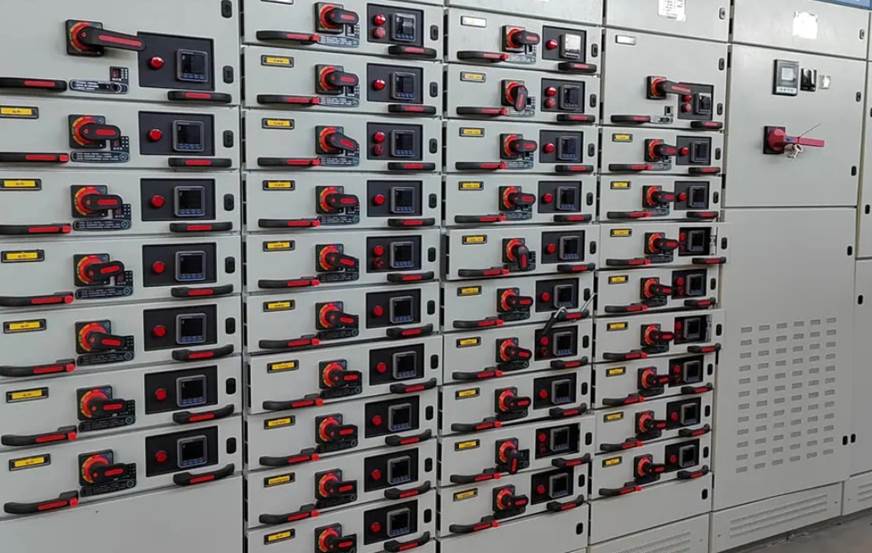
Low-voltage switchgear is where utility-scale power becomes usable power for motors, lighting, IT and chargers. This guide shows where LV equipment sits relative to MV and HV, how to size a main LV switchboard from its transformer, and which IEC 61439 ratings belong on every specification.
LV, MV and HV: Where the Boundaries Are
“Switchgear” covers every assembly that switches, protects and isolates electrical circuits. What changes with voltage is the technology needed to interrupt current and insulate live parts. The IEC voltage bands are:
| Band | Typical AC range | Main standards | Typical switching devices |
|---|---|---|---|
| Low voltage (LV) | Up to 1,000 V AC (1,500 V DC) | IEC 61439 (assemblies), IEC 60947 (devices) | ACBs, MCCBs, MCBs, contactors, switch-disconnectors, fuses |
| Medium voltage (MV) | Above 1 kV up to 36 kV (52 kV in some definitions) | IEC 62271-200 and related parts | Vacuum circuit breakers, load break switches, contactors |
| High voltage (HV) | Above 36/52 kV | IEC 62271 series | SF6 or vacuum breakers, disconnectors, GIS bays |
In a typical industrial or commercial site, power arrives at MV (for example 10, 11, 20 or 33 kV), passes through MV switchgear and a distribution transformer, and leaves the transformer secondary at 400 V or 690 V. From that point on, everything is LV switchgear.
The LV Hierarchy: From Main Switchboard to Final Circuit
LV distribution is organized in tiers, each with lower current and lower fault level than the one above it:
- Main LV switchboard (MLVS, sometimes called PCC): fed directly from the transformer, usually through an air circuit breaker incomer. It carries the full transformer current and the highest prospective short-circuit current on the site.
- Motor control centers (MCCs): group starters, contactors and drives for process plants, pumping stations and HVAC.
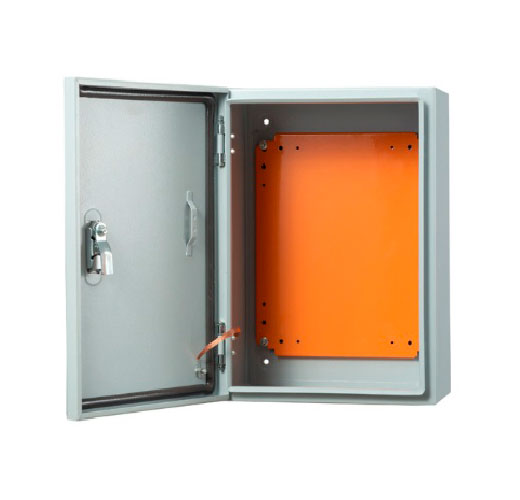
- Sub-distribution boards: located close to loads on each floor or production area, typically fed by MCCBs.
- Final distribution boards: MCBs and RCDs supplying individual sockets, lighting and small equipment.
Sites that need high availability use two or more transformers, each feeding its own main board section, linked by a bus coupler. If one transformer is out of service, the coupler closes and the healthy transformer carries the essential load.
Sizing a Main LV Switchboard from Its Transformer
The transformer rating sets two key numbers: the rated current of the incomer and busbars, and the short-circuit current the board must withstand. At 400 V, rated current is I = S / (√3 × 400 V):
| Transformer | Rated current at 400 V | Approx. short-circuit current (uk = 6%) | Typical busbar rating |
|---|---|---|---|
| 1,000 kVA | ≈ 1,445 A | ≈ 24 kA | 1,600 A |
| 1,600 kVA | ≈ 2,310 A | ≈ 38 kA | 2,500 A |
| 2,500 kVA | ≈ 3,610 A | ≈ 60 kA | 4,000 A |
| 4,000 kVA | ≈ 5,775 A | ≈ 96 kA | 6,300 A |
These are first-pass values that ignore upstream network impedance and motor contribution, which can add several kiloamperes. They explain why 6,300 A and 100 kA are the practical ceiling for a single 400 V board: beyond about 4 MVA, designers split the load across several transformers rather than build a larger board. Many projects also select 2,000-2,500 kVA dry-type transformers close to the load to keep LV cable runs short.
The Ratings Every LV Switchboard Specification Needs
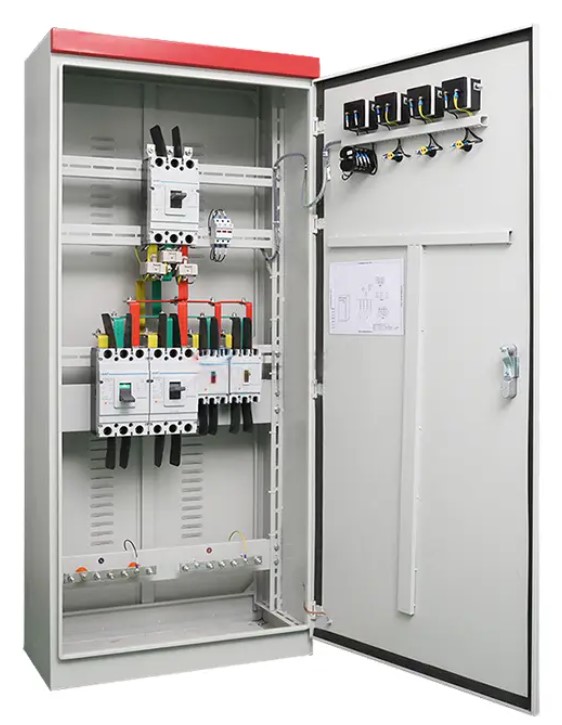
IEC 61439-1 and -2 define the characteristics a manufacturer must declare for a power switchgear and controlgear assembly. A clear specification lists at least:
- Rated operational voltage (Ue), such as 400 V or 690 V, and rated insulation voltage (Ui), commonly 1,000 V.
- Rated impulse withstand voltage (Uimp), typically 8 kV or 12 kV for boards near the origin of the installation.
- Rated current of the assembly (InA) and of each circuit (Inc), with the rated diversity factor (RDF) the design assumes.
- Rated short-time withstand current (Icw), for example 65 kA for 1 s, and the matching peak withstand current (Ipk).
- Degree of protection (IP code per IEC 60529) and impact protection (IK code per IEC 62262).
- Form of internal separation (Form 1 to Form 4) and whether functional units are fixed, removable or withdrawable.
- Earthing system (TN-S, TN-C-S, TT or IT), which decides whether a four-pole incomer and a separate PE bar are needed.
IEC 61439 replaced the older “type-tested” and “partially type-tested” labels with design verification (by test, calculation or comparison with a tested reference design) plus routine verification of every board leaving the workshop. Asking for both sets of records is the simplest way to compare offers on equal terms.
Where LV Switchgear Works
- Industry and mining: MCC line-ups, high fault levels, dust and vibration; IP54 enclosures and withdrawable starters are common.
- Commercial buildings and hospitals: main boards with generator and transfer sections, plus sub-boards on each floor.
- Data centers: paired A/B switchboards, busway to the white space and dense metering.
- Solar and storage: AC combiner boards for inverters, battery system interfaces and export metering.
- EV charging hubs: boards that feed many chargers in parallel, often with load management to stay within the grid connection.
What Has Changed in LV Switchgear Since 2020
Three shifts stand out. First, digital monitoring is now standard rather than optional: breakers with built-in metering, Modbus or Ethernet gateways and wireless temperature sensors on busbar joints feed energy and condition data straight to a building or SCADA system. Second, arc-flash safety gets more attention; arc-resistant designs tested to IEC TR 61641, arc-flash detection relays and remote racking keep operators away from the front of live equipment. Third, bidirectional power flow from rooftop solar, batteries and vehicle-to-grid chargers means protection settings and metering must handle current flowing in both directions.
Frequently Asked Questions
What is the maximum voltage for LV switchgear?
Under IEC 61439 and IEC 60947, low voltage means up to 1,000 V AC or 1,500 V DC. Most boards operate at 400 V or 690 V AC.
How large can a single LV switchboard be?
Main busbars of 6,300 A with short-time ratings around 100 kA for 1 s are the practical upper limit at 400 V, which matches a transformer of roughly 4 MVA.
What is the difference between a switchboard and a distribution board?
A switchboard is usually the floor-standing main assembly fed from the transformer. Distribution boards are smaller assemblies further downstream, often wall-mounted, feeding final circuits.
Do I need four-pole breakers?
It depends on the earthing system and on whether multiple sources share a neutral. TN-S systems with a generator or a second transformer often need four-pole incomers and couplers to avoid stray neutral currents.
Work with METTZ Group
METTZ Group offers a wide range of low-voltage cabinets and switchboards to suit many needs – from compact sub-distribution boards to main switchboards for industrial plants, data centers and mining sites. Check out our website to learn more, or contact METTZ Group today to work with a representative.
