
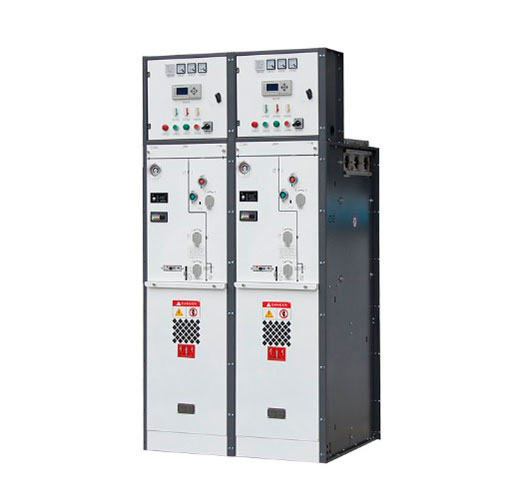
Gas-insulated switchgear packs a complete switching station into sealed metal tanks, which makes it the standard solution where space is tight or the environment is harsh. This article explains how GIS is built, how it interrupts faults, where it is used, and how the move away from SF6 is reshaping the technology.
What is gas-insulated switchgear?
Gas-insulated switchgear (GIS) is metal-enclosed switchgear in which the live parts are housed in gas-tight, earthed metal tanks filled with an insulating gas at a pressure slightly above atmospheric. The gas, rather than open-air distance, provides the insulation. As a result, phase-to-phase and phase-to-earth clearances shrink from tens of centimetres or metres to just a few centimetres.
The first commercial GIS installations appeared in the late 1960s. For most of its history the insulating gas has been sulfur hexafluoride (SF6). Today, SF6-free gases are entering the market, driven by climate regulations.
GIS covers two main voltage ranges:
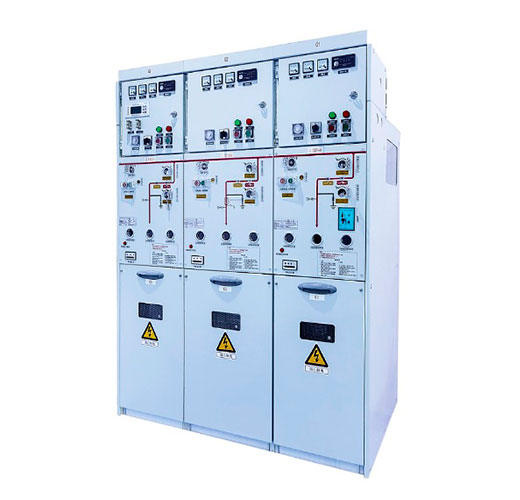
- MV GIS (up to 52 kV, IEC 62271-200): compact panels and ring main units for distribution substations, industrial plants and renewable energy stations.
- HV GIS (above 52 kV, IEC 62271-203): modular bays for transmission and primary substations, up to the highest system voltages.
How GIS is built
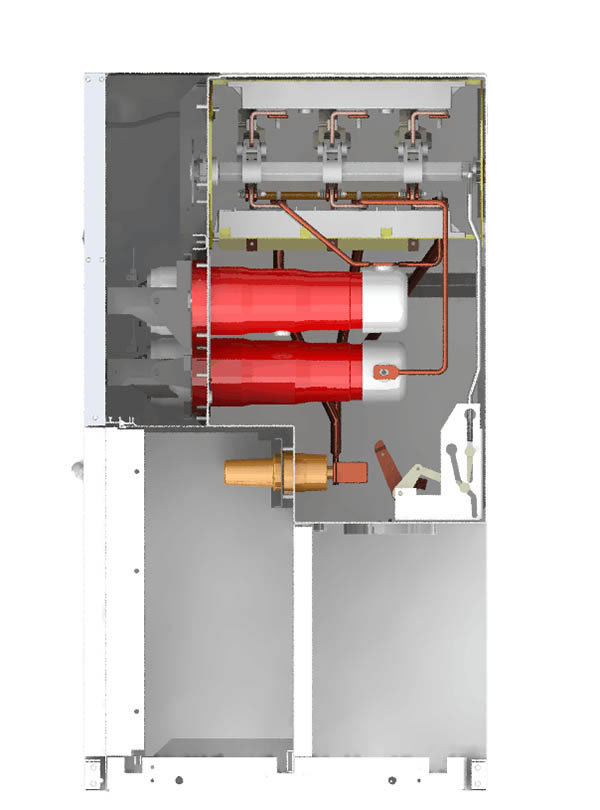
A GIS line-up is divided into separate gas compartments. If one compartment has to be opened or develops a leak, the others remain sealed. Typical building blocks are:
- Enclosures: stainless steel tanks at MV; aluminium or steel tubes at HV.
- Busbars: run inside the gas, either three-phase in one tank or one phase per tube.
- Switching devices: circuit breakers, three-position switches (closed, open, earthed), disconnectors and earthing switches.
- Barrier insulators: cast-resin partitions that support conductors and separate gas compartments.
- Instrument transformers: toroidal current transformers and voltage transformers or low-power sensors.
- Cable connections: plug-in cable terminations, so no exposed live parts remain outside the tank.
- Gas density monitors and pressure relief devices for every compartment.
How GIS interrupts a fault
Insulation and interruption are two different tasks, and GIS can solve them differently.
At medium voltage: mostly vacuum
Most modern MV GIS uses vacuum circuit breakers inside the gas tank. The gas only insulates; the arc is extinguished in the sealed vacuum interrupter at current zero. This keeps the gas clean and reduces the amount of decomposition products.
At high voltage: mostly SF6 puffer or self-blast breakers
HV GIS has traditionally used SF6 for interruption too. When the protection relay trips the breaker on overcurrent or another fault condition, the contacts separate and an arc forms. A piston (puffer design) or the arc’s own energy (self-blast design) builds up gas pressure and blows SF6 through the arc. Because SF6 is strongly electronegative, it captures free electrons, cools the arc and rapidly rebuilds dielectric strength after current zero. The gas recombines largely after the arc and stays in the same closed compartment.
Why SF6 made GIS possible
- Dielectric strength about two to three times that of air at the same pressure.
- Excellent arc-quenching properties.
- Chemically stable, non-flammable and non-toxic in its pure state.
- About five times denser than air, so leaks collect at floor level in rooms and cable trenches.
There are two important drawbacks. Arcing produces toxic and corrosive by-products, so opened compartments must be handled by trained staff with proper equipment. And SF6 is an extremely potent greenhouse gas, with a global warming potential more than 23,000 times that of CO2 and an atmospheric lifetime of thousands of years.
Where GIS is used
- Dense urban areas: indoor and underground substations, building basements and city extensions.
- Harsh environments: coastal and offshore sites, deserts, chemical plants, cement works and other polluted areas.
- Difficult terrain: mountain regions, hydropower caverns and sites at high altitude.
- Infrastructure: railway traction substations, airports, tunnels and ports.
- Renewables and storage: wind turbine towers, solar and battery stations, where compact ring main units fit inside skids and containers.
- Transmission: HV substations where land is scarce or expensive.
Advantages and limitations
| Advantages | Limitations |
|---|---|
| Very small footprint and volume | Higher purchase price than AIS |
| Live parts sealed from dust, moisture, salt and animals | Internal faults cannot be seen; diagnosis relies on monitoring |
| Low routine maintenance | Repairs inside tanks may require specialist or factory support |
| High personnel safety; no exposed live parts | SF6 versions require gas handling, leak checks and end-of-life recovery |
| Good seismic performance and quiet operation | Increasing regulatory restrictions on SF6 |
For a full comparison of footprint, cost and maintenance with air-insulated designs, see our article on choosing between AIS and GIS.
The SF6 phase-out and SF6-free GIS
The EU F-gas Regulation (EU) 2024/573 restricts new switchgear that uses fluorinated gases:
- MV switchgear up to and including 24 kV: no F-gases with GWP of 10 or more from 1 January 2026.
- MV switchgear above 24 kV up to 52 kV: from 1 January 2030.
- HV switchgear above 52 kV up to 145 kV: from 1 January 2028; above 145 kV: from 1 January 2032 (with conditions depending on short-circuit rating).
Exemptions exist when no SF6-free offer is received in a tender, but the direction is clear. Existing equipment can stay in service with proper leak control and recovery. Similar policies are under discussion in other regions, and many utilities worldwide already prefer SF6-free solutions.
Main SF6-free alternatives
- Dry air or synthetic air with vacuum interrupters: GWP of zero, already widely used at MV and increasingly at HV.
- Fluoroketone or fluoronitrile gas mixtures: much lower GWP than SF6 and good dielectric performance; mostly used at higher voltages, but some mixtures exceed the GWP limit of 10 set for MV.
- Solid insulation: solid-insulated switchgear casts live parts in epoxy and uses vacuum switching, avoiding gas altogether.
Alternative gases usually need slightly higher filling pressure or larger tanks than SF6, so some SF6-free designs are a little bigger than their predecessors.
Maintenance and monitoring
GIS is low-maintenance rather than maintenance-free. A typical program includes:
- Regular reading of gas density monitors, with alarms wired to the control system.
- Periodic leak checks and gas quality analysis (moisture, purity, decomposition products) for SF6 equipment.
- Inspection and lubrication of operating mechanisms and checks of interlocks.
- Partial discharge measurement, often with UHF sensors at HV.
- Thermal checks of cable terminations, which remain a common weak point.
Digital monitoring – continuous gas density, breaker condition and partial discharge data over IEC 61850 – is now standard on many new GIS installations.
Frequently Asked Questions
Is GIS the same as an SF6 circuit breaker?
No. An SF6 circuit breaker is a single switching device. GIS is a complete switchgear assembly where busbars and all devices are gas-insulated; at MV it often uses vacuum breakers.
Is SF6 dangerous to people?
Pure SF6 is non-toxic but can displace oxygen in low areas. Gas from compartments where arcing has occurred contains toxic by-products and must be handled with protective equipment by certified personnel.
How long does GIS last?
GIS is typically designed for a service life of 30 to 40 years or more, provided gas tightness and mechanisms are maintained.
Can SF6-free GIS replace SF6 GIS one-to-one?
Often yes at MV, where vacuum and dry-air designs are mature. Dimensions, ratings and cable connections should be checked case by case.
Work with METTZ Group
METTZ Group designs, manufactures and commissions equipment from 1 kV up to 220 kV, including versions for mining and tropical conditions, and supports customers through local partners in 29 countries. METTZ Group offers a wide range of gas-insulated switchgear to suit many needs – from compact ring main units for secondary substations to HV GIS for space-limited primary substations, with SF6-free options where required. Check out our website to learn more, or contact METTZ Group today to work with a representative.
